

Later this month, the 2024 Olympic Games will begin in Paris. When I thought about making the connection between the Olympics and M*A*S*H, there was one obvious connection. In the season six episode, “The M*A*S*H Olympics” (06×10), the 4077th holds its own Olympics to get the camp back into shape. In the episode, they held their own Olympic Games because everyone had been following the 1952 Olympics in Helsinki, Finland. There are some inconsistencies with this, but we’ll get to that in the episode review. I do have two scripts for “The M*A*S*H Olympics,” and one of them is particularly interesting. So let’s dig into the script and then watch 4077th’s own Olympic Games!
The Script

I have two copies of the script, one Revised Final draft and a Second Revised Final draft. For this review, I am going to focus on the Second Revised Final draft, dated September 16, 1977, because it has more documentation and a better back story. “The M*A*S*H Olympics” was written by Ken Levine & David Isaacs. They had been part of the series since season five and would continue with M*A*S*H through season eight. After M*A*S*H, they went on to write for AfterMASH, Cheers, Frasier, and other popular shows. The episode was directed by Don Weis, who is credited with directing 16 episodes of M*A*S*H.
The cover of the script has the name “Ted” written on it, and based on my research, and the documents within the script, I believe this script belonged to Ted Butcher. He was the unit production manager on M*A*S*H, but IMDb only credits him for that role for seasons two through five. However, it is possible that the credits are incorrect as I have found some inaccuracies for credits for M*A*S*H on IMDb before. So what is a unit production manager? I found a 2011 copy of the Directors Guild of America Basic Agreement that defines many of these roles, including unit production manager (pages 13 – 15). According to the DGA, the primary roles of a unit production manager include: preparing the shooting schedule, coordinating the budget, coordinating the search for filming locations, assisting in the preparation of production, supervising the daily production reports, coordinating the travel and living arrangements for cast and crew, overseeing of the contracts for locations and personnel, and maintaining a connection with local authorities regarding filming locations. Butcher’s job was to make sure each episode was ready to film, had the required filming locations, and was properly staffed.

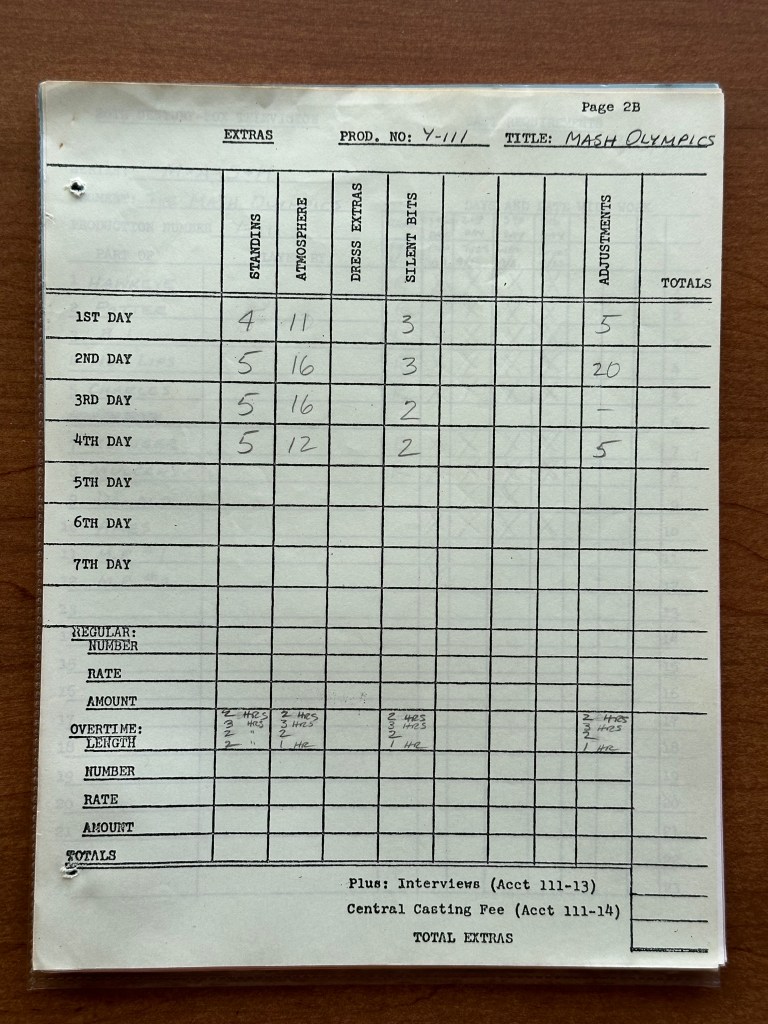
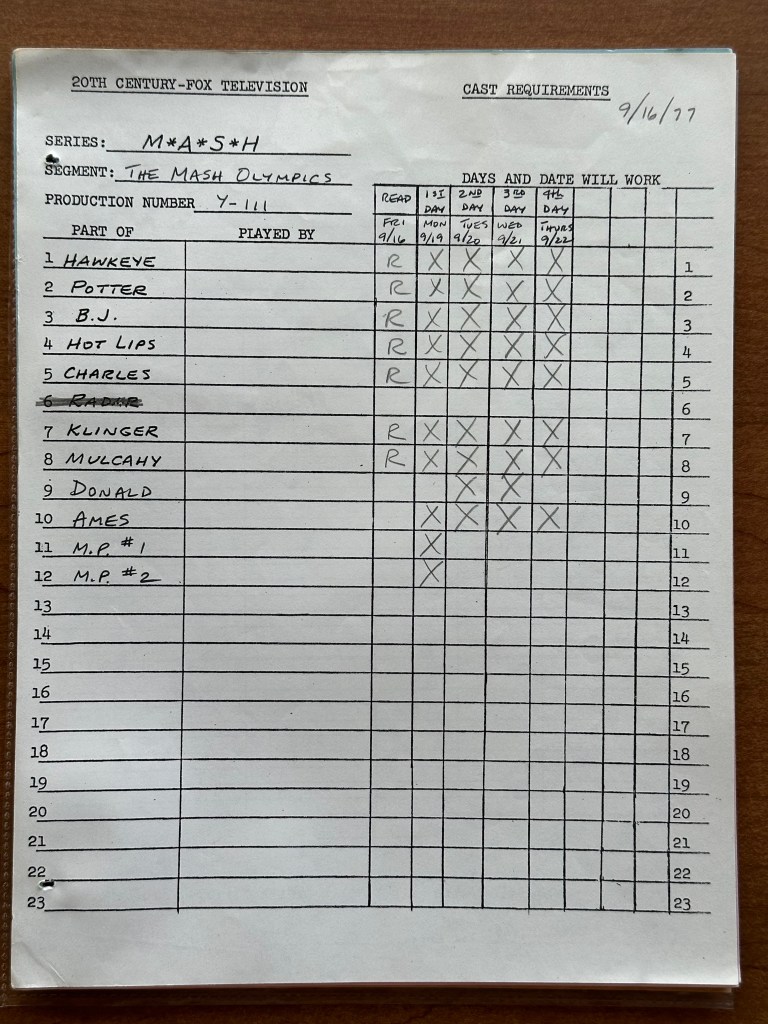
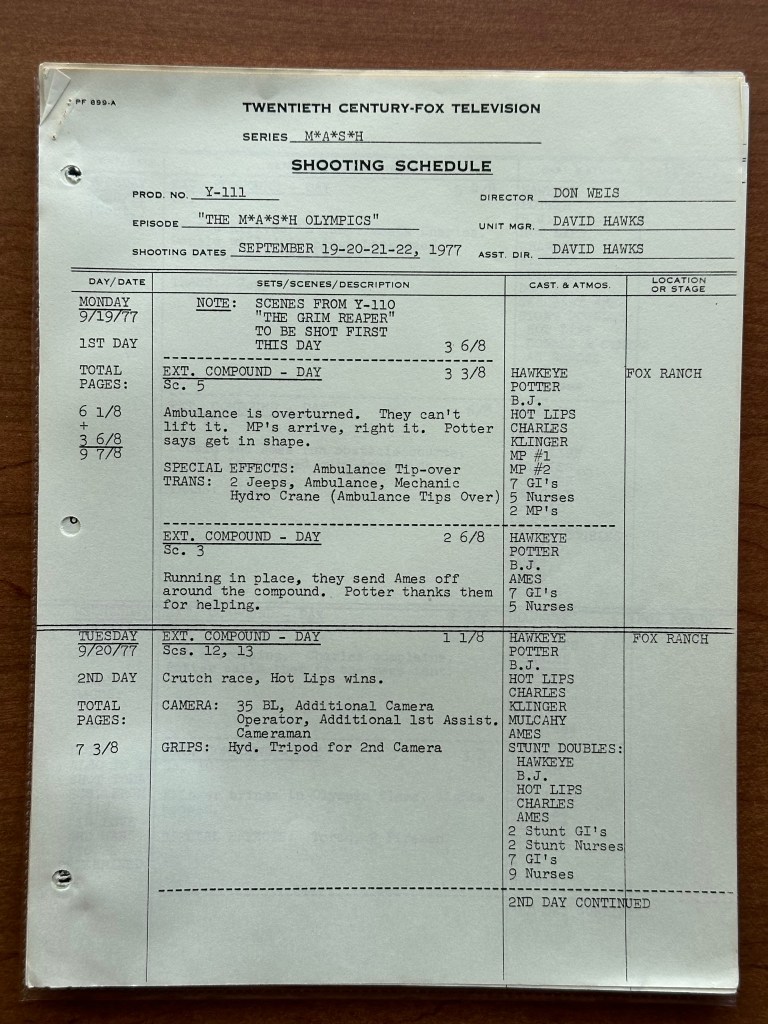
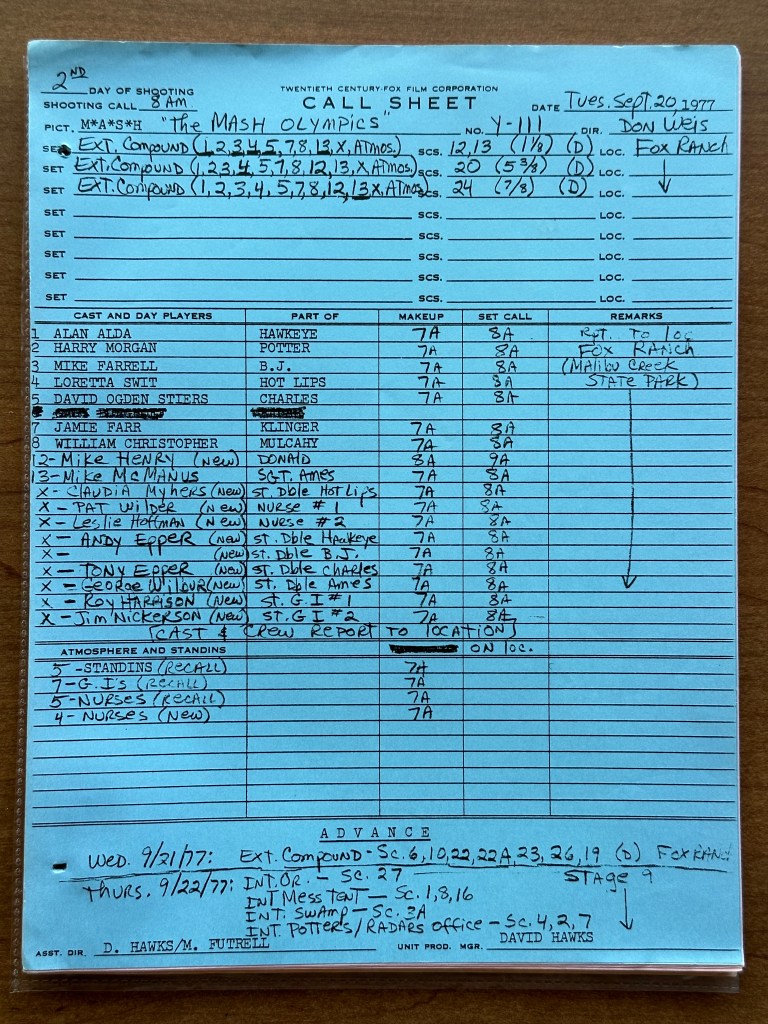
Butcher’s script does have a few of the production documents that I have discussed in the past. The daily Call Sheets with Production Requirements are here for all four days of filming. These documents listed all the cast, extras, crew, cameras, lighting, props, food, etc. that were needed for each day’s production. The Shooting Schedule is here as well. It lists which scenes from the script were to be filmed each day. These documents were essential to production and would have been a key part the responsibilities of the unit production manager.
Butcher’s script has three pages that I don’t believe have been in other scripts I’ve reviewed. The first is the Cast Sheet. This listed each cast member, the actor’s name and their agency information, and it also included their home address and phone number. For guest cast and extras, their information is also listed, and so is their salary. Guest cast and extras’ salaries were set by the Screen Actors Guild agreements with studios. There is a page just for Extras. For each day of filming the number of people needed for various roles was listed. The amount of time they were needed is also listed. (Just a few quick definitions of these terms. “Standins” were used in the place of an actor if you were only going to see their back on camera. “Atmosphere” were background extras, such as people sitting at Mess Tent tables in the background. “Silent Bits” are people who will appear on screen and have a role in the shot, but don’t have any lines.) Finally, the third page is Cast Requirements. This page outlines each character defined in the script and lists whether they are required for the days of production. That included the script reading and all four days of filming.
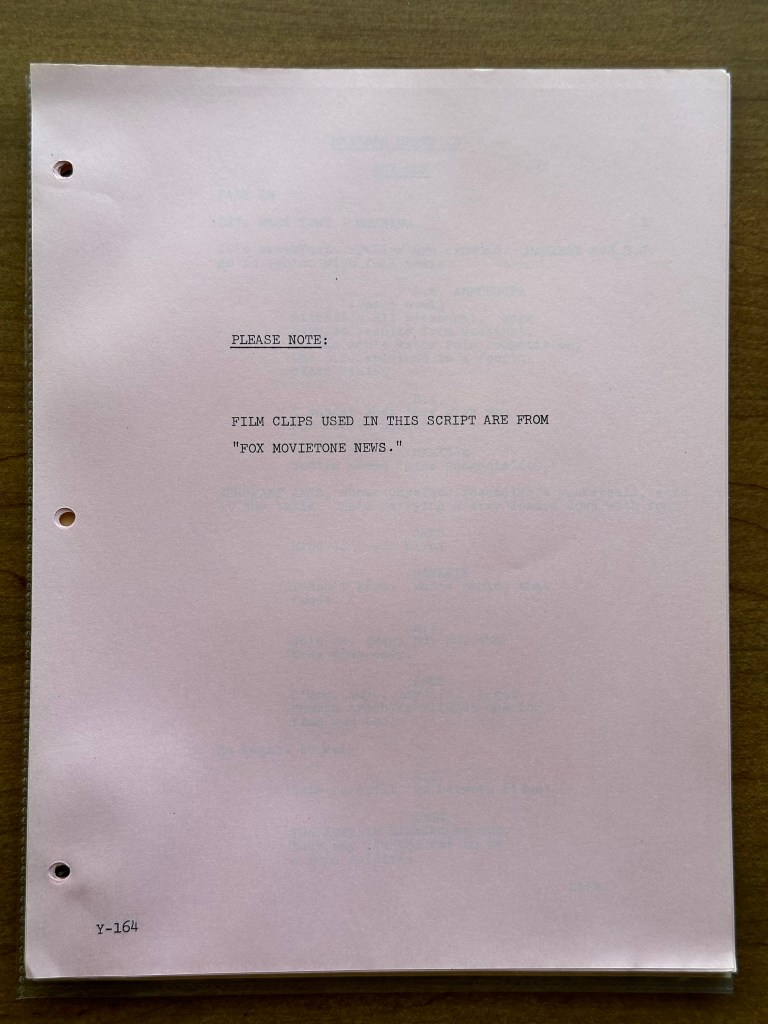
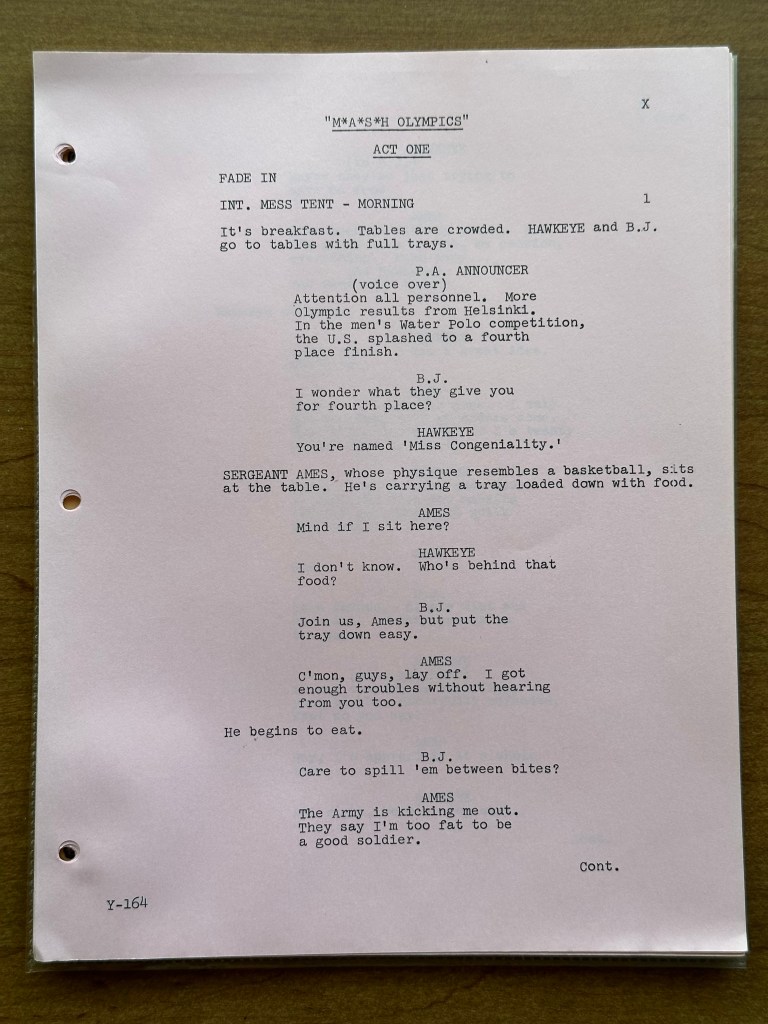
This script does not contain any revised pages since it is a Second Revised Draft, but there is one additional page worth noting. In the episode, we see several clips from the 1952 Helsinki Olympic Games. There is a page at the beginning of the script that states, “Film clips used in this script are from ‘Fox Movietone News.'” This made sense because the show’s producers could use the materials from Fox’s archives, but it was also a great tie-in to the Olympic Games being held at the 4077th. The detail in this script is very telling. While there are no markings on the pages of dialogue, there are a lot of production documents that tell more of the story of how an episode of M*A*S*H was made. The Call Sheets and Shooting Schedule tell a big part of the story, but meeting the unit production manager puts the scope of the production of M*A*S*H into perspective. Butcher had to coordinate filming locations, the primary cast, guest cast, extras, and budgets to ensure that the four days they had to film each show went off without a hitch. Seeing the production documents in the script reenforces the amount of work it took to create 26 minutes of television.
The Final Episode
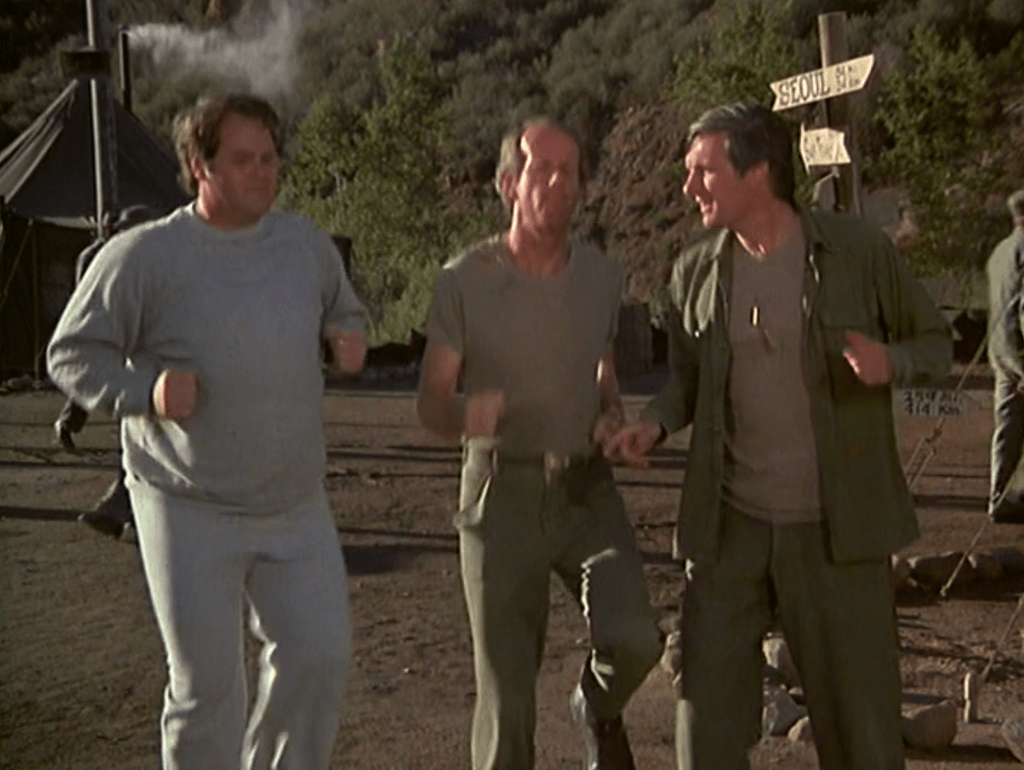
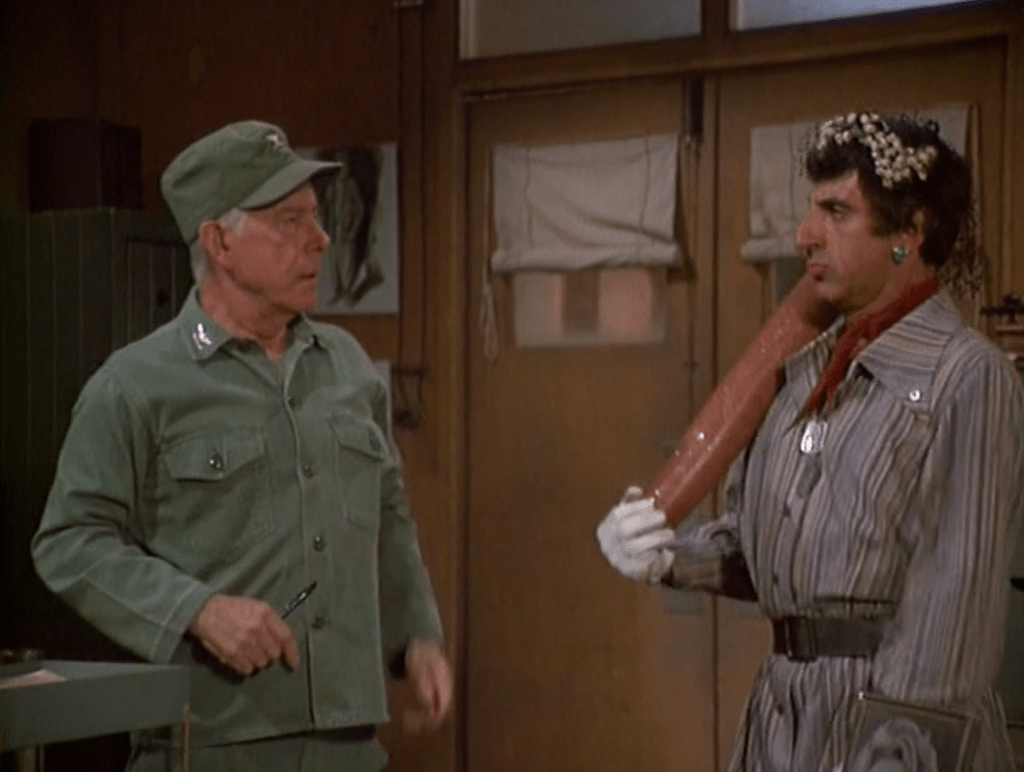
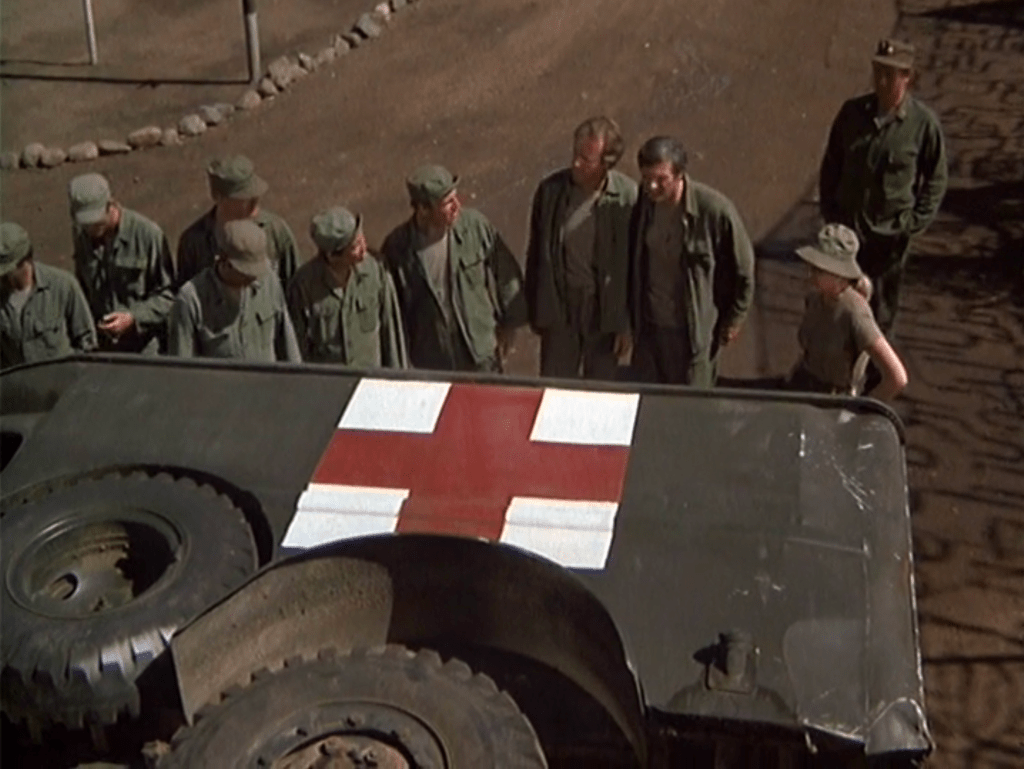
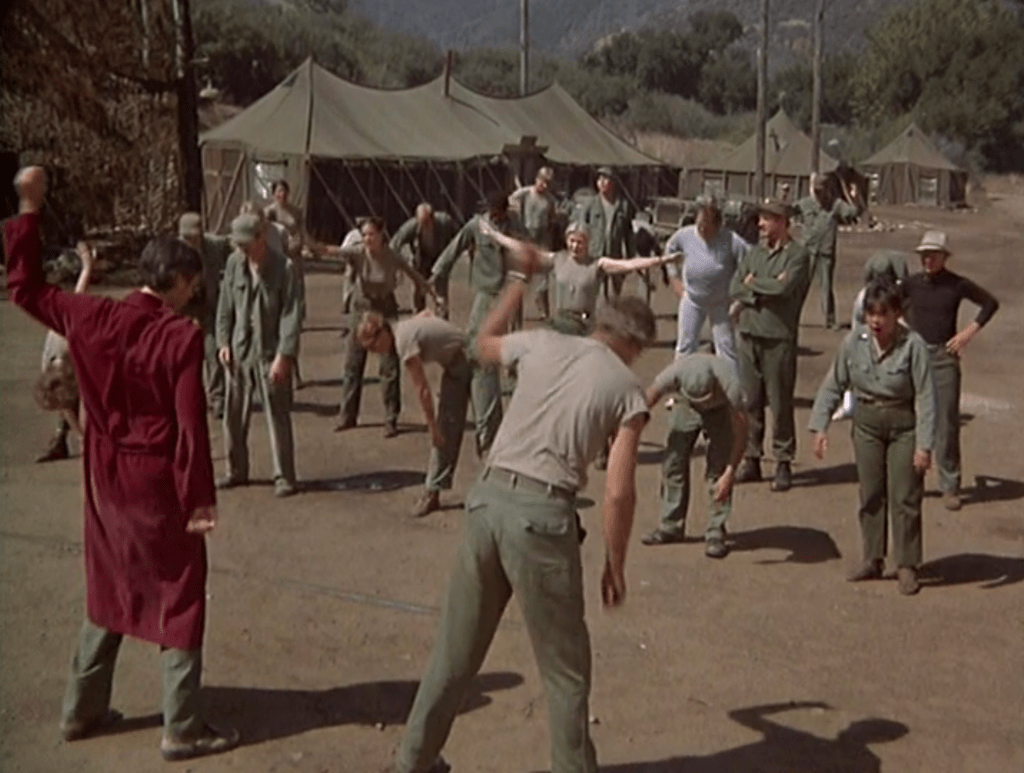
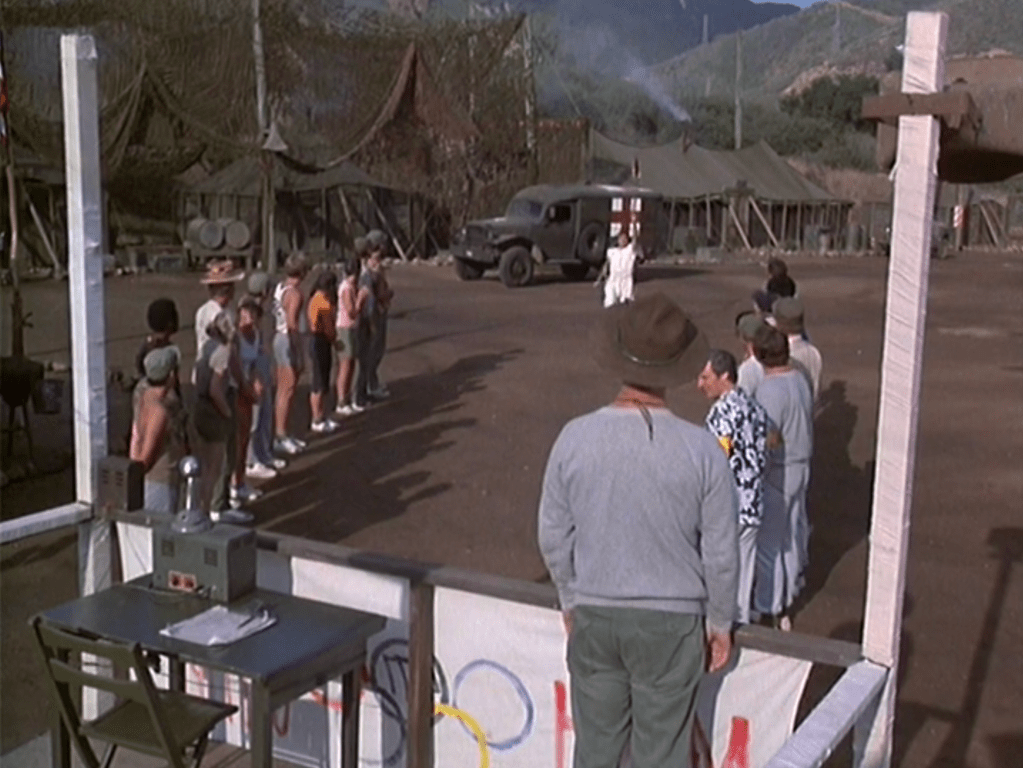
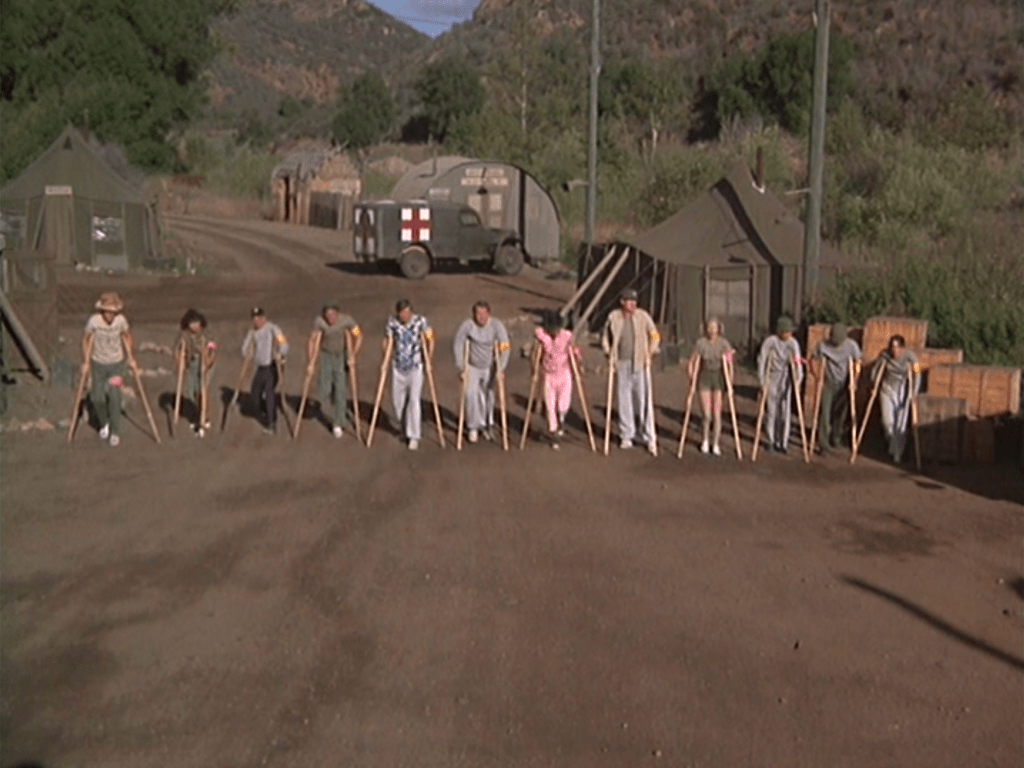
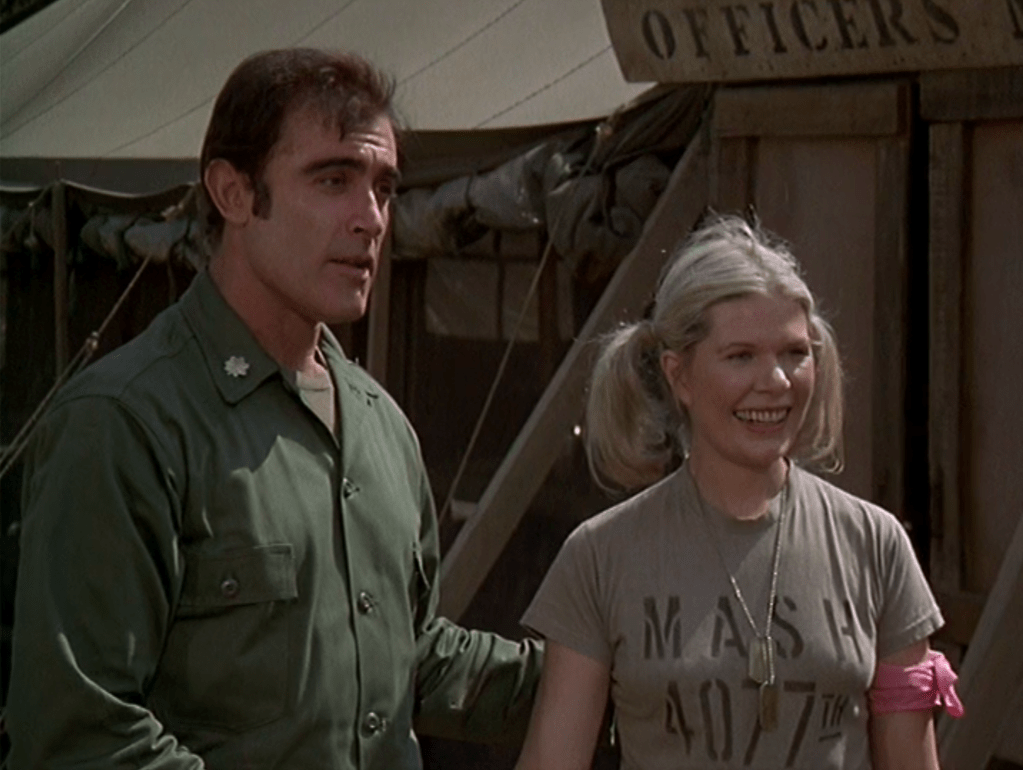
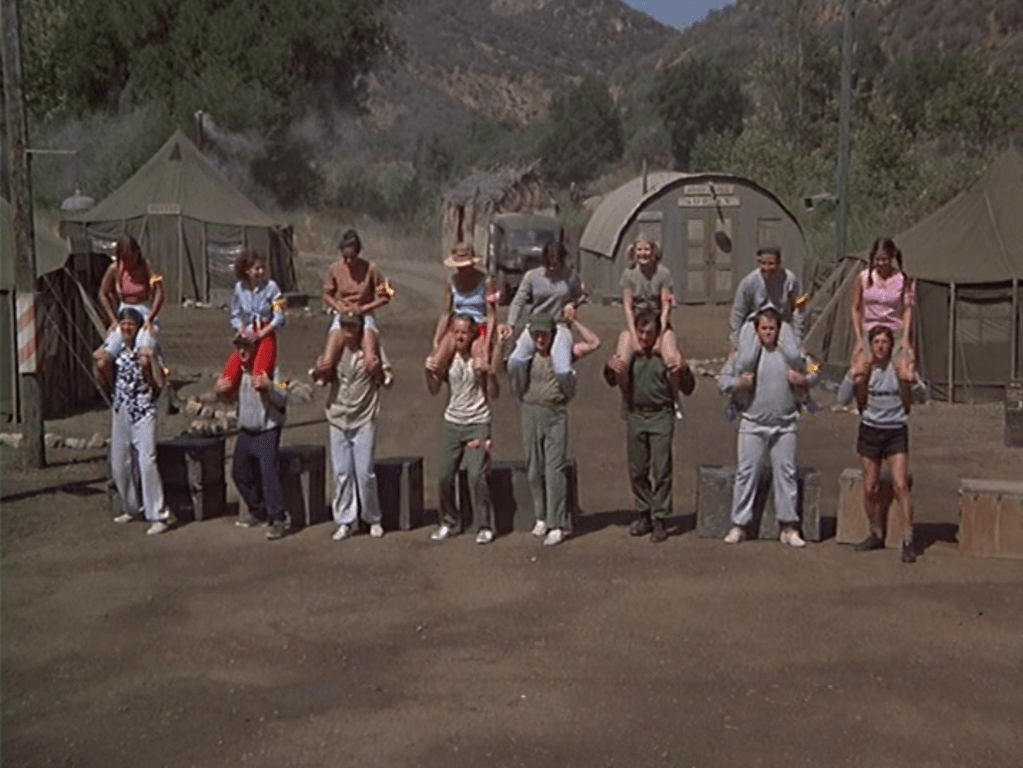
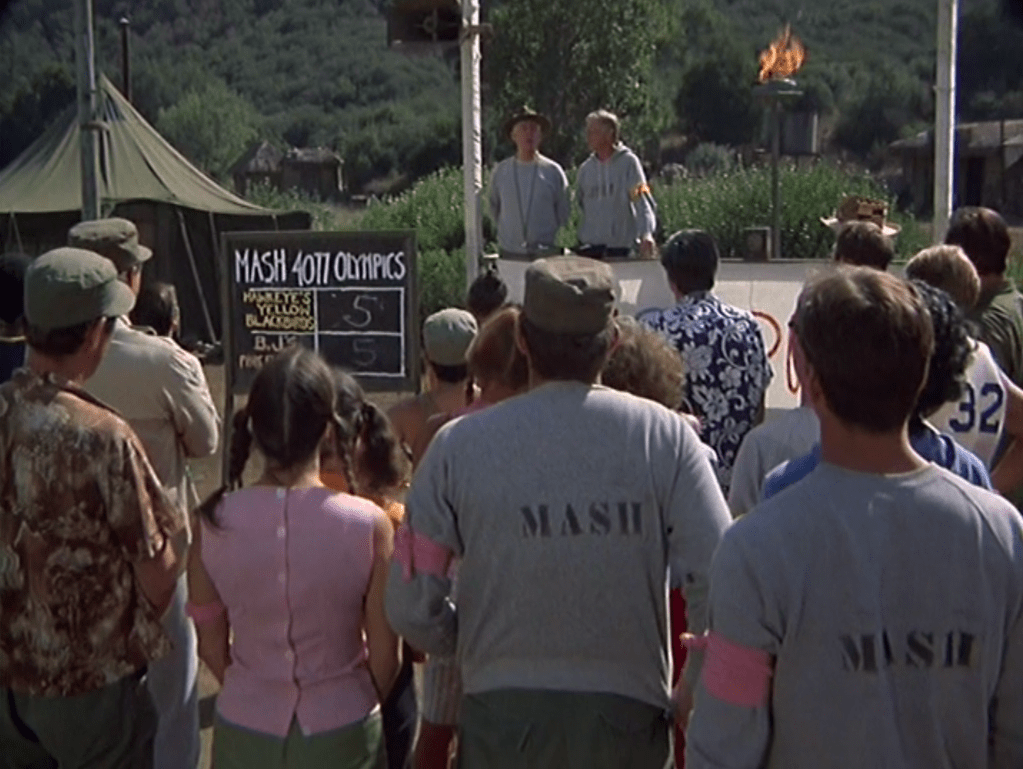
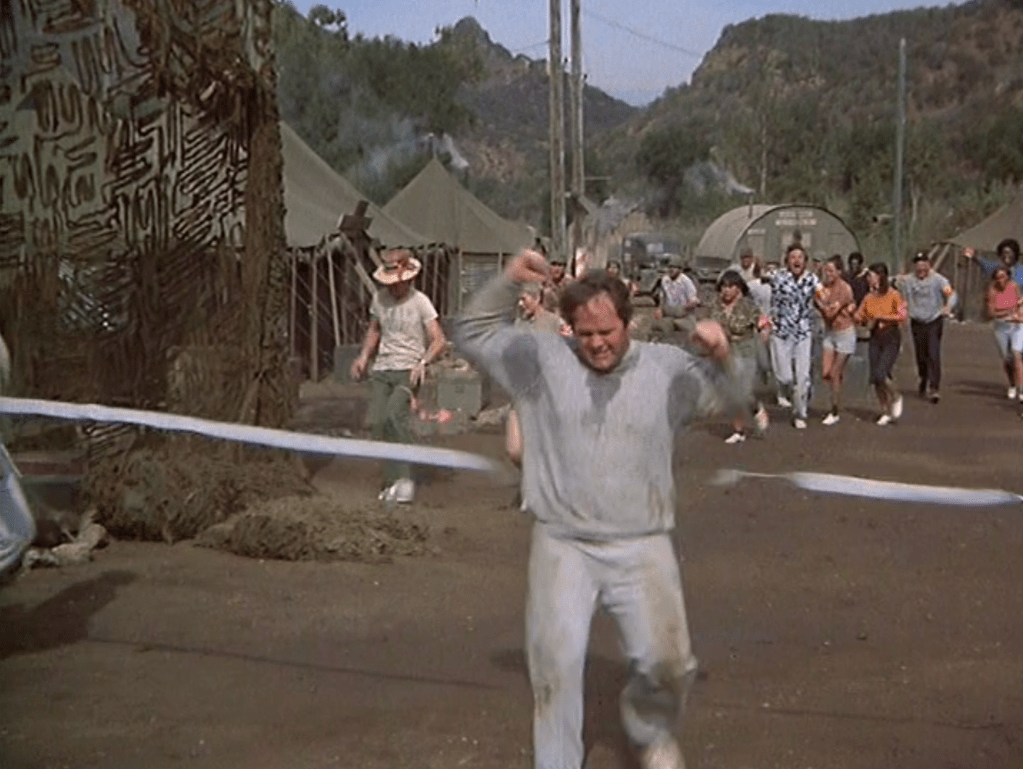
The episode opens with Hawkeye and B.J. having lunch with Sergeant Ames, a soldier who is about to be kicked out of the Army for being overweight. Klinger overhears, and decides that he is going to eat to the point that he can also be kicked out of the Army for being overweight. Hawkeye and B.J. team up to help Ames lose weight so he doesn’t get discharged. After an ambulance overturns in the compound, the members of the 4077th are unable to flip it back over onto its wheels. The gang is outshone by a group of four MPs, so Col. Potter decides the camp needs to get into shape. After daily calisthenics fails to gain popularity, Col. Potter decides to make things more interesting. Since they have been following the events of the 1952 Olympics in Helsinki, Finland, he plans a series of events for the “M*A*S*H Olympics.” Hawkeye and B.J. each lead a team. After lighting the “Olympic Bedpan,” the games are off! In between archival footage of the actual 1952 Olympics, we see the 4077th compete in a crutch race and nurse-carry. The teams end up tied with each winning five events, so a tie breaking obstacle course is arranged with two random contestants from each team. Ames is selected from Hawkeye’s team, and Margaret’s husband, Lt. Col. Donald Penobscott is chosen from B.J.’s team. Penobscott is over confident, and ends up losing the race!
As I mentioned, this is a fun tie-in to the upcoming Olympics in Paris. It is also a really good episode. We see Lt. Col. Penobscott again, but he is played by a different actor in this episode (Mike Henry instead of Beeson Carroll at the end of season five). This episode has a few consistency errors, however. The biggest one is when Penobscott arrives and Col. Potter says that he is just in time for “the last two events.” However, Col. Potter couldn’t have known that two events were left because the final event was a tie breaker. There is a consistency error with the timeline as well. The Helsinki Olympics were held in July and August 1952, but Col. Potter didn’t arrive at the 4077th until September 1952. Consistency with dates was never M*A*S*H‘s strong point! The other thing I wondered as I watched was where everyone at the camp got the same white shoes? As for the script, since the script I used for comparison was the Second Revised Final, there were only two major changes. The scene where Ames and Penobscott were drawn for the obstacle course, Hawkeye asks for a re-draw (page 28). At the end of the episode, the scene in the O.R. was written as the tag with the scene with Hawkeye, B.J., and Ames coming before the commercial break. The scenes were switched in the final episode (pages 30 – 32).
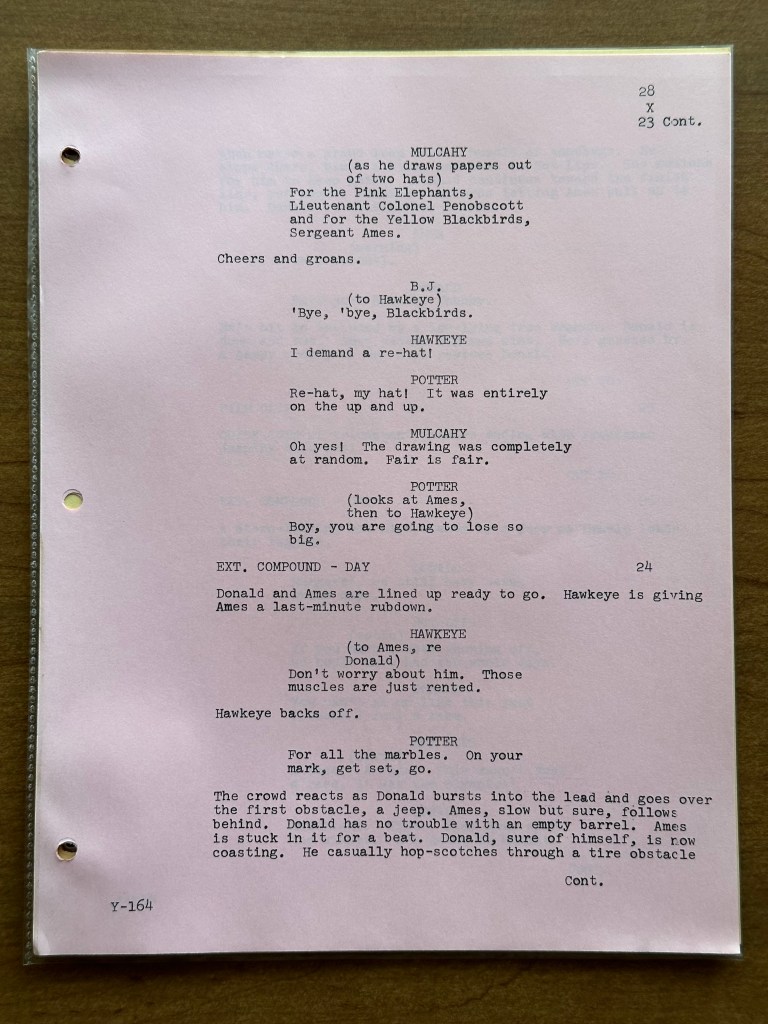
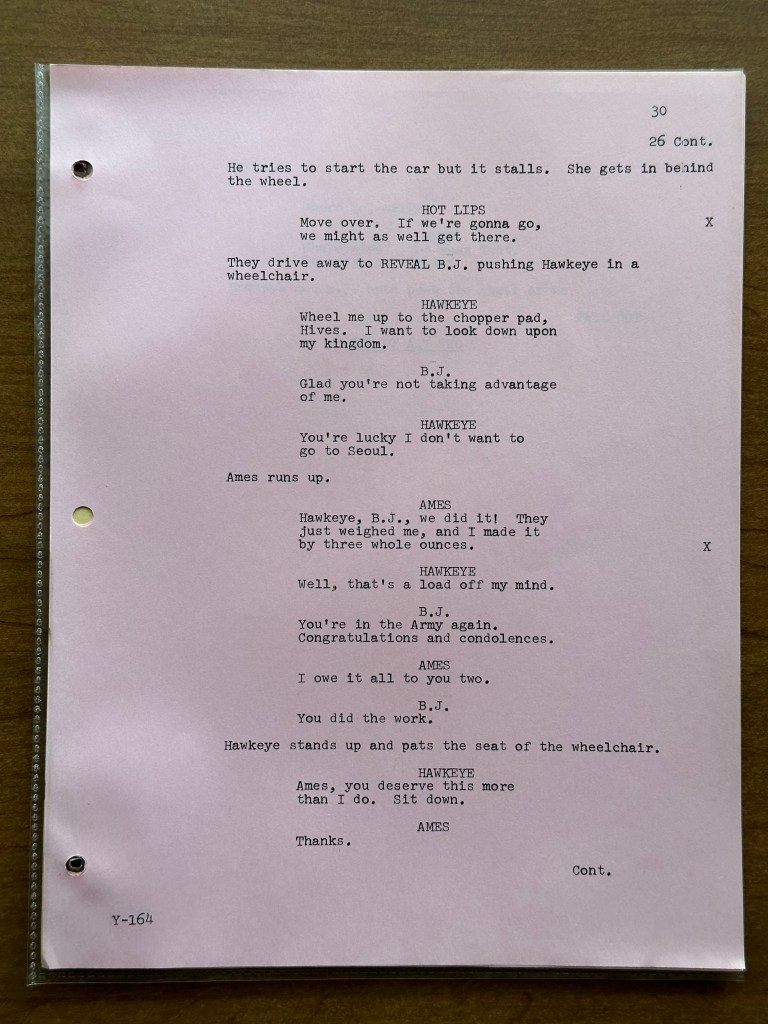
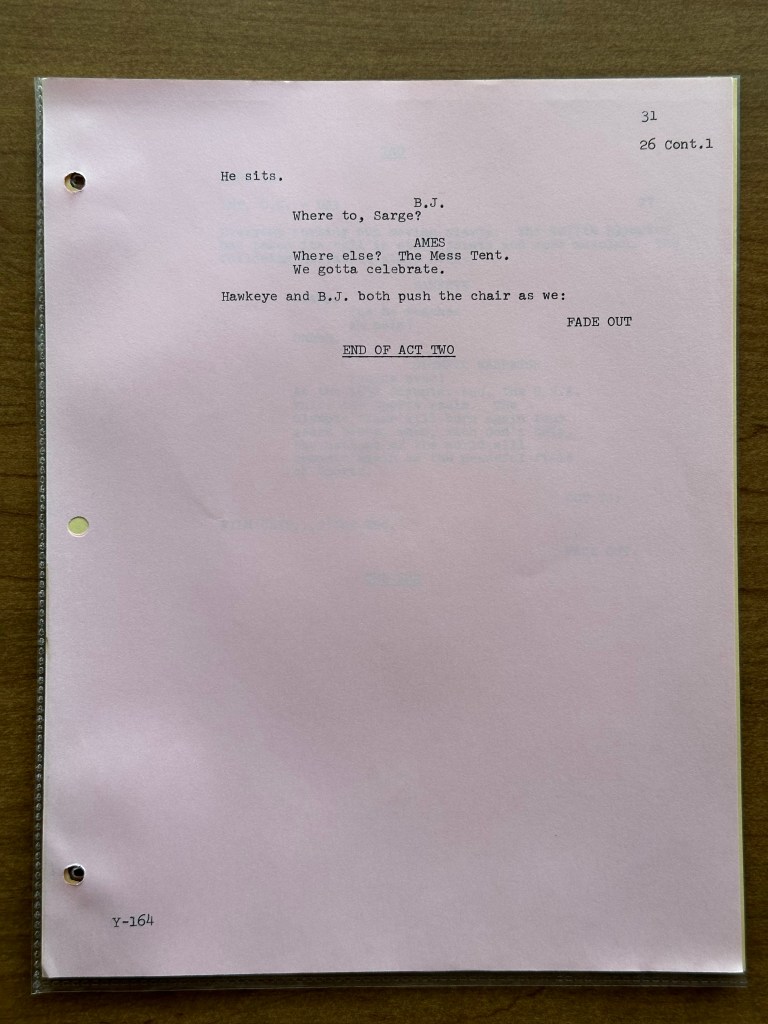
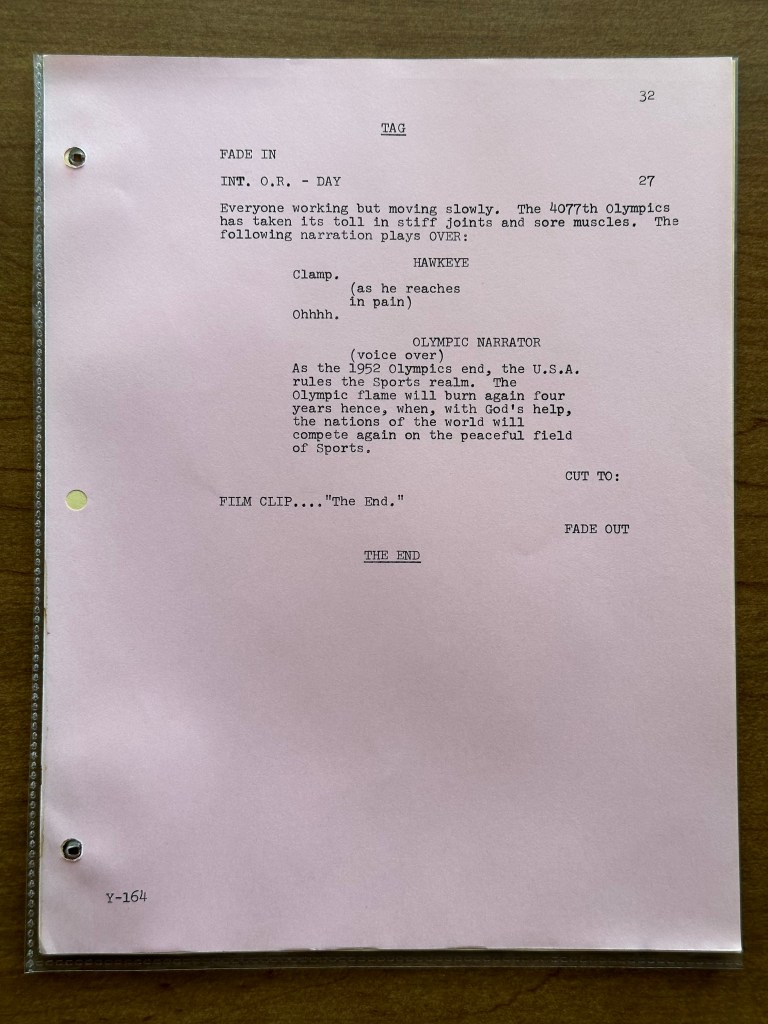
“The M*A*S*H Olympics” was a fun episode, but for me, the highlight of this post is the script. Seeing the variety of production documents is my favorite part of reviewing the episode scripts. I can’t help but think that this show was created in a time before the widespread use of computers and cell phones. That means that all of the scripts, location planning, shooting schedule creation, and budgeting were done on paper. Contacting the cast and crew would have required land lines. Everything was done on paper, and that’s why these records still exist. In today’s world, it’s easy to forget how different things were only 40 years ago. And without the modern conveniences, the show runners of M*A*S*H were able to put together 24 episodes of M*A*S*H per season. The documentation in the scripts tells the stories of creating 26 minutes of television in 1977, and it is my favorite aspect of collecting M*A*S*H scripts!
 The M*A*S*H Historian
When I try to go to the article via your link, I get a bad connection. Is the post on your site yet? I was able to read it here, but the print on the attachments is too small here. It’s very good in any case.
LikeLike
Sorry about that! The link should be fixed!
LikeLiked by 1 person
Thanks! I find these pages fascinating, especially things like the guest star salaries. As the call sheet notes, Gary Burghoff was crossed off, since he sat out this episode. This call sheet is from Sept. 20, 1977, coincidentally the original airdate for the season premiere. I hope the cast members got to see themselves on tv that night.
LikeLiked by 1 person
I noticed that Gary Burghoff was marked out too! I am not sure if the cast watched the show or not. I am sure some did!
LikeLiked by 1 person
I love the insight you give to each episode. Great stuff!
I don’t know why but I’ve always found it a bit odd that Col. Potter tells Ames, “Boy, you are gonna lose so big!” and then laughs at him. It seems like an uncharacteristically mean comment from the Colonel.
LikeLiked by 1 person
Thank you! I agree, it was kind of uncharacteristic, but I think competition got the better of him!
LikeLike