
Since I am rewatching one season of M*A*S*H per month throughout 2025, I decided to sync my script reviews with the season I am watching for the month. February means season two, so I had a decent selection of scripts to choose from. After reading over my list, I selected “The Choson People” (02×19) because that episode stands out for me because of the appearance of Pat Morita and the two, strong storylines. When I first looked at the cover, I noticed that it had been corrected from “The Chosen People” to “The Choson People.” In fact, I often see this episode mislabeled as “The Chosen People.” The correct title is “The Choson People” because this is the name of a dynasty in Korea that lasted for over 500 years. Though it is typically spelled “Joseon,” the pronunciation sounds more like “Choson.” Now that the titling issue has been cleared up, let’s review the script and the episode!
The Script

This is final draft of the script dated December 10, 1973. This episode is the 19th episode to air in season two, and it aired on January 26, 1974. This script has interesting writing credits. The story was by Gerry Renert and Jeff Wilhelm. This is the only M*A*S*H credit for either writer. The teleplay is credited to Laurence Marks, Seldon Keller, and Larry Gelbart. Marks and Gelbart have a long history with M*A*S*H, but Keller has four writing credits in the series in both seasons one and two. While Renert and Wilhelm likely came up with the story for this episode, Marks, Keller, and Gelbart heavily reworked it. The episode was directed by Jackie Cooper, and it is the final of thirteen episodes that he directed.
The copy of the script in my collection for “The Choson People,” and it is one of the bound scripts that belonged to Cooper. I have written about a few other of Cooper’s scripts in my collection (“The Sniper” (02×10) and “Hot Lips and Empty Arms” (02×14)), and I really like reviewing his scripts. His scripts typically include a number of production documents, and this one is no different. There are Call Sheets for each of the filming days, and those call out who was needed for each day of filming. On the back of the Call Sheet is a list of materials and equipment that were needed for each day of filming, and that even included gallons of coffee. One of the documents that is included in several of Cooper’s scripts is the Script Supervisor’s Daily Report. For each day, they would record the number of scenes that were filmed, the number of pages from the script that were filmed, the number of minutes that were filmed, and the number of setups that were needed. The sheet also details the time that filming began through the time that filming wrapped for the day. It is a great insight into how much work went into filming each day.


The script also includes revised pages and a copious amount of handwritten notes from Cooper. There are two revised pages in this script dated December 10, 1973 (blue pages) and December 13, 1973 (pink pages). The original pages have been discarded, but that is what the cast and crew were instructed to do when the revised pages were released. Flipping through the script, however, the most obvious thing are the endless, handwritten notes in green ink. These notes are from Cooper, and they often note changes and instructions for the cast and crew. Lines were marked out, words were underlined for emphasis, and new lines were written in. There are also direction notes. On some pages, Cooper indicated where he wanted a wide shot, a close-up, or when he needed a camera to pan a scene. The stage directions printed in the script were written for the cast and crew, but it was up to the director to help frame the actual scenes.
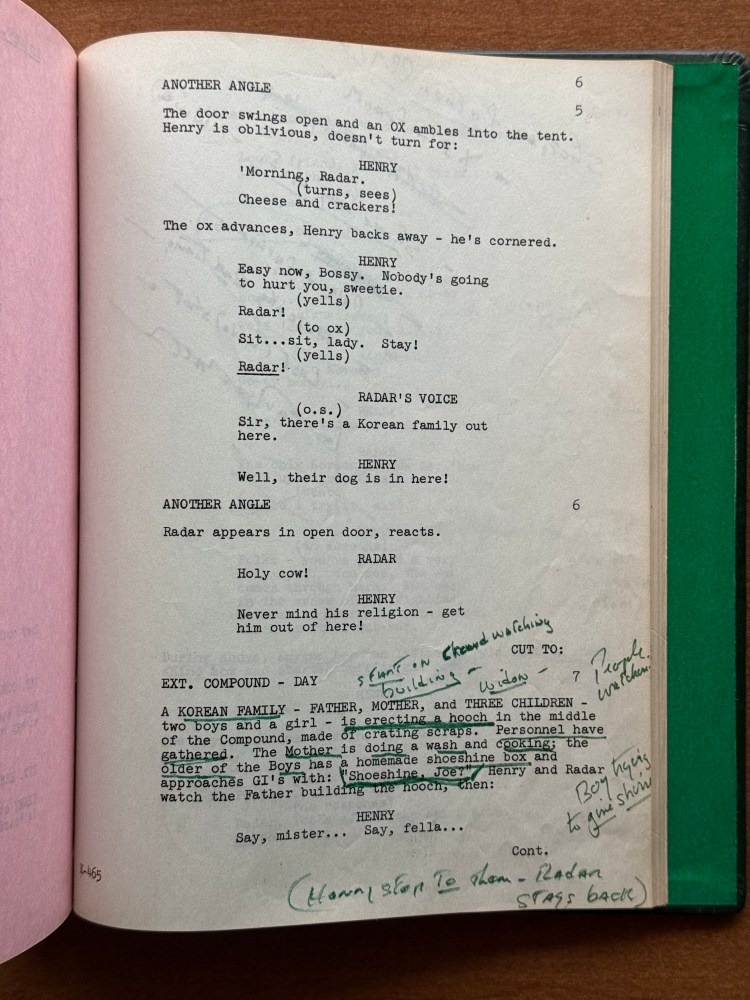

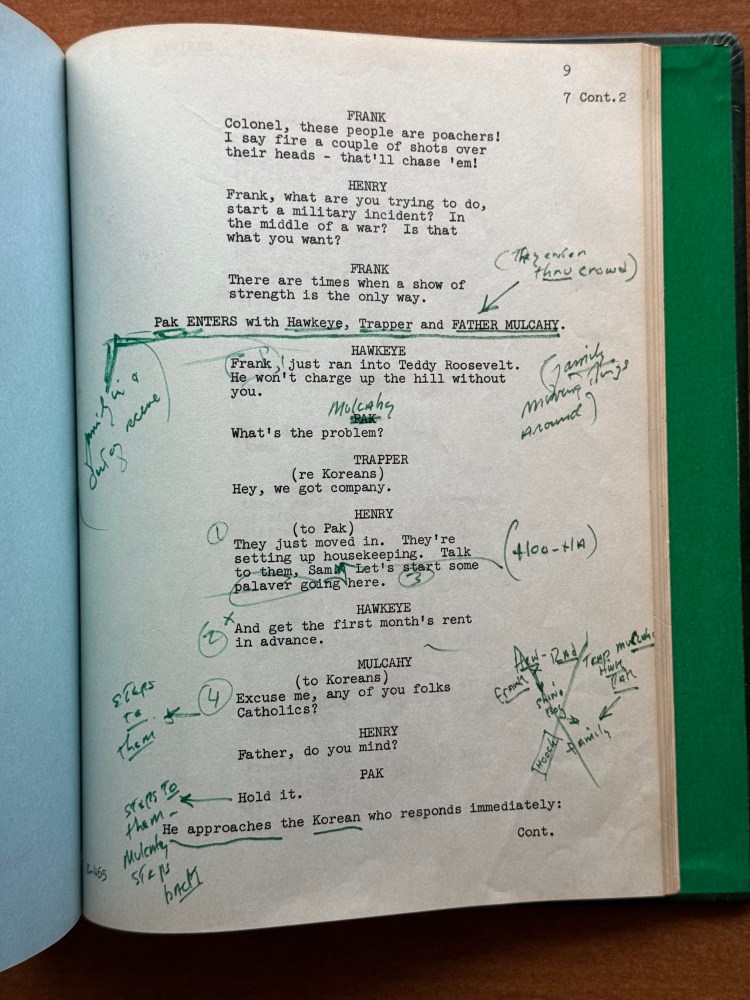


M*A*S*H scripts are my favorite objects in the collection. There is so much you can learn from a single script. A great example of the detail in each script is well illustrated here. The writers have included translations what the Korean farmer and Captain Pak say to each other in Korean. The script (page 8) shows both the English and Korean words for the conversation. This is a level of detail that was important to ensure that nothing was being said that could be recognized as being offensive. Cooper’s scripts have proven to a be treasure trove for me because they include so much more detail. Belonging the director of the episode, there are things that Cooper had to be ready for that no other cast or crew member did. His notes and the documentation in this script show the attention to detail that was paid to each M*A*S*H script.
The Final Episode


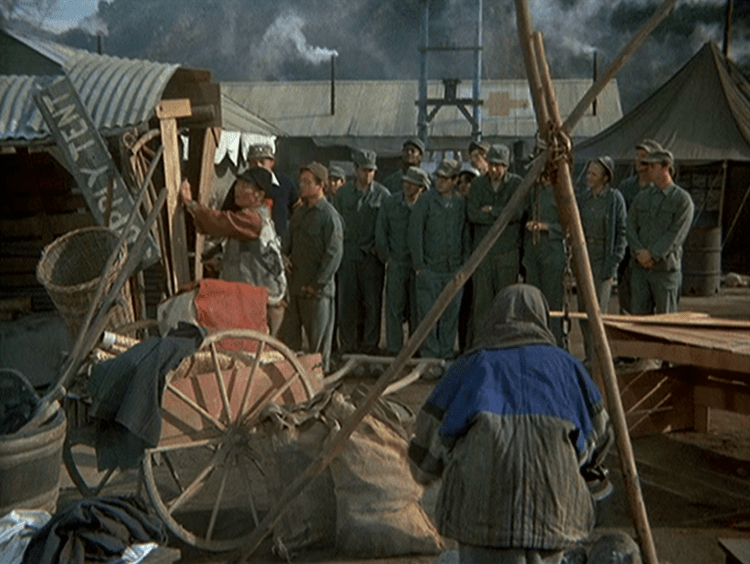

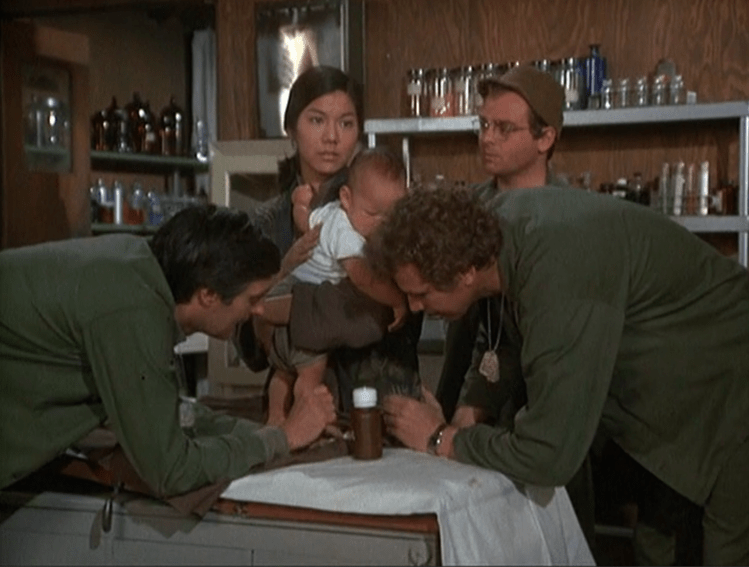

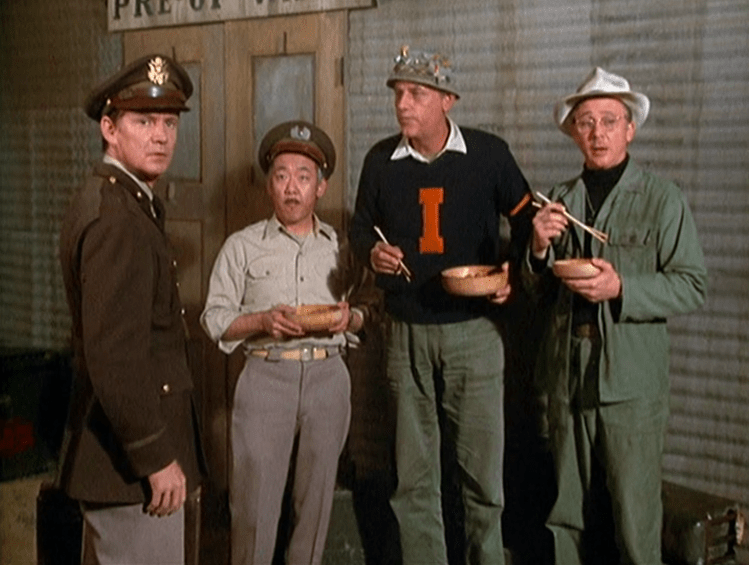

After a long session in O.R., the group are surprised to find that a group of Koreans are building a house in the compound. Captain Pak talks with the family, and discovers that the 4077th is on the farmer’s land. Henry calls civilian affairs to get the family relocated, but while they wait, their ox makes a mess of the compound. Meanwhile, a young woman arrives separate from the Korean family and claims that Radar is the father of her baby. While they wait for blood results, an officer from the JAG office is sent to review her claim. Radar likes how he is treated when they believe he is a father, so he claims that he is. Hawkeye and Trapper run blood tests to prove that he is not. A truck from civilian affairs arrives to take the family and the mother of the baby to a refugee camp so they are not in the middle of a potential combat zone.
“The Choson People” has a number of memorable lines, and most are from Captain Pack (Pat Morita). Captain Pak is one character I would have liked to have seen stick around longer. The storyline with the Korean woman saying that Radar is the father of her baby is a sad, but true reality of war. We learn that she was not only abandoned by the father of the baby, but her family had as well because she had an American baby. It truly is a sad reality of war that is often ignored by the military and it is left to civilian organizations to handle. This was such a common issue that Alan Alda donated his proceeds from the sale of his book The Last Days of M*A*S*H to the Pearl S. Buck Foundation. The foundation was working in 1983 for the benefit of Amerasian children in Korea, Okinawa, the Philippines, Taiwan, and Thailand. The treatment of these children, often the children of an American service man and local woman, in their home countries was very poor. M*A*S*H showed this again in the episode “Yessir, That’s our Baby” (8×15).

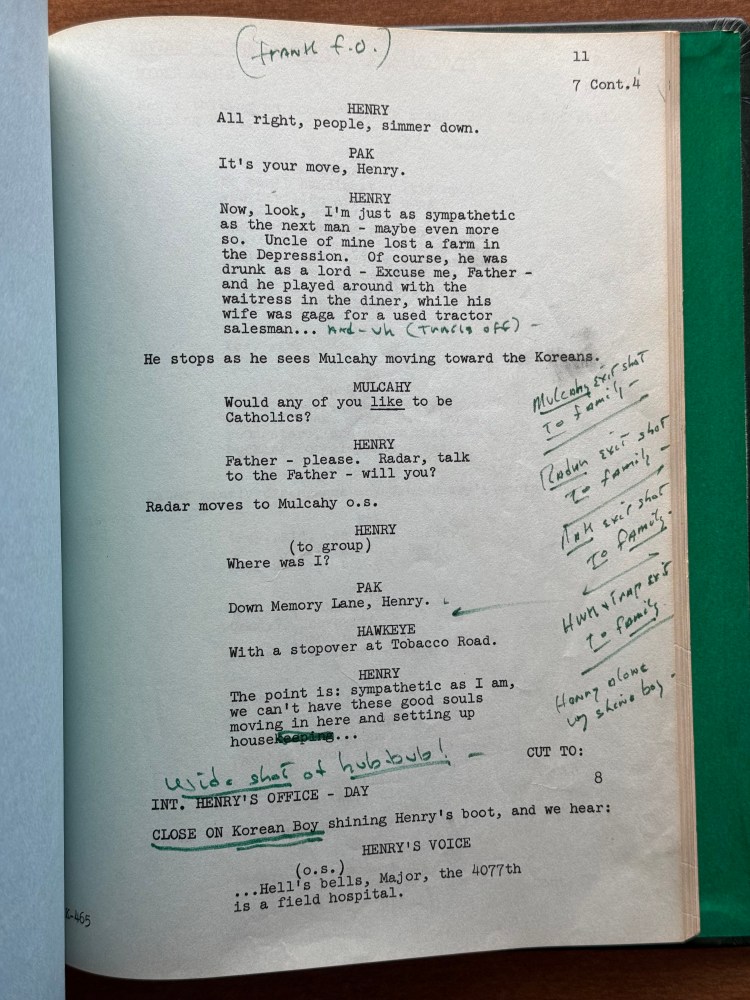

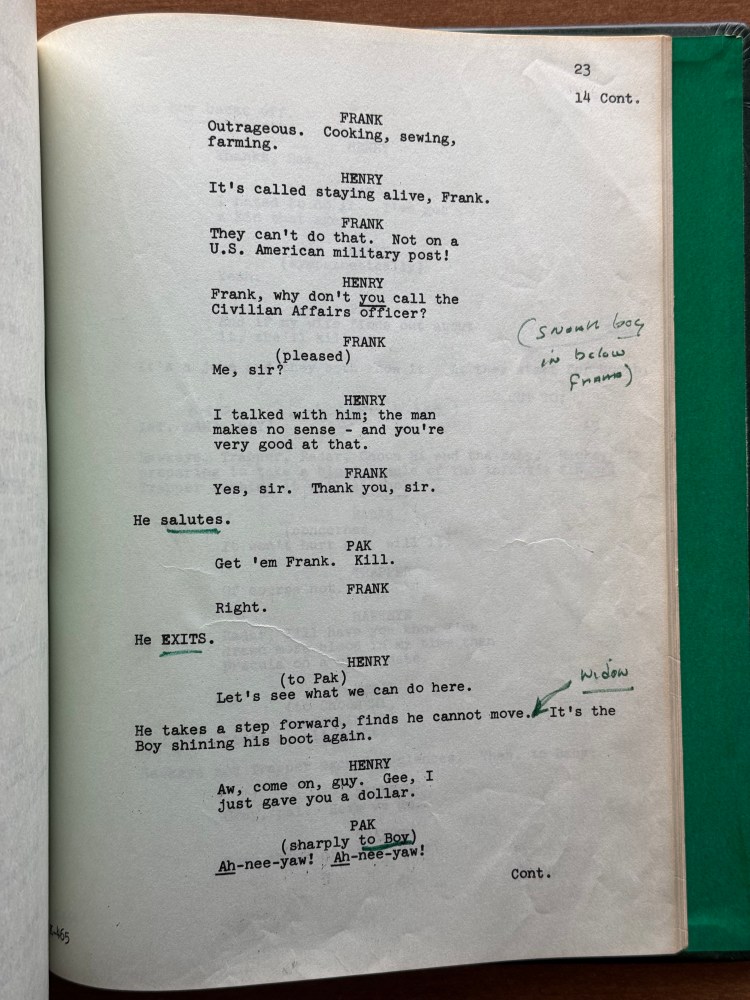

There were a number of minor changes throughout the episode, but there were several major differences between the script and final episode as well. On pages 10 – 11, the scene with the Korean family in the compound was originally longer as Captain Pak talked to the family. On page 22, the scene between Hawkeye, Trapper, and Henry in Henry’s office had a few additional lines. And on pages 23 – 24, the scene with Captain Pak and Henry in the compound is longer. Overall, the episode is largely as written, which makes sense since it contains the revised pages from the week of production. Another observation from the episode is that Margaret doesn’t appear.
Every time I review a M*A*S*H script that belonged to Jackie Cooper, I am reminded of Cooper’s memoir (Please Don’t Shoot my Dog: The Autobiography of Jackie Cooper). He famously did not get along with the cast of M*A*S*H, and he did not have much nice to say about them in his book. Despite the tension behind the camera, you’d never know it on the screen. Cooper directed thirteen episodes of M*A*S*H, and they are some of the highest rated episodes of the series. After reading his memoir, I was reminded of an old adage that “two things can be true at once.” It is likely true that Cooper was difficult to work with and the cast did not enjoy working with him. It is equally true that they produced some incredible episodes, including an Emmy win for Cooper (for his direction of the episode “Carry On, Hawkeye” (02×11)). “The Choson People” is a great, early episode that shows the strength of M*A*S*H and how it focuses on all aspects of how war affects human beings.
 The M*A*S*H Historian
2 thoughts on “Script Spotlight 41: “The Choson People””