
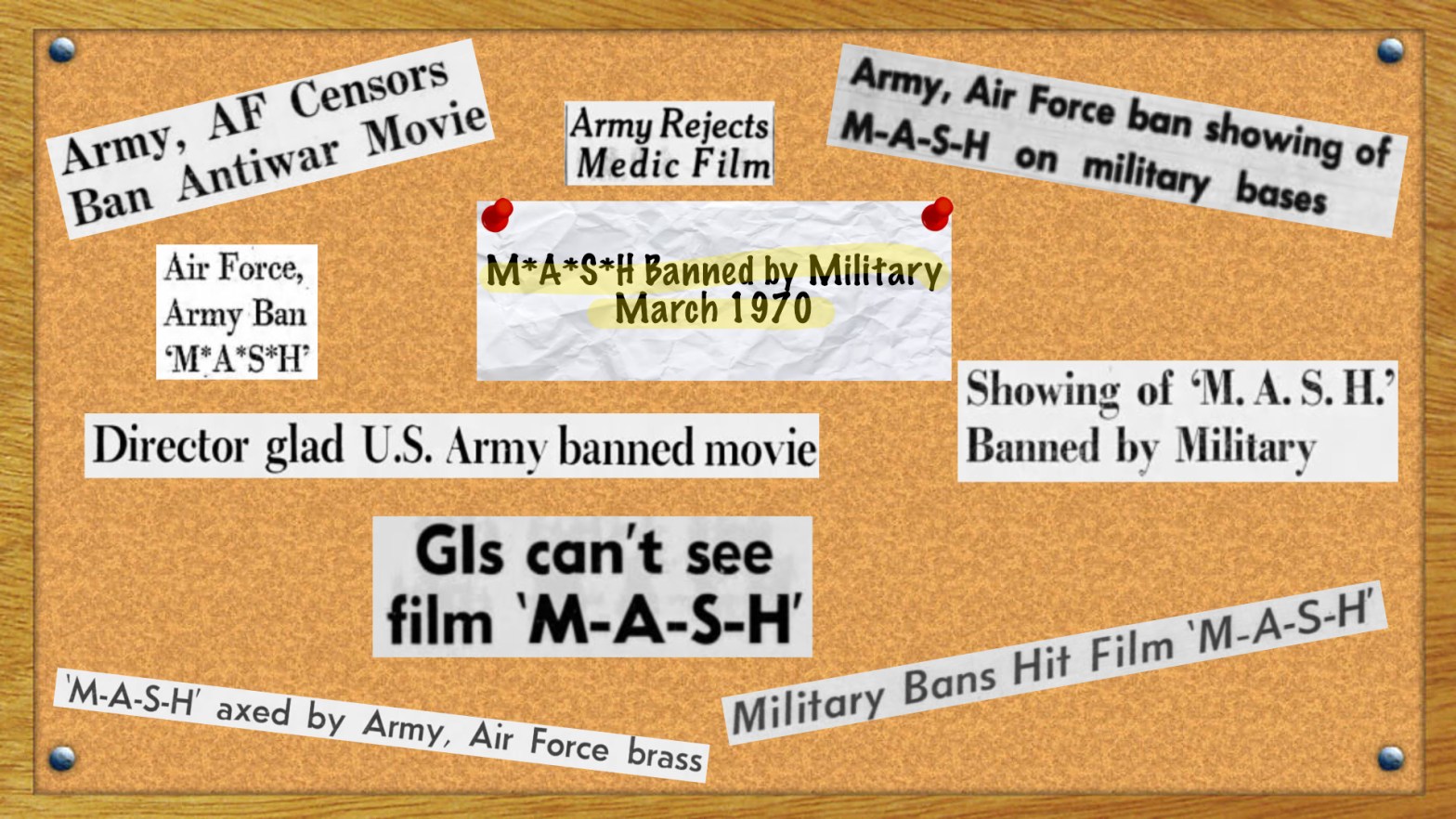
“M*A*S*H Headlines” is a new, limited time post that will focus on the press reaction to various events in the M*A*S*H timeline. The Press Pass posts focus on the press materials released by 20th Century Fox and CBS, but this series of posts will focus the press coverage of various M*A*S*H events including the release of Robert Altman’s film, the premiere of the M*A*S*H pilot episode on CBS, the death of Henry Blake, the M*A*S*H finale, and more! See the full series of Headlines posts here.
In 1970, 20th Century Fox released three war movies. Two were big budget, World War II movies. Released in February 1970, Patton told the story of General George S. Patton and focused on his time in the second world war. In September, Fox released Tora! Tora! Tora!, a film that focused on the Japanese bombing of Pearl Harbor, Hawaii in December 1941. Both movies received decent reviews, but they both trailed at the box office to a lower budged film about Army surgeons in Korea. Robert Altman’s M*A*S*H was released on January 25, 1970, and it received strong reviews. It was not the typical war movie filled with heroics and the good guys winning in the end. Instead, M*A*S*H was a dark comedy with a strong anti-war sentiment. Give the American attitude toward the Vietnam War in 1970, it is not surprising that an anti-war comedy out performed movies that glorified war heroics. What made M*A*S*H different, however, is that that it was banned from being shown on American military bases, and that turned out to be the best publicity a film could get. In this first “Headlines” post, we are going to look at the press reaction to the release of M*A*S*H in 1970 and the stories surrounding the film’s banning on military bases.
Initial Reviews

When M*A*S*H opened in January 1970, the reviews were largely positive. It was praised for its comedic take on war. By 1970, heroic World War II movies were a dime a dozen, but M*A*S*H had a very different tone. It was refreshing, and it caught the attention of the American public at a time when war was not popular. And that is what made it successful. Kathleen Carroll noted in her review, “They’re always saying that war is hell. But what about the fact that war breeds hell-raisers?” That was certainly true of the Vietnam War and the anti-war protests that were happening across the country. M*A*S*H took the anti-war sentiment and ran with it. It was a gamble at the time, but it was a gamble that paid off.
No one would call M*A*S*H a traditional army film, in fact, that is what Joseph Gelmis says made it successful. “Perhaps ‘hip’ is the best word to use for M*A*S*H. I saw the film, went home, and watched part of a World War II vintage army film. M*A*S*H is an army film; it’s also commentary on the traditional war film.” It was an “anti-war” war film that showed that war isn’t filled with heroic act. M*A*S*H showed the ugly side of war by taking place at a medical unit. It was bloody, and it didn’t apologize for it. M*A*S*H was also very sexual. It came out a few years after the “Summer of Love” and the year after Woodstock, so the inclusion of sex and music spoke to the younger generation that was being drafted to fight in Vietnam and protesting the war. Bernard Drew said, “There is no doubt about it, M*A*S*H is THE service comedy of the pot generation.” Robert Altman knew his audience, and they came out to see it. But the Army wasn’t happy with M*A*S*H, and an action they took in March 1970 only made the film more popular.
Banned by U.S. Military
After M*A*S*H had been out for over a month, the movie made headlines again. A Philadelphia Inquirer headline read “Army, Air Force Censors Ban Antiwar Movie,” and The Roanoke Times said, “M*A*S*H Banned by Armed Services.” The military banned M*A*S*H from playing on military bases to keep military personnel from seeing it (I have written about M*A*S*H being banned briefly). The banning had the opposite effect, however, as everyone wanted to see M*A*S*H to see what made it so off-putting.
According to the United Press, M*A*S*H was the first film to be banned by the military since 1963 when War is Hell and Man in the Middle were prohibited from being shown on military bases. The Army and Air Force judged that M*A*S*H “reflected unfavorably on the military and would undermine the confidence of soldiers who may need medical treatment in combat.” The scenes in the operating room were bloody and graphic, but it would be hard to argue that the movie did not portray the dedication of the surgeons to do their jobs well. But the irony of the movie being banned for showing the realities of war was not lost on Al Martinez. He said, “The Army may actually have a point in banning M*A*S*H because if you are going to have a war at all you’ve got to make it seem tolerable, if not downright desirable. Films such as M*A*S*H are bound to tarnish its image.” Certainly when compared to the other two 20th Century Fox war films released in 1970, M*A*S*H showed the results of combat which made war look less heroic and more ugly.
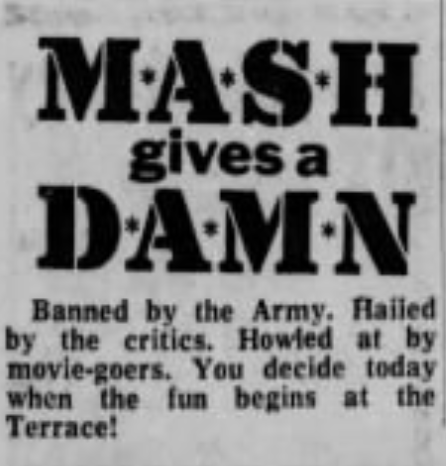
If the goal of the Army was to diminish the effect that M*A*S*H had on audiences, they failed. Military personnel could simply go see the film in civilian theaters. And promoters of M*A*S*H were quick to take advantage of the ban with several advertisements for local theaters including the blurb “banned by the Army.” It was an effective promotional tool, and Altman knew it. He told the United Press, “This is the best press in the world. It’s getting us ink that otherwise we’d have to pay for.” The old adage that “all publicity is good publicity” definitely played into the ban. Nothing makes someone want to see a movie more than being told that they can’t see it. The editorial board of The Philadelphia Inquirer understood this, and they blasted the Army for their decision to ban the film. “In condemning the film, the military men could not have done a better job of promoting it. And they made themselves look more ridiculous than the film ever could.”
Despite the ban, M*A*S*H went on to be the third highest grossing film in 1970 with $81.6 million (which is $659.7 million in 2025 dollars). And that was that was a great return on a film that was made on a budget of only $3.5 million ($28.2 million in 2025 dollars). M*A*S*H was successful for several reasons. It reflected the anti-war sentiment of the American public in 1970. The banning of the film by the Army and Air Force played into the message of the film, and it fueled interest in the film. Then there’s the simple fact that M*A*S*H was funny. It was a funny, anti-war war film, and that was something that American audiences were not used to seeing. It was exciting and new, and the reviews called that out. The success of M*A*S*H in 1970 led to the development of the television series that debuted on CBS in 1972, and it led to a surge in sales of the original novel by Richard Hooker (Dr. Richard Hornberger), a MASH surgeon in the Korean War. Seeing the newspapers from 1970 gives us the true reaction to the movie. It is easy for us to look back and see its success, but the success of M*A*S*H was not guaranteed. In fact, 20th Century Fox placed more stock in the success of Patton and Tora! Tora! Tora!, but it is M*A*S*H that struck a cord with audiences and led to more IP for Fox.
Bibliography of Articles
- 20th Century Fox. “M*A*S*H Gives a D*A*M*N.” News Record. April 11, 1970, B5.
- Archerd, Army. “Elliott Gould’s Career Helped by New Movie.” Portage Daily Register. January 24, 1970, 2.
- Associated Press. “Army, Air Force Ban Film.” The Macon Telegraph. March 18, 1970, 5A.
- Associated Press. “Film is Banned by Army.” The Danville Register. April 25, 1970, 10.
- Associated Press. “M*A*S*H Banned by Armed Services.” The Roanoke Times. March 18, 1970, 24.
- Associated Press. “M*A*S*H Banned by Army.” Pacific Daily News. March 19, 1970, 12.
- Associated Press. “Military nature Banned from Post Theaters. The Kansas City Times. March 19, 1970, 1B.
- Associated Press. “Military Theaters Won’t Show Satirical Film.” The Courier-Journal. March 19, 1970, A14.
- “Banned No Longer at Military Bases.” The Arizona Daily Star. April 16, 1970, 6C.
- Beebe, Jim. “M*A*S*H is the Best Comedy in Several Years.” Toronto Daily Star. March 28, 1970, 61.
- Carroll, Kathleen. “War is Hell-Raising, M*A*S*H Reveals.” Daily News. January 26, 1970, 39.
- “Comedy Banned by the Military.” New York Daily News. March 20, 1970, 87.
- Daily Breeze News Sources. “National…” The Redondo Reflex. March 17, 1970, 3.
- Drew, Bernard. “Wildly Funny, Stylishly Sick, M*A*S*H Still Makes Sense.” The Standard-Star. January 26, 1970, 22.
- Eichelbaum, Stanley. “M*A*S*H is a Howling Smash.” The San Fransisco Examiner. March 18, 1970, 70.
- Gelmis, Joseph. “M*A*S*H Goes to the Gory Core of War.” Newsday. January 26, 1970, 32A.
- Goldthwaite, Thomas. “Exuberance, Slapstick Make M*A*S*H Success.” The Arizona Republic, 71.
- “Half-M*A*S*H.” Tampa Bay Times. March 22, 1970, 4D.
- Herb, Bridges. “Show Biz.” The Times-Herald. January 29, 1970, 5C.
- Keating, Micheline. “M*A*S*H Steps on Many Toes.” Tucson Daily Citizen. March 19, 1970, 21.
- Lewis, Dan. “As a Hospital Farce M*A*S*H Proves Cutting.” The Record. January 26, 1970, A-17.
- Martinez, Al. “War Might be Good for Us.” Oakland Tribune. March 23, 1970, 15.
- “M*A*S*H Banned by Army, Air Force.” Deseret News. March 17, 1970, A9.
- Miller, Ottrell. “Banned-Movie Director Happy.” The Evansville Press. March 19, 1970, 2A.
- New York Times News Service. “Showing of M*A*S*H Banned by Military.” Winston-Salem Journal and Sentinel. March 22, 1970, D5.
- The Patriot Wire Service. “M*A*S*H is Banned by Military.” The Patriot News. March 17, 1970, 12.
- Scott, Vernon. “M*A*S*H Should Help His Career.” The Ogden Standard-Examiner. March 1, 1970, 10A.
- “Sounding the Brass.” The Philadelphia Inquirer. March 25, 1970, 20.
- UPI. “Air Force, Army Ban M*A*S*H.” The Los Angeles Times. March 24, 1970, 19.
- UPI. “Army, AF Ban Movie Hit M*A*S*H.” Courier-Post. March 17, 1970, 13.
- UPI. “Army, Air Force Ban Showing of M*A*S*H on Military Bases.” The Lompoc Record. March 18, 1970, 8A.
- UPI. “Army, AF Censors Ban Antiwar Movie.” The Philadelphia Inquirer. March 17, 1970, 1.
- UPI. “Army Bans M*A*S*H.” The Telegram-Tribune. March 17, 1970, 14.
- UPI. “Army Bans M*A*S*H From Base Showings.” The Cedar Rapids Gazette. March 17, 1970, 16.
- UPI. “Army Censors Ban M*A*S*H.” The Miami Herald. March 17, 1970, 4B.
- UPI. “Army Places Ban on Zany Film M*A*S*H.” Detroit Free Press. March 17, 1970, 8C.
- UPI. “Army Rejects Medic Film.” Omaha World-Herald. March 17, 1970, 19.
- UPI. “Banned Film Brings Joy to Director.” Traverse City Record-Eagle. March 19, 1970, 8.
- UPI. “Boston Bans ‘Anti-Army’ Film M*A*S*H.” Anaheim Bulletin. March 20, 1970, 48.
- UPI. “Director Glad U.S. Army Banned Movie.” Toronto Daily Star. March 19, 1970, 68.
- UPI. “GIs can’t See Film M*A*S*H.” The Palo Alto Times. March 17, 1970, 24.
- UPI. “M*A*S*H Axed by Army, Air Force Brass.” The Tampa Times. March 18, 1970, 3D.
- UPI. “M*A*S*H Banned.” The York Dispatch. March 17, 1970, 27.
- UPI. “M*A*S*H Banned as Undermining Soldier Morale.” The Bridgeport Post. March 22, 1970, D15.
- UPI. “M*A*S*H is Blotted by Military Censors.” The Record. March 17, 1970, B3.
- UPI. “Military Ban M*A*S*H from Base Showings.” The Memphis Press-Scimitar. March 17, 1970, 13.
- UPI. “Military Bans Film M*A*S*H – Lowers Morale.” The Fresno Bee. March 18, 1970, 38.
- UPI. “Military Bans Hit Film M*A*S*H.” Honolulu Star-Buletin. March 17, 1970, 2.
- UPI. “Military Claims M*A*S*H ‘Reflects Unfavorably’” The Waco Times-Herald. March 19, 1970, 16A.
- UPI. “That M*A*S*H Furor Means Big Box Office.” The Independent. March 19, 1970, 15.
- “War or Anti-war.” Newsday. March 17, 1970, 32A.
 The M*A*S*H Historian
One thought on “M*A*S*H Headlines 1: Altman’s M*A*S*H (1970) Opens Strong, Banned by Military”