
As we are well into May, and I have been rewatching M*A*S*H season five, I knew I had to choose an episode from the season to review. I am missing scripts for about half of season five, so that narrowed down my options. As I looked through the scripts in the collection, the cover of one really stood out. It was covered in writing and markings that I had several questions about. Thankfully, I was able to get answers to the questions, so I decided to write about the episode “Souvenirs” (05×22). I have several thoughts about this episode that I will get into later, but the script itself tells a very interesting story. This script was corrected and reviewed by Orven Schanzer for several post-production tasks. The script is heavily marked up with lines of dialogue marked out and typewritten corrections throughout the script. This copy of the script was corrected to match the dialogue delivered by each actor in the final episode that aired on CBS. In this week’s post, we’ll learn more about this script, why it was corrected, and why this episode left me confused.
The Script
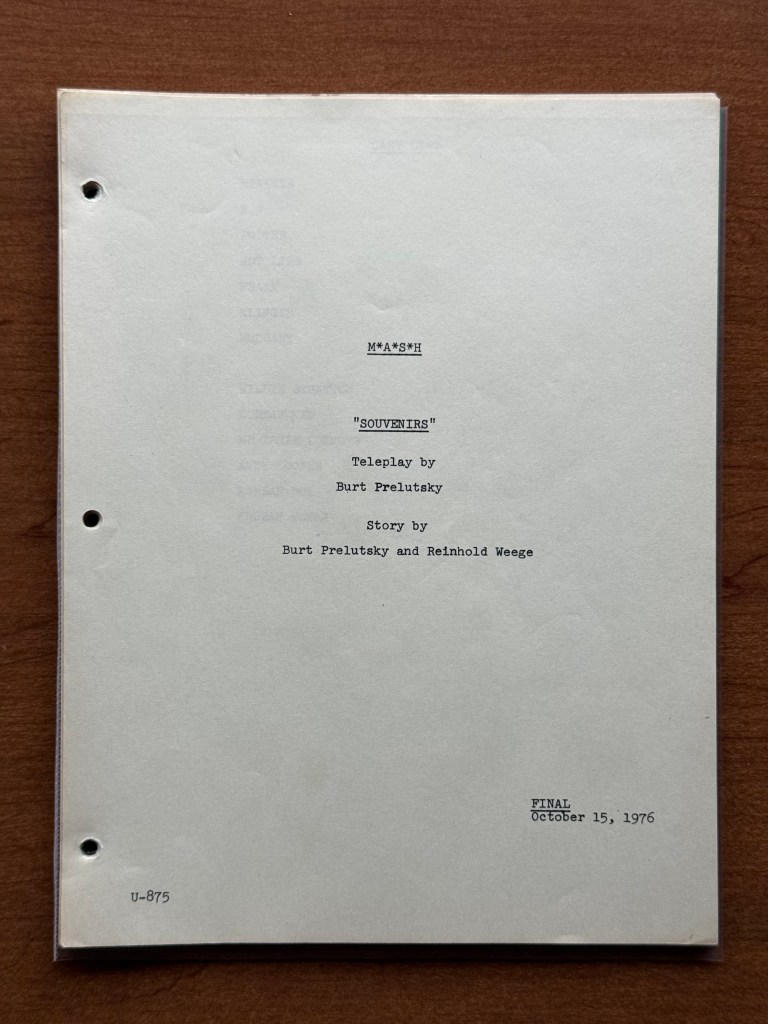
This is a “Final” draft of the script dated October 15, 1976. The final episode aired on CBS on March 1, 1977. The teleplay was written by Burt Prelutsky and the story credit is shared by Prelutsky and Reinhold Weege. Prelutsky has eight writing credits for M*A*S*H, in seasons four through six, including this episode. This is the only M*A*S*H credit for Weege, but he is better known as the series creator of Night Court. “Souvenirs” was directed by Joshua Shelley, and this is his only M*A*S*H credit as well. Perhaps the fresh writer and director is part of the reason why the episode felt so different for me?
This script is very unique for its markups, but I’ll address that in a moment. There are no production documents with this script such as Call Sheets or the Shooting Schedule. However, there are several sets of revised pages. There are revisions dated November 3, 1976 (blue pages), November 10, 1976 (pink pages), November 11, 1976 (green pages), and November 17, 1976 (yellow pages). The fact that there are so many separate revisions over the span of multiple weeks makes me wish that the Shooting Schedule was included with the script. I am curious when this episode was actually filmed since the revised pages are typically correlated to the days of filming.
As I mentioned in the introduction, this script belonged to Schanzer, and he had a very important task that is often overlooked in television production. I have mentioned several times in my script reviews that the actors might slightly modify a sentence or inadvertently flip around a few words as they performed a scene. This meant that the final episode didn’t match the script word for word, but it was important for the network to have a script that did match the episode as it would air. That was where Schanzer came in. He “corrected” a final draft of the script to match the edited episode as it would air for two important post-production tasks: creating dubbed versions of the show in other languages and to generated closed captions. Today, sites like YouTube use voice recognition tools to create captions, but in the 1970s, the closed captions were created manually, and a final copy of the script that matched the episode word-for-word was important.
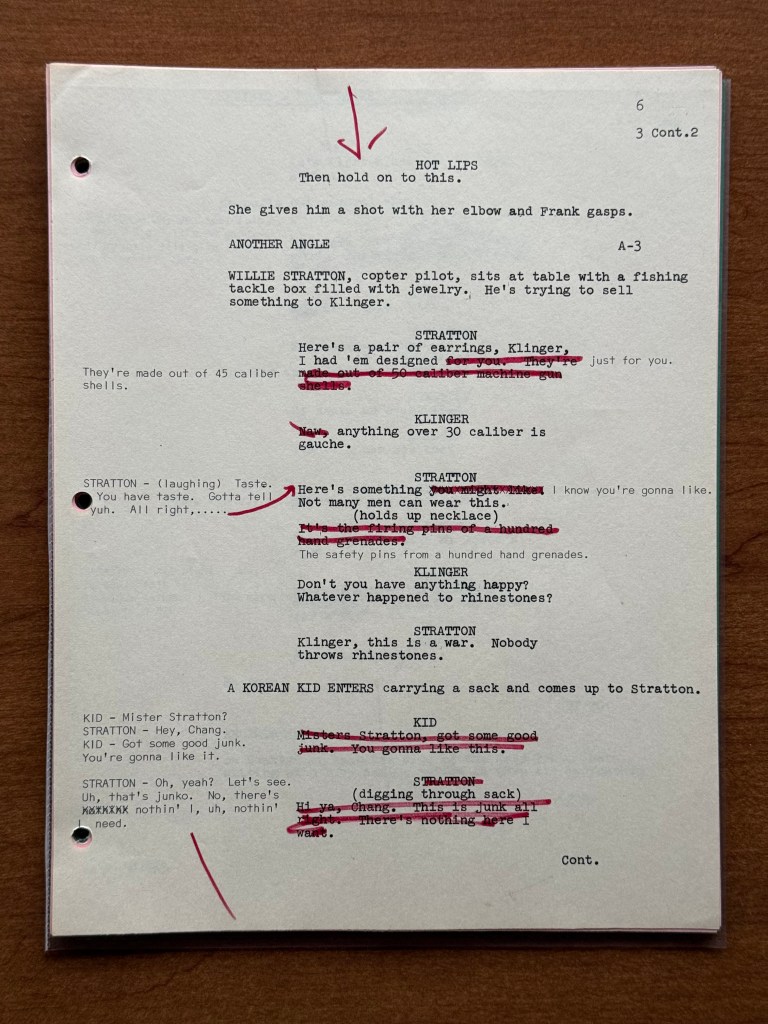
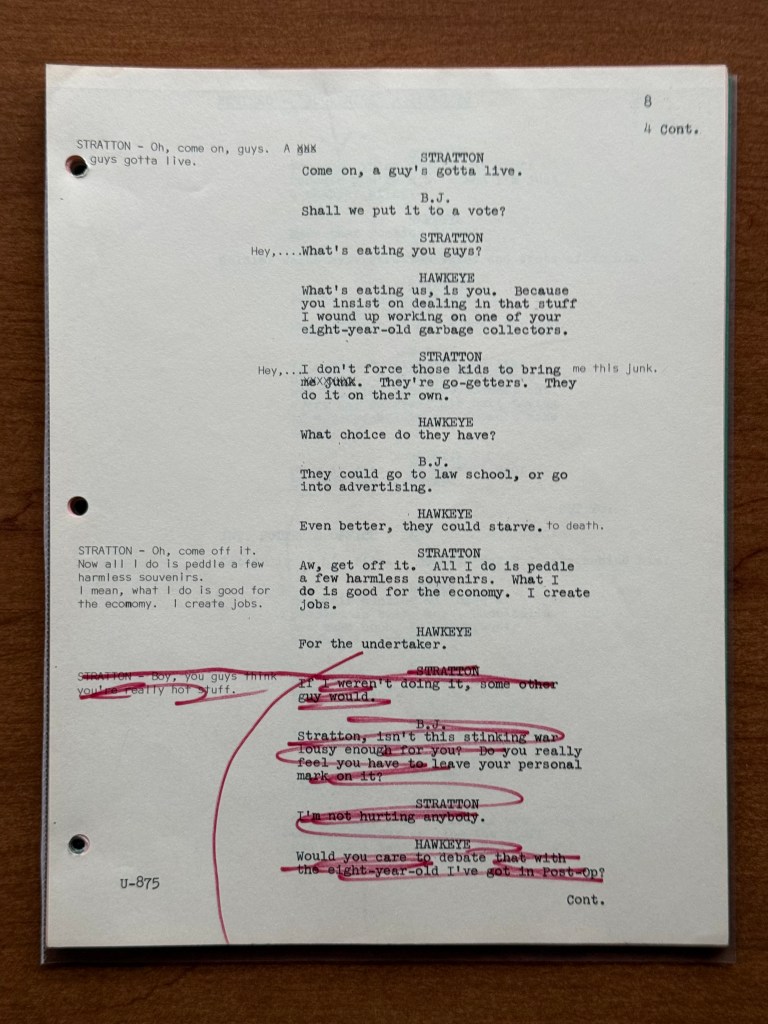
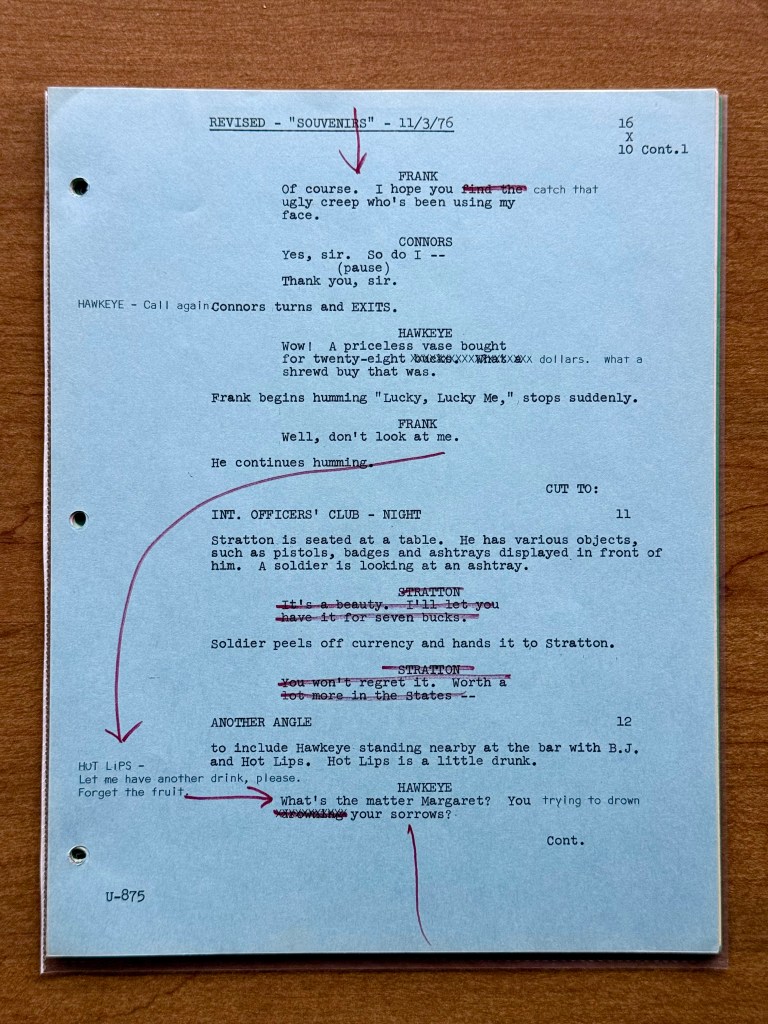

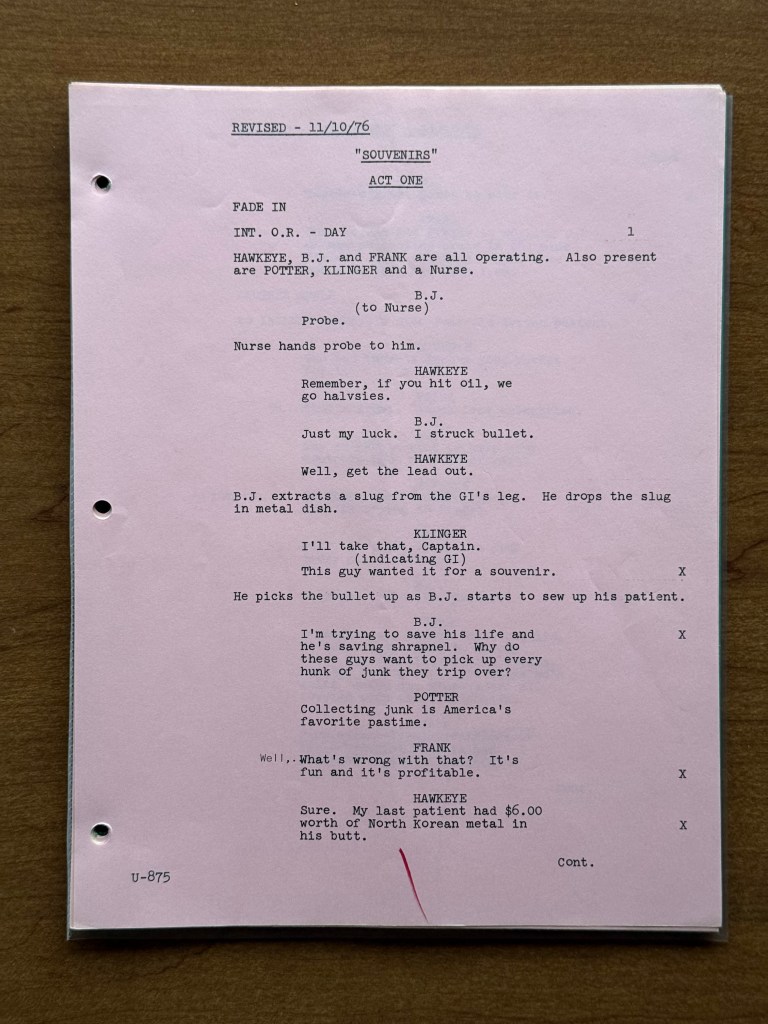
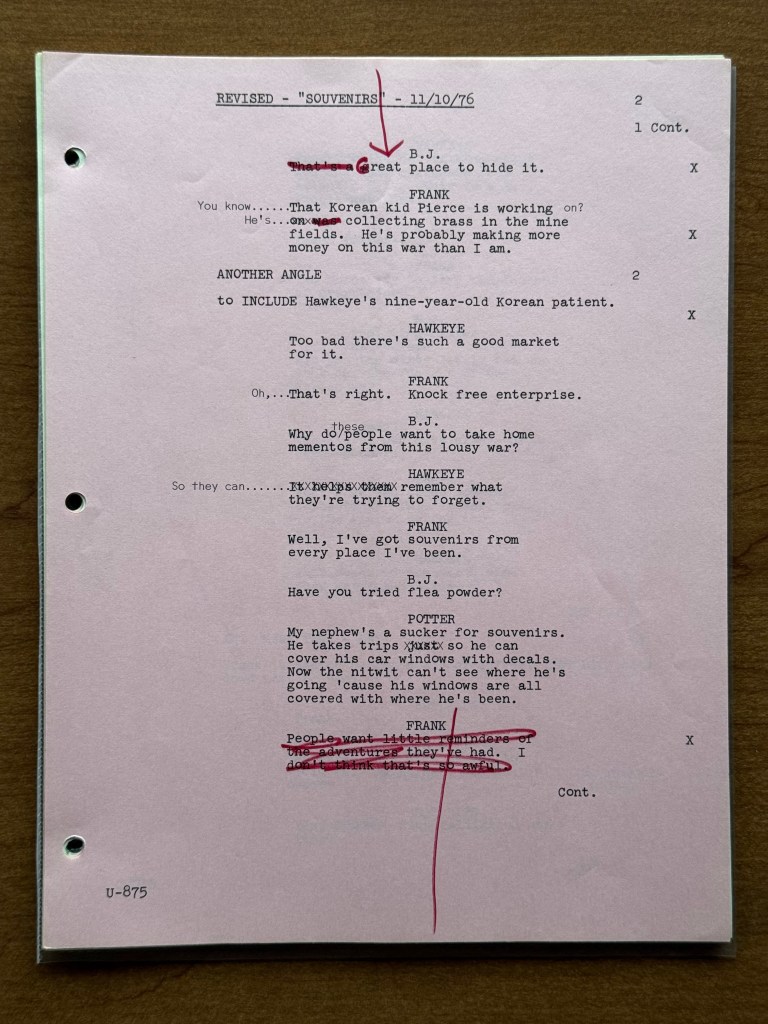
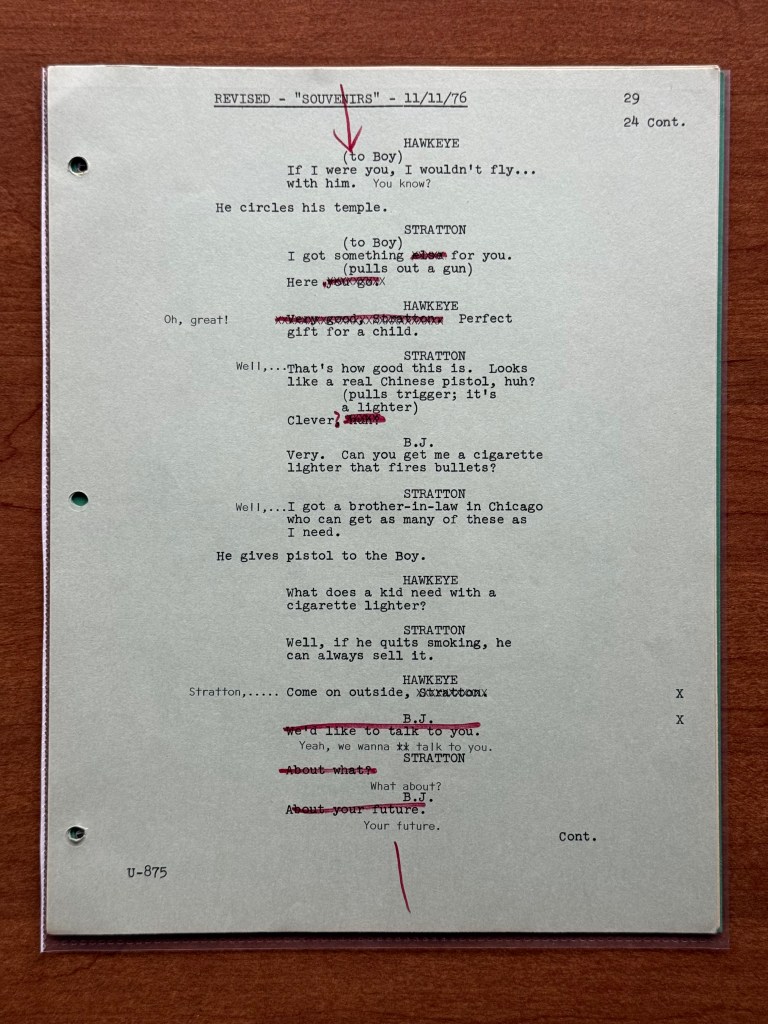

This script highlights an often forgotten task. Closed captioning is important to viewers who are hearing impaired. Having a script that matched the dialogue from the episode ensured the accuracy of closed captioning. I have watched shows with the closed captions on before where the captions didn’t exactly match what is being spoken by the actor. That is likely because a version of the script that had not been updated to reflect line changes was referenced when creating the captioning. The level of detail that went in to making an episode of M*A*S*H accessible to everyone in the audience went far beyond blocking, lighting, and filming. There are people who worked behind the scenes to ensure that everyone in the viewing audience could enjoy an episode of their favorite show, and this script highlights one of the tasks that was undertaken behind the scenes to ensure that was possible.
The Final Episode
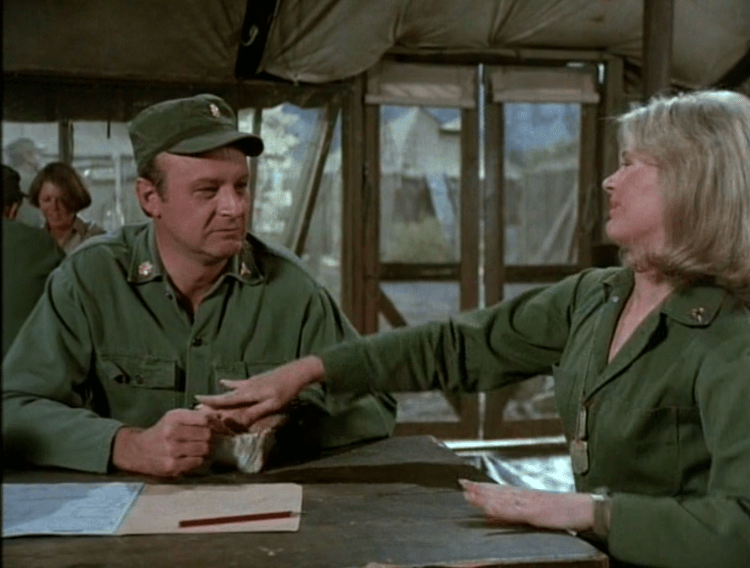


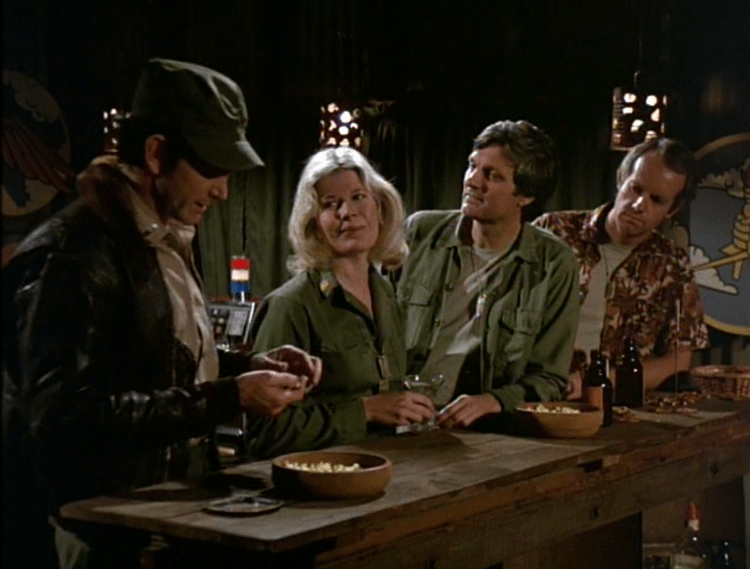
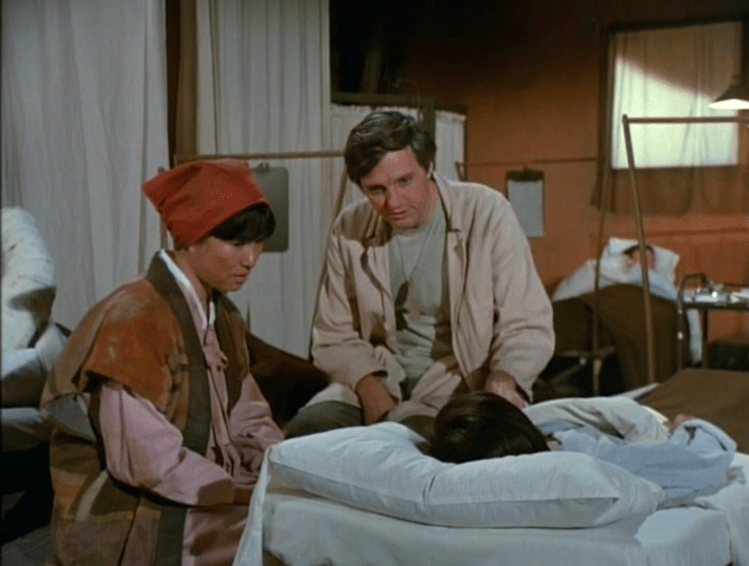
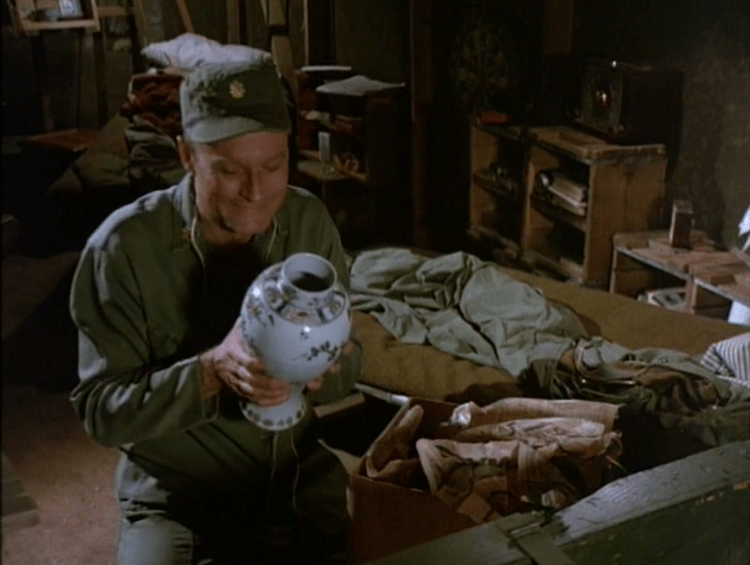
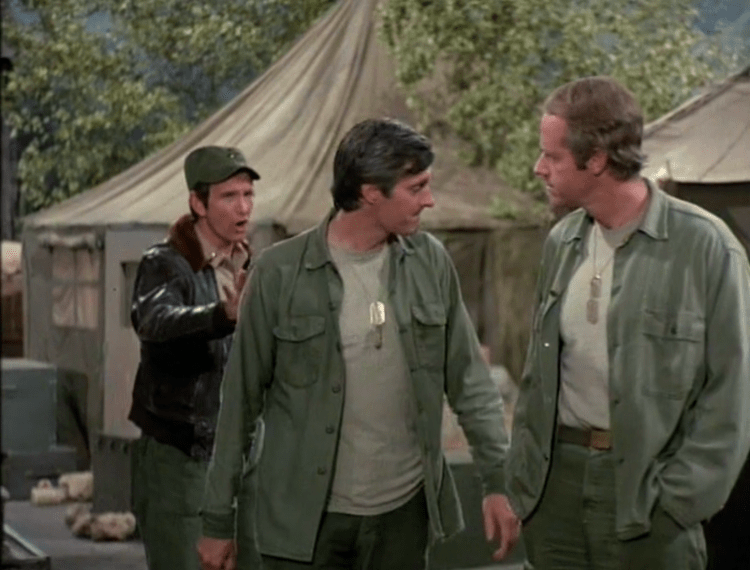

The episode opens in O.R. with the doctors operating on wounded, including a child who was injured when he was collecting brass shell casings for the helicopter pilot, Stratton. He uses the brass to make war souvenirs, and pays local kids to collect the metal for him. Hawkeye and B.J. are disgusted by the practice, and they ask Potter to do something about it. He gives a flowery speech to the camp, but it doesn’t stop Stratton. He continues to sell his souvenirs, and Hawkeye and B.J. threaten him the Mess Tent, but they don’t follow through. In the Officers’ Club, however, Margaret does punch Stratton. He agrees to give up the practice when Hawkeye and B.J. threaten to take away his ability to fly by claiming he has a medical condition. Related to Stratton’s selling of souvenirs, Frank finds out that a vase he bought for $27.75 is a priceless antique. He tries to send it home, but B.J. and Hawkeye intervene. Meanwhile, Margaret tries to get a ring back from Frank that he claims not to have. She does get it back eventually. And while everything else is going on, Klinger sets the record for pole sitting with a stunt that started out as an attempt to get a Section 8.
After watching this episode, I have mixed feelings. I like the storyline where Klinger’s Section 8 attempt becomes a record breaking success, and he is rewarded with a three-day pass to Tokyo. The camera work in those scenes is really good, and it seems like something that Klinger would do. I also enjoyed the storyline between Frank and Margaret as we see the continued fallout of their relationship after Margaret’s engagement. I believe that Frank would try to keep a ring, and I also believe that he would try to give it to his wife as a gift.
It’s the multiple, separate souvenirs storylines that feel inconsistent. The wounded patient who wants to keep the bullet that didn’t kill him is understandable. I don’t agree with B.J.’s contempt for that. No one was hurt in that situation but the man who was wounded, so him keeping the bullet that wounded is fairly common. Unfortunately, Frank buying stolen artwork from a country in which a foreign Army is stationed is another common occurrence. It happened in both world wars, and there are stories of it occurring in the 2000s in both Afghanistan and Iraq. It is deplorable that national treasures are looted then sold on the blackmarket. If this episode stopped at these storylines (Klinger, Margaret/Frank, the wounded soldier keeping the bullet, and Frank buying a stolen vase), I think the episode would have worked better. The additional storyline of Stratton goes a few steps further. He has kids collect the brass shells, taking advantage of their poverty, then has them made into other objects that he sells. This is certainly something that happened in war time, but how is he having the brass made into something else? When does he have time? He is a helicopter pilot in a war zone. I also have a hard time believing some of the lines from Hawkeye or that Margaret would punch a man for selling souvenirs. Those scenes don’t feel authentic to the characters. I agree that the practice of buying and selling “war souvenirs” is wrong, especially when it puts children in danger because they are desperate for money or lotting national treasures. But there are too many storylines in this episode that didn’t fit well together.
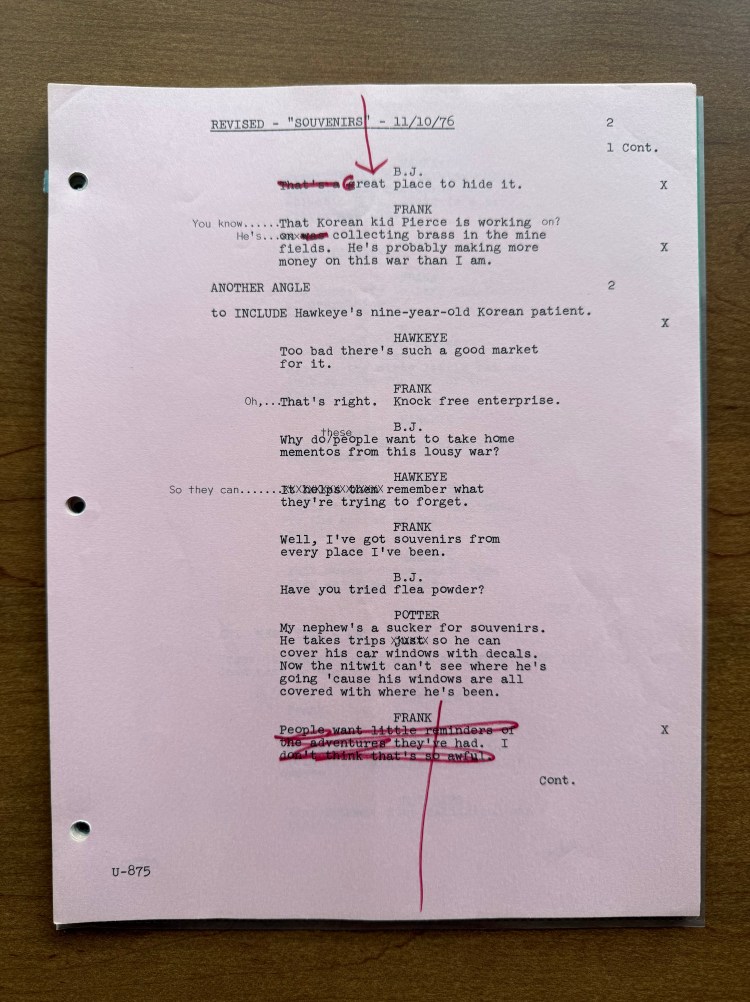
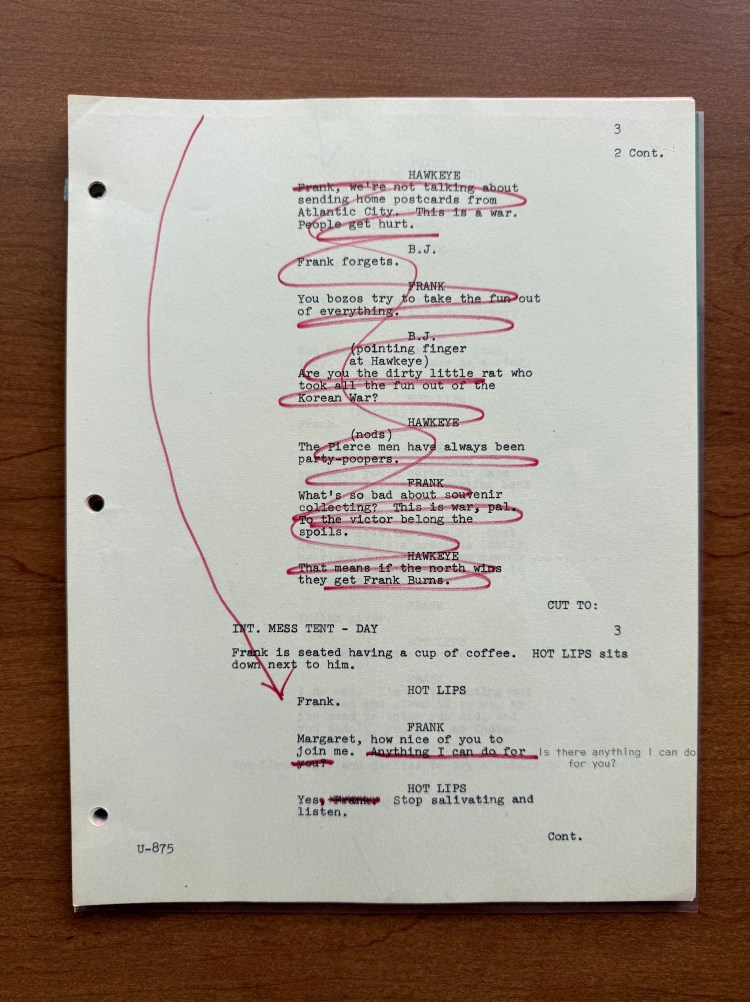

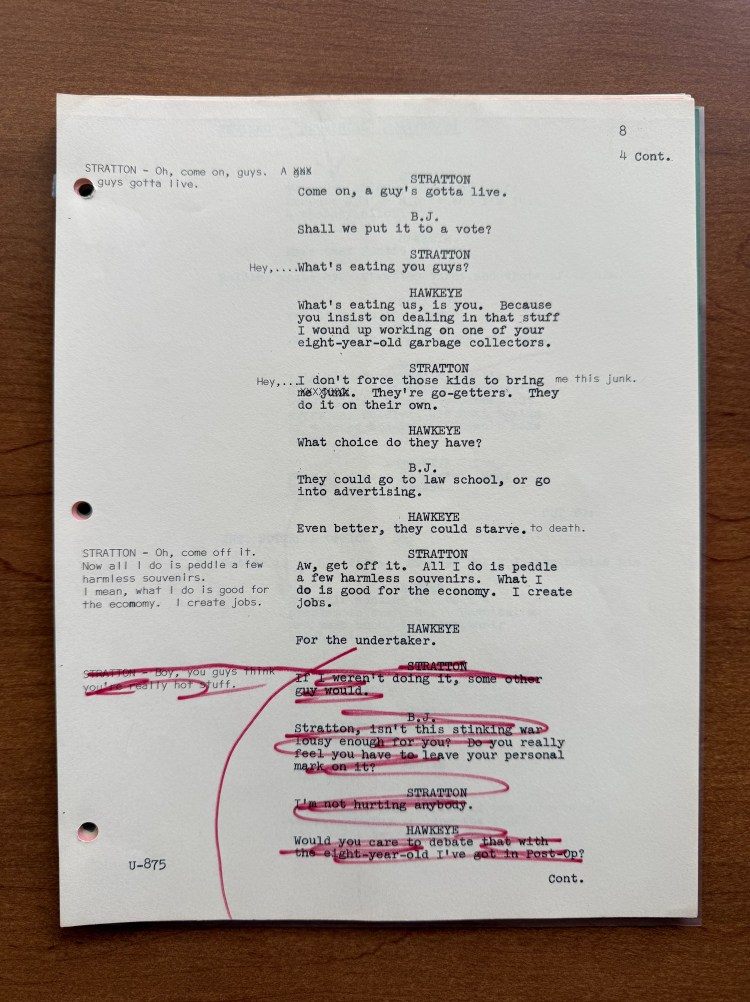
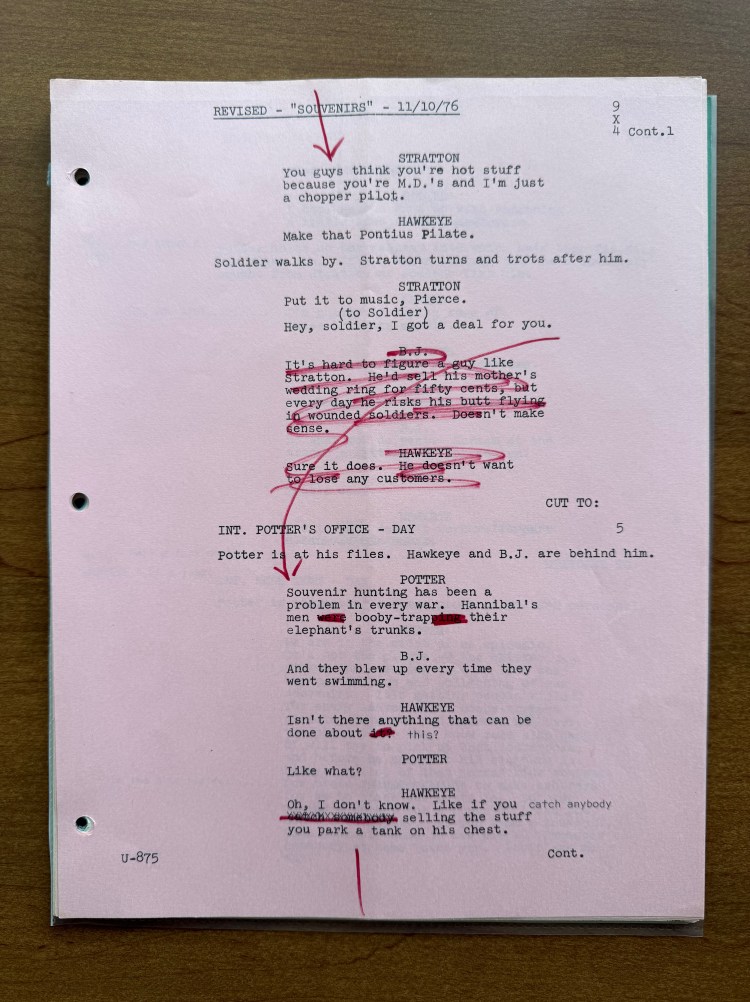

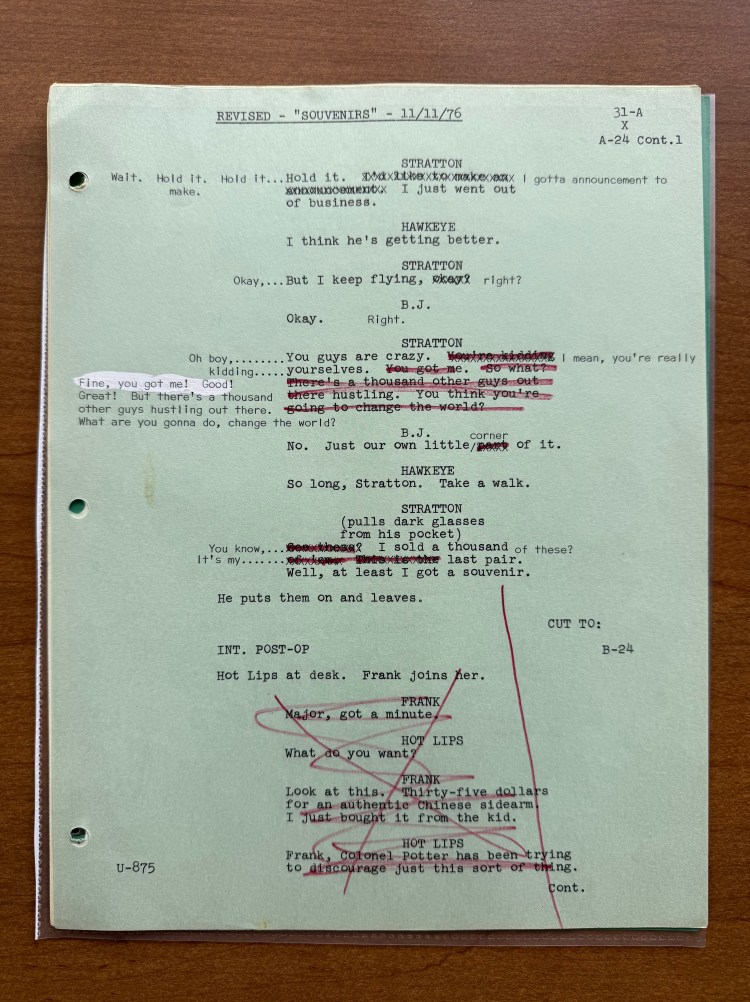
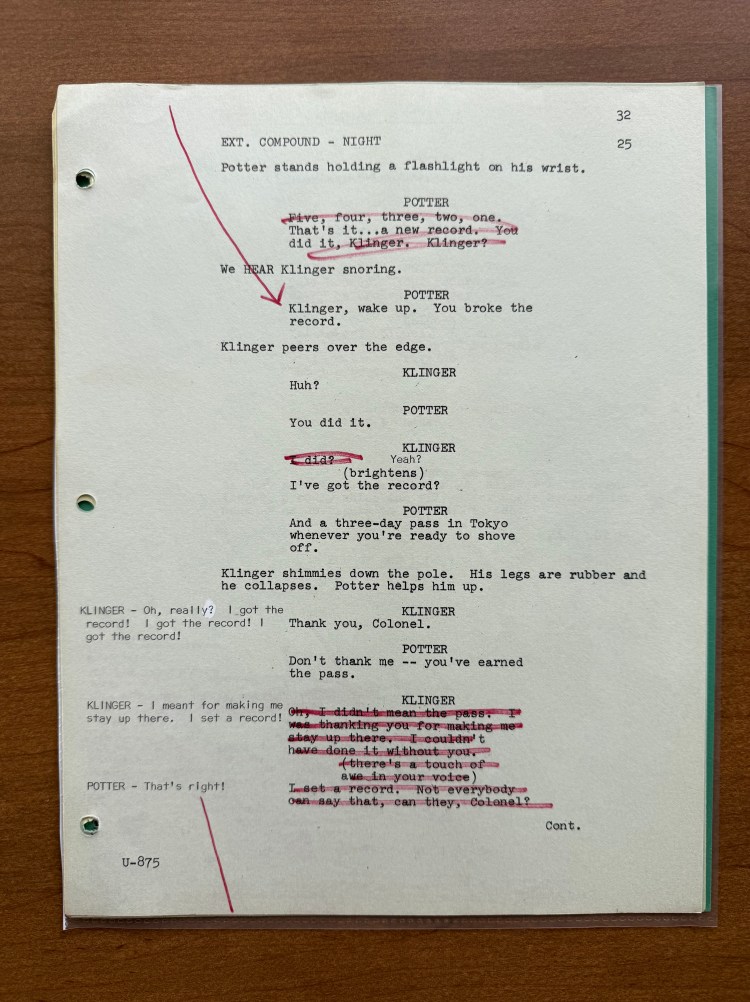
Since this script is a corrected copy, there are not many differences, or rather, the differences are corrected. But since this script is a final draft that has been marked up, there were some scenes that were removed from the final episode. The opening O.R. scene was originally written to be longer (pages 2 – 3). One change that I found interesting was that Margaret didn’t originally put Frank’s hand in the oatmeal, she was going to elbow him (page 6). Perhaps this was changed since she punches Stratton later in the episode. The scene in the Mess Tent with Hawkeye, B.J., and Stratton was written to be longer (pages 8 – 9). There was a scene cut that showed Stratton selling products after Potter’s speech (page 16). There was a scene between Frank and Margaret cut (pages 31 – 32). I suspect that some of these cut lines/scenes were filmed, but cut for time.
It is fair to say that “Souvenirs” is not one of my favorite episodes. I don’t think it is a bad episode, but I do feel like the storylines failed to make the point they were pushing because there was too much complexity. It is episodes like this that I believe some in the M*A*S*H fandom would call “preachy.” Larry Gelbart left after season four, and I feel like his tight writing style was sorely missed. “Souvenirs” comes at the end of season five, so we’re about to say goodbye to Frank, and the new characters from season four have made themselves at home at the 4077th. It’s interesting to note that Radar doesn’t appear in this episode, and season five is when we start to see less of him in the series. As for the script, I find it fascinating that a version of the script was created to match the final episode to assist with the creation of dubbed episodes and the generation of the closed captions. This is a task that would likely have not been thought about by the producers, actors, or audience. Schanzer was one of the hundreds of employees at both CBS and Twentieth Century Fox whose names don’t appear in the credits who ensured that M*A*S*H was available, and accessible, to fans of all abilities across the world.
 The M*A*S*H Historian
One thought on “Script Spotlight 44: “Souvenirs””