

In the early 2000s, M*A*S*H aired in syndication on the cable network FX. I watched daily and kept track of the episodes that aired. I had a binder with the names of episodes, and I would note when they aired. That rewatch and binder is how I memorized the episodes titles, but it was also how I realized that FX mostly showed M*A*S*H in order. However, there were a few episodes that, for whatever reason, FX did not air. One of those episodes was “Tell It to the Marines” (09×08). I did not see this episode until I bought the season nine DVD box set. Along with my 2025 rewatch of M*A*S*H, I have been reviewing episodes from the same season I am watching that month. So for September, I had to find an episode from season nine. As I glanced over the list, “Tell It to the Marines” made the most sense since it was episode that I truly saw for the first time when I bough the DVDs. The script for this episode also belonged to Albert Frankel, so I knew that was a great choice for season nine!
The Script

This copy of the script is a final draft dated July 17, 1980. The episode originally aired on CBS on January 12, 1981. The script was written by Hank Bradford, who only wrote this one episode of M*A*S*H. Bradford was no stranger to writing comedy as he was a long time writer for The Tonight Show Starring Johnny Carson. Harry Morgan directed this episode, and he directed nine episodes of the series from seasons four through eleven. After Alan Alda, I believe that Harry Morgan ranks second on the list of most episodes directed by a M*A*S*H actor. That was quite a feat for any of the actors since they also appeared in the episode.
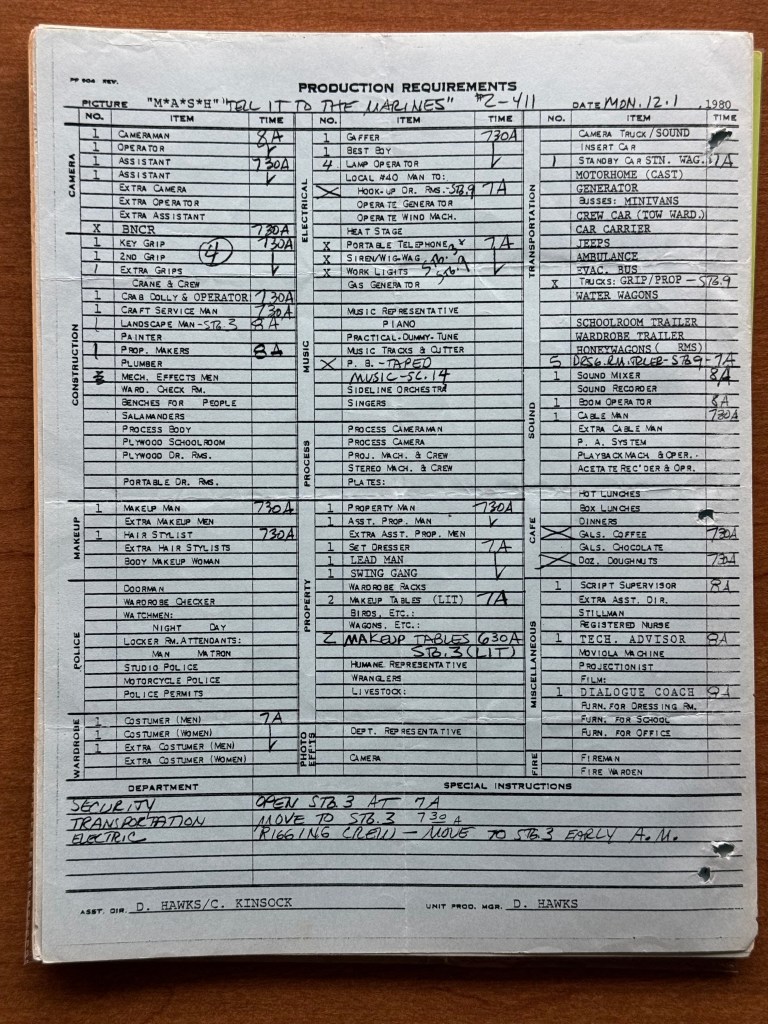
As I have often mentioned, the scripts that belonged to Albert Frankel are my favorite. They aren’t only my favorites because they are the first scripts I ever purchased, but they are great scripts because Frankel saved everything. His scripts contain the Call Sheets. Each days sheet would list the actors who were needed, the location where they’d be filming, the scenes they’d film that day, and any additional standins that were needed. The reverse of the Call Sheet lists the Production Requirements including the cameras, lighting equipment, key grips, microphones, and just about everything from people to gallons of coffee! Most of his scripts contained the Shooting Schedule, but this one does not. That is okay as the shooting schedule listed the days of filming, the location, and the scene to be filmed each of the four days. The information on the Shooting Schedule was transferred to the daily Call Sheets, so it is largely duplicated information, but I do like seeing both.


What makes Frankel’s scripts unique is that as the men’s costumer, he had pages that he placed in the back of the script with details about the costumes that each character needed for each scene. Each character had a page (or two) with these details. In addition, he marked up his script noting characters and wardrobe that were mentioned in the script so he could put together what was needed. His markings were made in multiple colors of marker, and it’s great to see how he marked up each script. Since he was on set for each of the four days of filming, Frankel also received the revised pages in case it affected the characters’ costumes. In this script, there are three sets of revised pages. One set of pages is from November 25, 1980 (blue) and two sets of revised pages are dated November 26, 1980 (pink and yellow). The revised pages are marked up the same way the original pages are, so Frankel would have to be sure that his costume sheets remained accurate as new, revised pages were released.
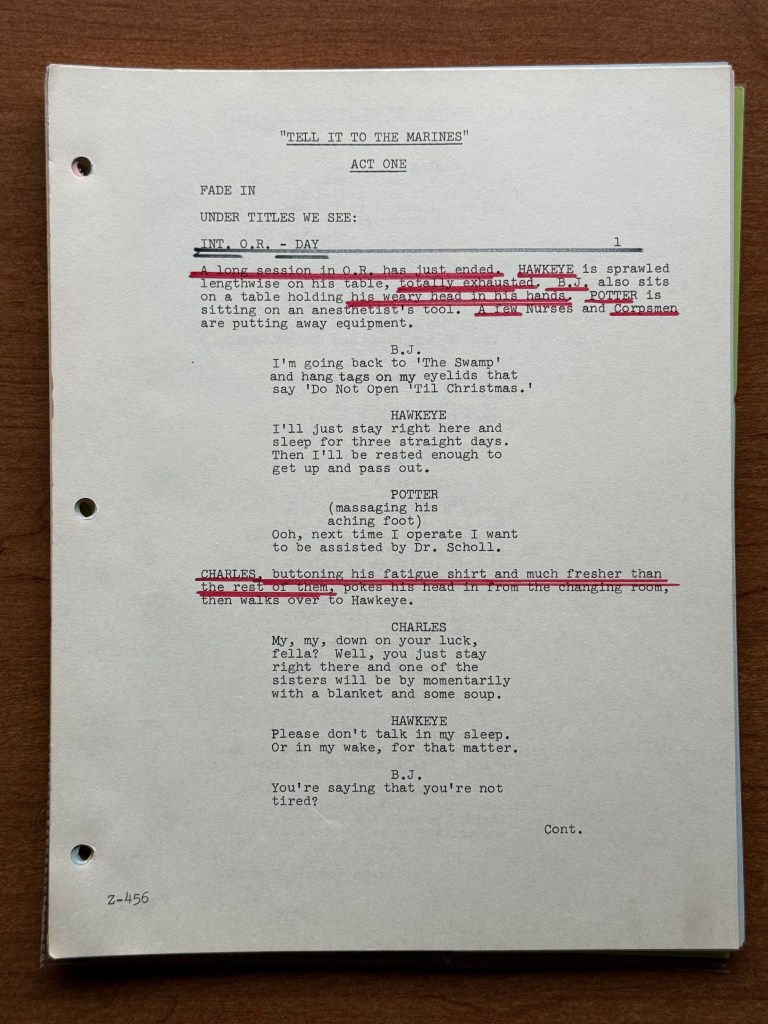
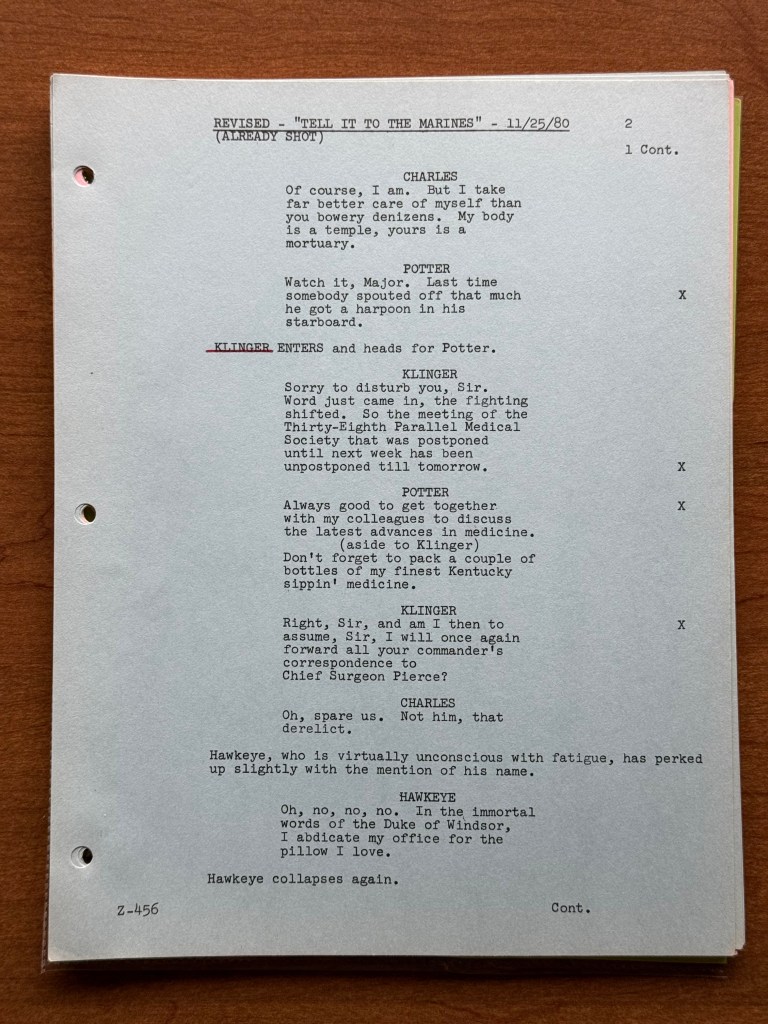
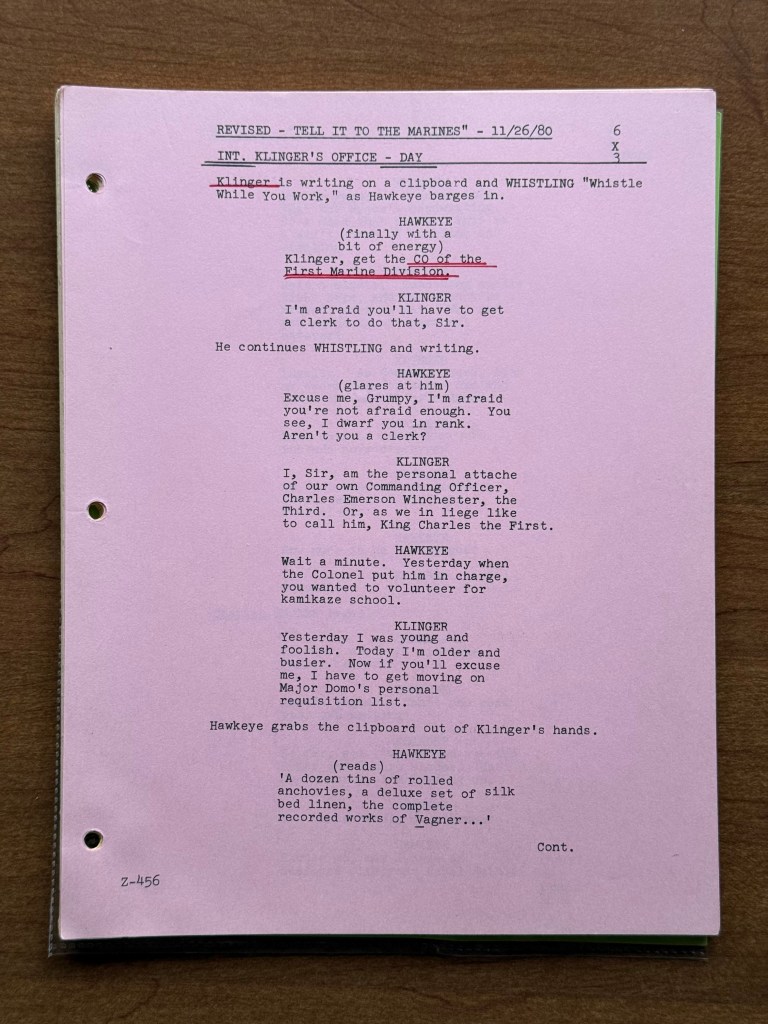

You may have noticed that there is quite a gap between the date on the script (July 17, 1980), the dates on the revised pages (November 25 & 26, 1980), and the date the episode aired (January 12, 1981). It was not unusual for episodes to not air in the order they were filmed, but that is not the story here. All of season nine was delayed due to a strike by the Screen Actors Guild (SAG) that lasted from July through October 1980. Because of the strike, all of the network television shows were delayed. Instead of beginning in September, season nine of M*A*S*H did not debut on CBS until November 17, 1980. With the actors on strike, scripts could be written, but nothing could be filmed. Once the strike ended in October, the actors went back to work and filming began on the new season of M*A*S*H and all of the other network television shows. This is also why season nine only has 20 episodes instead of the typical 24. I believe it is possible that is why this script has two sets of revised pages from the same day. Due to the strike, Fox was pushing to get episodes produced to air. As I have said many times, each script tells a story, and this one is no different!
The Final Episode
After a long session in O.R., the surgeons are worn out. Before they can get to sleep, a wounded Marine has an issue. Private Jost Van Liter is due to be discharged due to his wounds, and he found out that his mother is being deported. His current discharge date will put him getting home after she is gone. He tried to get the Marines to let him leave early, but they refused. Hawkeye tries to talk to his commanding officer, Col. Mulholland, and he refuses again. Hawkeye tries to have an article published in Stars & Stripes about Van Liter’s issue, but Mulholland has the story killed. Hawkeye and B.J. take the story to the civilian press, and it is published in the United States. Finally, Stars & Stripes publishes the article, and Mulholland comes to the 4077th to confront Hawkeye. He vows to make Van Liter’s last three weeks in the Marines rough, and they decide to keep him at the 4077th with the “flu.” The article works, and his mother is hired by the Dutch Consul General, so her deportation is cancelled since she has diplomatic immunity. Meanwhile, Col. Potter is called away for a conference and Charles is in command. He uses Klinger as his personal assistant and pays Klinger to get records, silk sheets, and do his laundry. Potter does not approve of Charles’ use of Klinger, and when he returns, Charles takes a turn as company clerk!
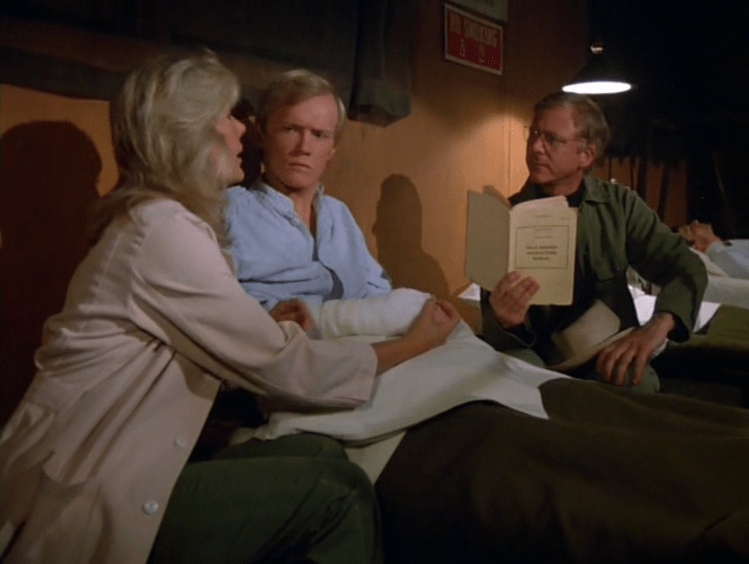
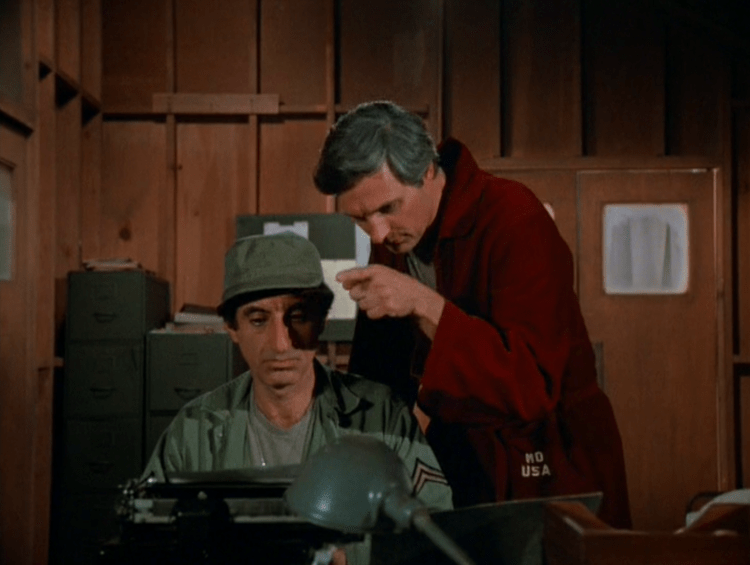


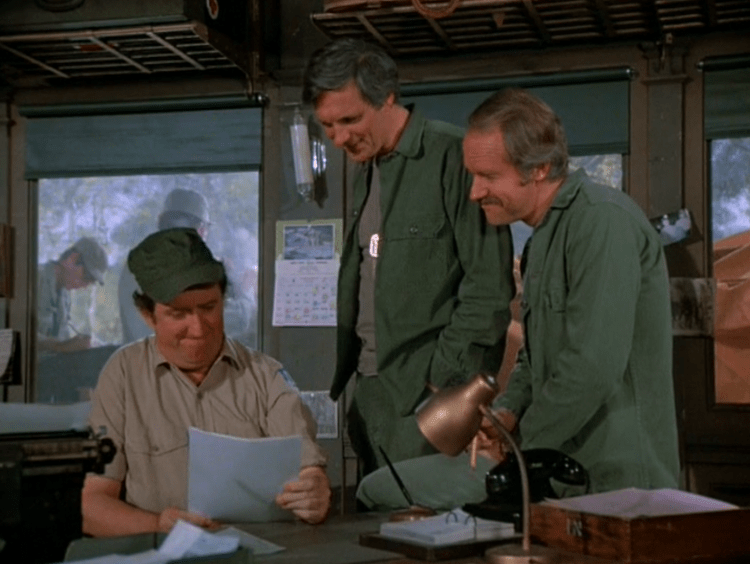


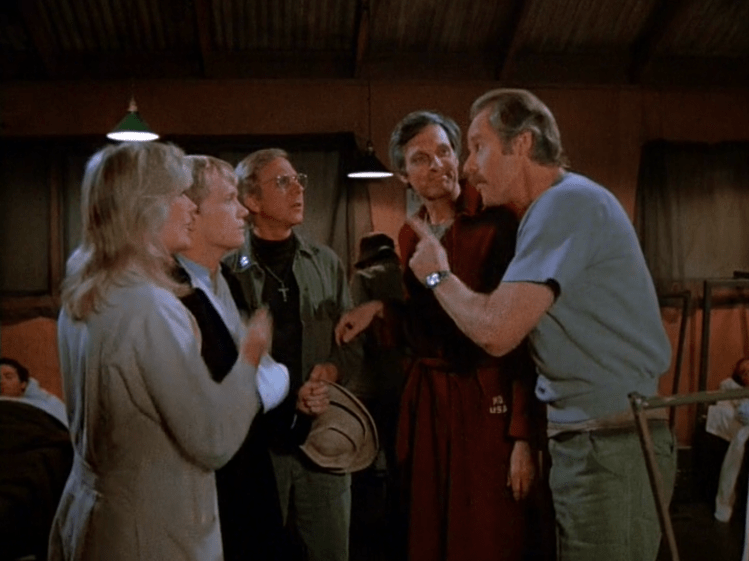
I am not sure why FX never aired “Tell it to the Marines” in syndication. It is a good episode with a solid A-story and a funny B-story. The storyline of Van Liter might be a bit over the top, but Charles using Klinger as his personal assistant is very fitting! It is also strange that, after being largely absent in season eight after becoming company clerk, Klinger was wearing a woman’s bathrobe and tries a Section 8 dodge at the end of the episode. I suppose they were trying to keep a little bit of that part of Klinger’s character alive. The episode has good guest stars as well. Stan Wells plays Van Liter well, but I think Michael McGuire stole the show as Col. Mulholland. As I rewatched the episode, he looked familiar, and his voice gave away the character he is probably best known for: Sumner Sloan in Cheers. As for the script, it did not have any major changes between it and the final episode. The revised pages match nearly word for word what is said on screen. It is a testament to the incredible writing and acting in M*A*S*H!
While this may not be one of the top episodes of M*A*S*H, I still do not understand why it was not shown on FX in the mid-2000s. It is a good later episode of M*A*S*H that contained more of a central message than drama or comedy. I actually like how calling attention to Van Liter’s problem got enough people’s attention to help his situation. That is the power to the press, and the power of the collective people. Hawkeye’s line, “But when people know about somebody in trouble, they do something.” This line stuck with me because it was written in 1980 for a show that took place in the 1950s. Americans had a lot in common by watching the same shows, reading the same news, and going to the same communal places. Today, we are factionalized. Social media, streaming platforms, and pay as you go news services have placed us into channels of people with similar views and backgrounds. I am not whether a story like Van Liter’s would gain traction today. As I write, I feel nostalgic for another time, but I also feel sad for something that we have lost. That is what makes shows like M*A*S*H timeless. The messages and lessons apply just as much today as they did 45 years ago.
 The M*A*S*H Historian
One thought on “Script Spotlight 48: “Tell It to the Marines””