
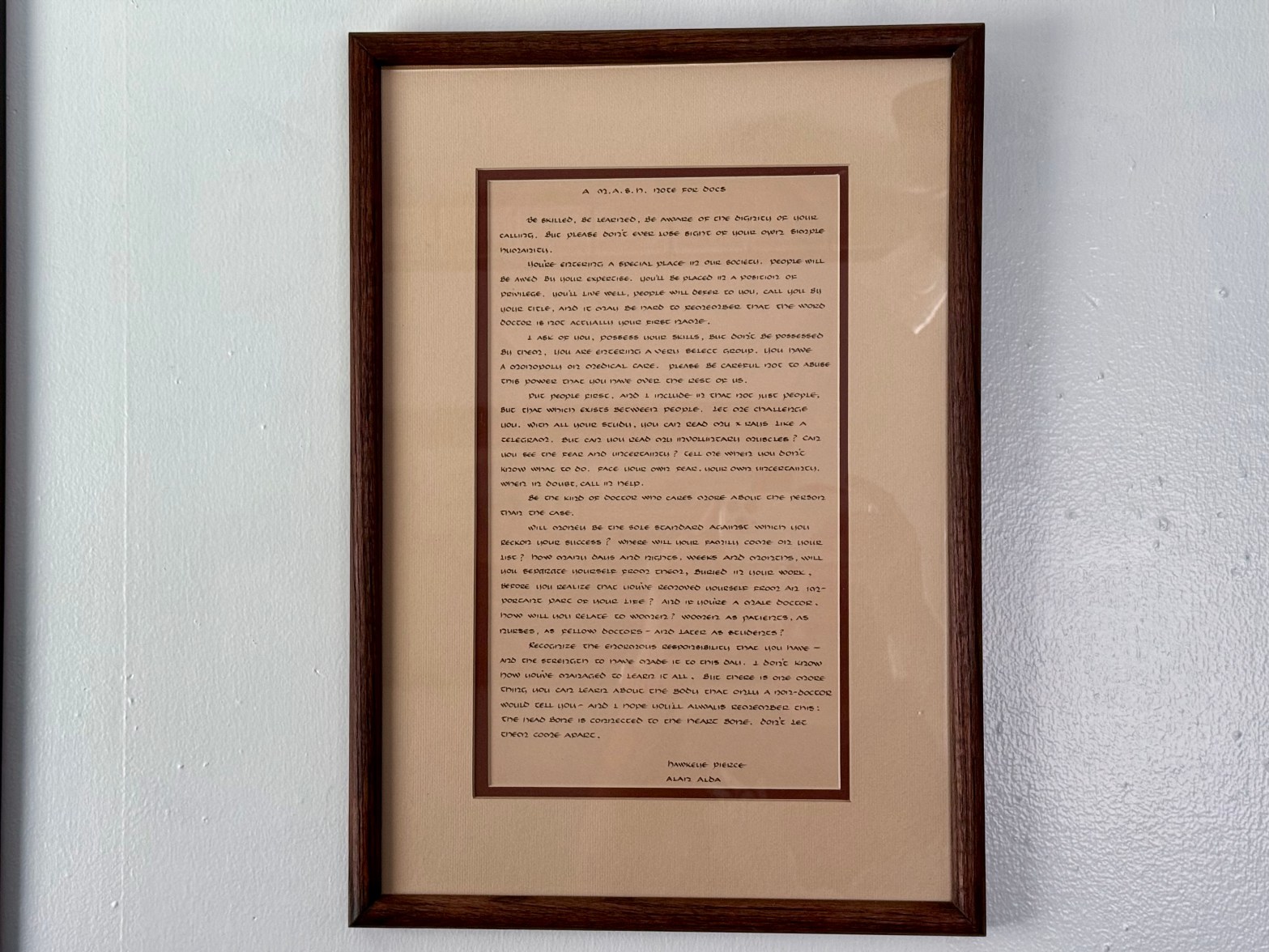
As the popularity of M*A*S*H grew in the 1970s, so did the popularity of Alan Alda. As Hawkeye Pierce, Alda was the lead actor of M*A*S*H, and it is primarily from the perspective of Hawkeye that we see life at the 4077th. This makes sense as this was how the original Richard Hooker novel and Robert Altman film were structured. Due to his rising popularity, Alda was often asked to attend events for various causes, speak to groups, and attend political rallies. He often turned down these requests, but there is one request that Alda would sometimes agree to: commencement addresses. At college graduations, there is generally an inspirational speaker chosen to speak to the graduating class and offer some nuggets of wisdom. Alda would agreed to speak at several in the late 1970s and early 1980s, but he primarily spoke at graduations for doctors. Those familiar with Alda’s book If I Understood You, Would I have this Look on my Face and his Clear & Vivid podcast know that Alda is passionate about connecting and communicating, and he is focused on teaching scientists and doctors to clearly communicate with the public and their patients. That passion is not new for Alda. We see the germination of these ideas in the late 1970s as he delivered commencement addresses to future doctors. In this week’s post, we are going to look at a portion of one of Alda’s speeches and meet a doctor who was inspired by his words.
Alan Alda’s Speech
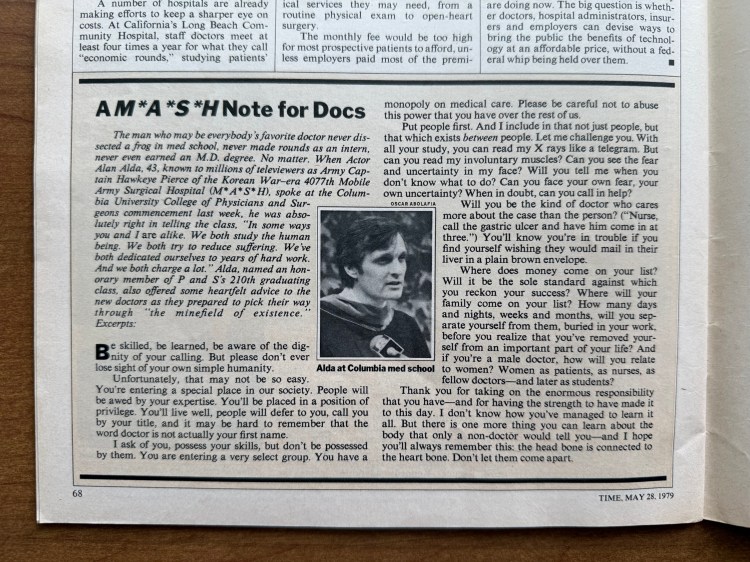

The May 28, 1979 issue of Time magazine features a cover story on the rising costs of medical procedures, a topic that is still relevant today. The issues has several articles about the medical field and the changes it was undergoing. At the end of the articles, there is a small, half page excerpt from a commencement address given by Alan Alda to the graduates of the Columbia University College of Physicians and Surgeons. Under the title “A M*A*S*H Note for Docs,” Time offers a glimpse at the full speech given by Alda, and includes a photo from the day the speech was given (see the full excerpt at the bottom of the post). In the speech, he asks doctors to be empathetic towards patients and to not be life a life that is solely defined by their chosen profession. He advocates for living a full life and being as devoted to their families as they are their patients. I was not aware of the speech Alda gave in 1979 until I purchased a framed copy of an excerpt of Alda’s speech that hung in the office of a doctor who took the words to heart and served his community for decades. That doctor was Robert Martens.
Dr. Robert Martens
Dr. Robert Martens was born and raised in Manitoba, Canada and served in the Canadian Air Force. He received his medical degree from the University of Manitoba, and he and his family moved to Oregon in 1977. There, he established a medical practice that served his community until his retirement. He passed away in July 2023 at the age of 83.

The actors of M*A*S*H have frequently discussed stories they’ve heard from fans about how the show influenced them to seek a particular career. With Dr. Martens, we see an example of a man who took Alda’s words from 1979, hung them on the wall of his medical practice, and used them as a guide for how to treat his patients and lived his life for more than 30 years. Television has been a reflection of our culture since its inception, but there are a few instances where the ideals of what we see on television are applicable to real life. M*A*S*H was about a group of doctors in a situation they hated doing the best they could. M*A*S*H represented the men and women of medical units who served not only in Korea, but in all wars across the world. It also represents the dedication doctors and nurses have for their patients. Alda applied the lessons he learned from M*A*S*H and offered them to real life doctors in a speech that was noteworthy in 1979. His words are just as applicable today. Below, you will see the slightly modified words from Alda that hung on Dr. Martens’ wall, and the except from Time magazine.
Excerpt of the Speech from Dr. Martens
A M*A*S*H Note for Docs
Be skilled, be learned, be aware of the dignity of your calling. But please don’t ever lose sight of your own simple humanity.
You’re entering a special place in our society. People will be awed by your expertise. You’ll be placed in a position of privilege. You’ll live well, people will defer to you, call you by your title, and it may be hard to remember that the word doctor is not actually your first name.
I ask of you, possess your skills, but don’t be possessed by them. You are entering a very select group. You have a monopoly on medical care. Please be careful not to abuse this power that you have over the rest of us.
Put people first. And I include in that not just people, but that which exists between people. Let me challenge you. With all your study, you can read my X rays like a telegram. But can you read my involuntary muscles? Can you see the fear and uncertainty? Tell me when you don’t know what to do. Face your own fear, your own uncertainty. When in doubt, call in help.
Be the kind of doctor who cares more about the person than the case.
Will money be the sole standard against which you reckon your success? Where will your family come on your list? How many days and nights, weeks and months, will you separate yourself from them, buried in your work, before you realize that you’ve removed yourself from an important part of your life? And if you’re a male doctor, how will you relate to women? Women as patients, as nurses, as fellow doctors-and later as students?
Recognize the enormous responsibility that you have-and the strength to have made it to this day. I don’t know how you’ve managed to learn it all. But there is one more thing you can learn about the body that only a non-doctor would tell you-and I hope you’ll always remember this: the head bone is connected to the heart bone. Don’t let them come apart.
Hawkeye Pierce
Alan Alda
Excerpt of the Speech from Time Magazine
Be skilled, be learned, be aware of the dignity of your calling. But please don’t ever lose sight of your own simple humanity.
Unfortunately, that may not be so easy. You’re entering a special place in our society. People will be awed by your expertise. You’ll be placed in a position of privilege. You’ll live well, people will defer to you, call you by your title, and it may be hard to remember that the word doctor is not actually your first name.
I ask of you, possess your skills, but don’t be possessed by them. You are entering a very select group. You have a monopoly on medical care. Please be careful not to abuse this power that you have over the rest of us.
Put people first. And I include in that not just people, but that which exists between people. Let me challenge you. With all your study, you can read my X rays like a telegram. But can you read my involuntary muscles? Can you see the fear and uncertainty in my face? Will you tell me when you don’t know what to do? Can you face your own fear, your own uncertainty? When in doubt, can you call in help?
Will you be the kind of doctor who cares more about the case than the person? (“Nurse, call the gastric ulcer and have him come in at three.”) You’ll know you’re in trouble if you find yourself wishing they would mail in their liver in a plain brown envelope.
Where does money come on your list? Will it be the sole standard against which you reckon your success? Where will your family come on your list? How many days and nights, weeks and months, will you separate yourself from them, buried in your work, before you realize that you’ve removed yourself from an important part of your life? And if you’re a male doctor, how will you relate to women? Women as patients, as nurses, as fellow doctors-and later as students?
Thank you for taking on the enormous responsibility that you have-and for having the strength to have made it to this day. I don’t know how you’ve managed to learn it all. But there is one more thing you can learn about the body that only a non-doctor would tell you-and I hope you’ll always remember this: the head bone is connected to the heart bone. Don’t let them come apart.
 The M*A*S*H Historian
One thought on “M*A*S*Hish 16: 1979 Commencement Address by Alan Alda”