
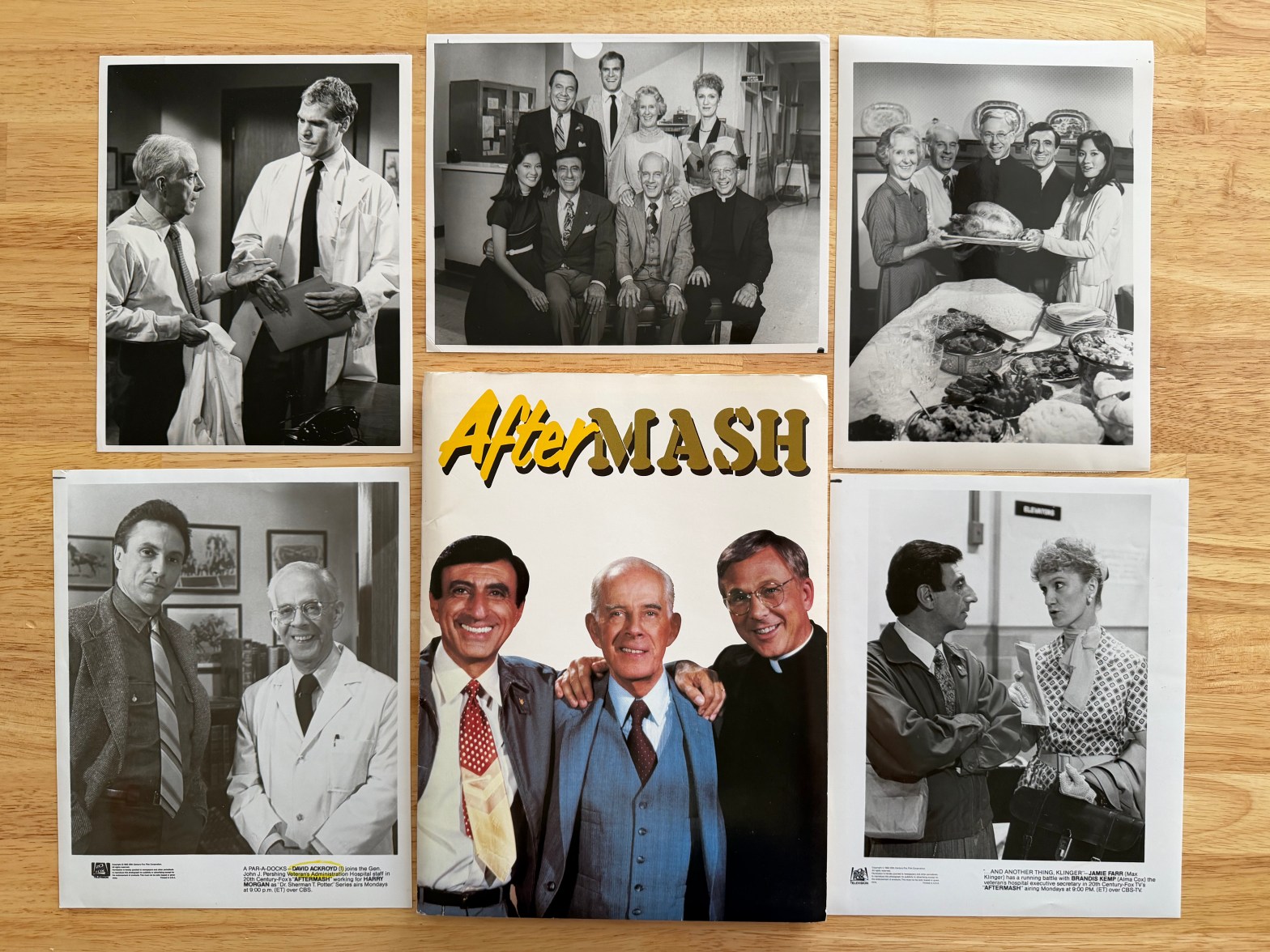
Throughout 2025, I rewatched M*A*S*H and reviewed each season on the final day of the month. You can find an archive of the rewatch posts here.
Earlier this month, I posted a Headlines post about the premiere of AfterMASH, and the initial reaction to the M*A*S*H spin-off. The reviews weren’t positive. I also mentioned that when publications such as Entertainment Weekly rank the worst spin-offs of all time, AfterMASH is consistently on the list. We’ve all seen the lists and jokes about AfterMASH, and that has left me wondering whether all the criticism was fair. Was the series judged too harshly for not living up to the standard of M*A*S*H? After rewatching all of M*A*S*H in 2025, I decided to give AfterMASH a chance. Unfortunately, there are no official ways to watch AfterMASH, and I do not condone unofficial methods, but…After watching all 22 episodes of the first season and the nine episodes of the second season that were released, I would argue that AfterMASH doesn’t deserve all the criticism it gets today. While I am not a fan of decisions that were made for the second season and the way the series handled character changes, AfterMASH had some compelling storylines.
Episode List
Episodes are listed in broadcast order. Hyperlinks direct to script posts for that episode.
| Episode # | Season X Episode | Episode Title |
| 1 | 01×01 | September of ’53 |
| 2 | 01×02 | Together Again |
| 3 | 01×03 | Klinger vs. Klinger |
| 4 | 01×04 | Snap, Crackle, Plop |
| 5 | 01×05 | Staph Inspection |
| 6 | 01×06 | Night Shift |
| 7 | 01×07 | Shall We Dance |
| 8 | 01×08 | Little Broadcast of ’53 |
| 9 | 01×09 | Sunday, Cruddy Sunday |
| 10 | 01×10 | Thanksgiving of ’53 |
| 11 | 01×11 | Fallout |
| 12 | 01×12 | Bladder Day Saints |
| 13 | 01×13 | All About Christmas Eve |
| 14 | 01×14 | Chief of Staff |
| 15 | 01×15 | C.Y.A. |
| 16 | 01×16 | Yours Truly, Max Klinger |
| 17 | 01×17 | It Had to be You |
| 18 | 01×18 | Odds and Ends |
| 19 | 01×19 | Another Saturday Night |
| 20 | 01×20 | Fever Pitch |
| 21 | 01×21 | By the Book |
| 22 | 01×22 | Up and Down Payments |
| 23 | 02×01 | Less Miserables |
| 24 | 02×02 | Calling Doctor Habibi |
| 25 | 02×03 | Strangers and Other Lovers |
| 26 | 02×04 | Trials |
| 27 | 02×05 | Madness to His Method |
| 28 | 02×06 | The Recovery Room |
| 29 | 02×07 | Ward is Hell |
| 30 | 02×08 | Saturday’s Heroes |
| 31 | 02×09 | Wet Feet |
Favorite Episodes
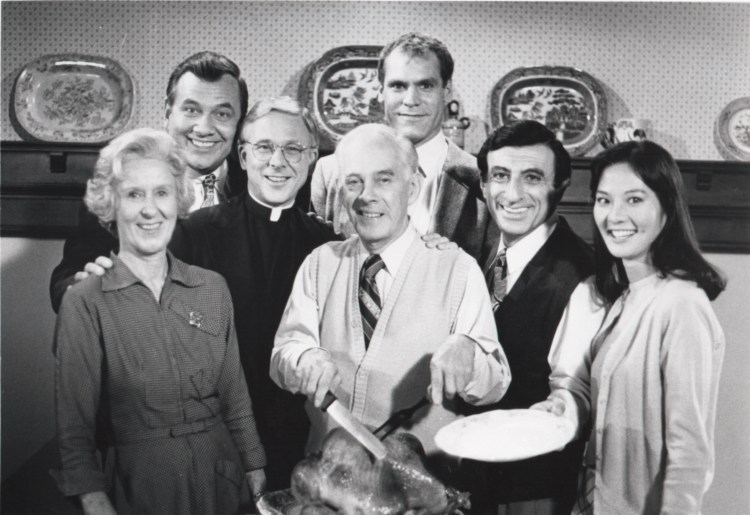
These are the top episodes that I believe contribute something important to the series as a whole. The episodes are listed in the order in which they aired.
- September of ’53 (01×01) & Together Again (01×02) – In the first two episodes, we see what happened to Col. Potter, Klinger and Soon-Lee, and Father Mulcahy after the war. Potter takes a job a local veteran’s hospital. Klinger and Soon-Lee have not had a great time in Toledo, so Potter asks Klinger to join him. Meanwhile, Father Mulcahy has struggled with being a deaf priest. He turns to alcohol, but Col. Potter is able to arrange for him to have corrective surgery for his hearing, and he joins the hospital staff as well. While the first two episodes aren’t overly dramatic or funny, it set a foundation for what could have been.
- Thanksgiving of ’53 (01×10) – It’s Thanksgiving, and everyone gathers at the Potter’s. Klinger is homesick, but he is also upset because of how his family treated Soon-Lee when they first came back from Korea. This is a very good episode of AfterMASH because it leaned in to the ensemble cast, and it addressed the tension between Klinger and his family for having a Korean wife.
- Fallout (01×11) – This is an Emmy nominated episode written by Larry Gelbart. A patient with leukemia is dying because of his exposure to radiation at atomic bomb testing. The Army denies his claims saying that his condition is not combat related because it deemed that radiation wasn’t dangerous. Dr. Pfeiffer fights the VA to cover the patient and his family. This is a true story in that the Army denied that cancer suffered by soldiers at atomic tests were not related to the bomb. This was later proven to be incorrect and the policy was reversed.
- Yours Truly, Max Klinger (01×16) – The “Dear home…” episodes of M*A*S*H were always great because they are a great narrative device. Klinger writes to Radar telling him about life in Missouri, Soon-Lee’s pregnancy, and working at a VA hospital. We find out that Radar is getting married, which sets up the next episode.
- It Had to be You (01×17) – The episode where Radar comes back! We find out that Radar is supposed to get married, but he runs away from his wedding when he thinks one of his buddies slept with the future Mrs. O’Reilly. He runs to Potter’s house, and they talk him in to talking to Sandy. To some extent, Radar acts like the Radar we all loved from M*A*S*H, and that is one of the redeeming qualities of this episode. This episode was likely a set up for the failed W*A*L*T*E*R spin-off series, which had a rough pilot.
- Ward is Hell (02×07) – There is not much to like about season two of AfterMASH, but I believe some of the characters in season two were pretty good. Dr. Boyer and the psychiatrist, Dr. Dudziak were great additions, and they played well with Potter, Klinger, and Mulcahy. Unfortunately, the new central cast was assembled too late to save the series.
- Wet Feet (02×09) – This is the best episode of season two because we see a focus on the hospital being a hospital. In season two, AfterMASH stopped focusing on patients and focused more on the drama of the doctors and nurses. But retunring the focus of the show to all things medical, we see how Klinger, Potter, Boyer, and the young Dr. Caldwell work well together in a disaster.
Least Favorite Episodes
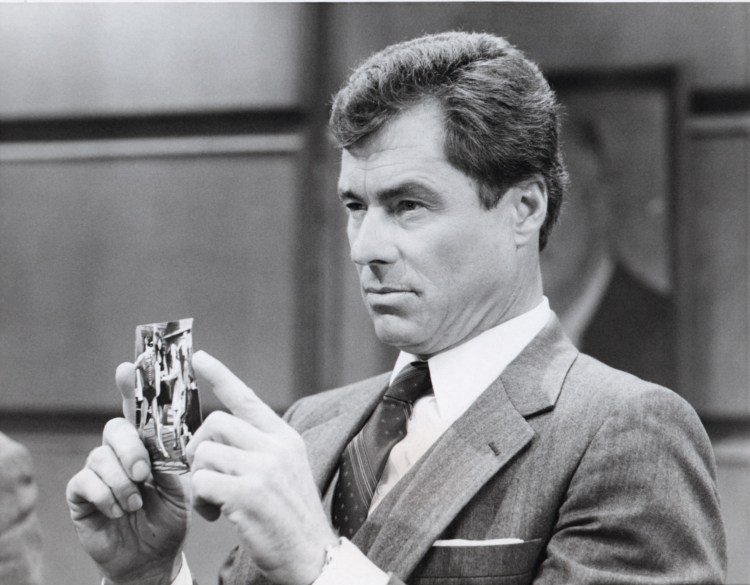
Liking or disliking an episode is subjective, so I have tried to be fair in my criticism of why certain episodes are not my favorites. The episodes are listed in the order in which they aired.
- Yours Truly, Max Klinger (01×16) – This episode was listed in the best episodes, but it makes the “least favorite” for one simple reason: this is the last appearance of Dr. Pfeiffer. When M*A*S*H changed characters, the character change was directly addressed. Trapper left, and it was addressed in “Welcome to Korea.” Same for Frank Burns. But Dr. Pfeiffer just disappeared without an explanation. It is not very M*A*S*H like, and it is a shame because Dr. Pfeiffer wasn’t a bad character. Dr. Boyer offered interesting storylines since he was a wounded veteran himself, but Potter mentoring Dr. Pfeiffer was also a compelling storyline.
- Less Miserables (02×01) – The whole premise of Klinger breaking out of jail and pretending to be crazy to get out of criminal charges that we know he is guilty of is disrespectful of Klinger’s character. All of season two focuses on this, and I am afraid that the writers put themselves in a similar corner as had been done to Frank Burns.
- Trials (02×04) – The trail is when Klinger being crazy becomes “official.” He is sentenced to the psych ward of the VA hospital. This, as Soon-Lee and several other people point out to him, is going to be very hard to undo. Once he is branded “crazy,” that is permanent. It set Klinger (along with his wife and son) up for an unhappy future, and it put the writers in an impossible position since we all know he was guilty of the crime he was accused of. Also, the appearance of Col. Flagg was over the top.
- Madness to His Method (02×05) – I really like the “Dear” episodes, and Potter writing to Dr. Sidney Freedman is a good idea. But Klinger is trying too hard to prove he is crazy, including being back in dresses. This is the fifth episode of season two, and they are still playing this storyline out, and it dragged on for too long.
Continuity Errors
There are minor issues in every episode that have been well documented, so I am choosing to focus on ones that really stand out to me.
- Together Again (01×02) – Col. Potter mentions that the 4077th moved 23 times when he was in command. Since he joined in September 1952, this is pretty unlikely since the war a stalemate by then.
- Little Broadcast of ’53 (01×08) – Klinger’s radio show over the PA system is introduced, but we never hear it again.
- Sunday, Cruddy Sunday (01×09) – In a previous episode, they say that no one under the age of 16 is allowed to visit patients at the hospital. But they show several kids in the ward on visitors’ day.
- Thanksgiving of ’53 (01×10) – We meet Potter’s daughter, and we see his son-in-law again. Not only is it a different actor, but his name is Bruce. His name was Bob when he visited the 4077th in M*A*S*H!
- Bladder Day Saints (01×12) – Klinger talks to a buddy about the football games they used to play in Korea, but we never see the 4077th play football in the series.
- Trials (02×04) – Col. Flagg is introduced as “Col. M. Flagg,” but we know that in M*A*S*H, his first name was Sam.
AfterMASH Wrap-Up
Often in the list of the worst television spin-offs of all time, there is a related list of the best spin-offs. Consistently Near the top of that list is Frasier. As a spin-off of Cheers, Frasier took a character from the Boston bar and put him in Seattle. We met a new supporting cast, and there were new storylines to explore. From this perspective, it doesn’t sound all that different from what Larry Gelbart and Burt Metcalfe attempted to do with AfterMASH. They took a few main characters out of a MASH unit in the Korean War and put them in a Veterans’ hospital in Missouri. Instead of dealing with the war, Col. Potter, Klinger, and Father Mulcahy would have to deal with the aftermath of wars. In some ways, the premise of AfterMASH doesn’t seem that far off from that of Frasier, so what went wrong with the execution? Throughout its eleven year run, M*A*S*H jumped genres from a sit-com to a drama, and had AfterMASH continued as a drama that focused on the patients, it might have succeeded.
The first twenty episodes of AfterMASH offer the strongest case for why the show might have succeeded. The show runners were coming off M*A*S*H‘s record breaking finale. They jumped in and showed the struggles Klinger had coming back to the United States. He struggled to find work, find a place to live, and he was surprised to find the negative attitude towards his new wife, Soon-Lee. Col. Potter returned and was bored. He retired, but he wasn’t ready to retire. And Father Mulcahy turned to drinking after losing his hearing. The three of them reunite at a veterans hospital in Missouri. Potter is chief of staff, Klinger is Potter’s clerk, and Mulcahy is a priest at the hospital. Each episode focused on the difficulties of working within the Veterans Administration and the patients in the hospital. From the outset, this doesn’t sound all that different from M*A*S*H. And at first, it wasn’t. The focus on the patients in the hospital as seen through the eyes of the veteran Dr. Potter and a new doctor named Dr. Pfeiffer. Pfeiffer learns the ropes from Potter, and it worked well. AfterMASH debuted in first place, but then the ratings quickly slipped because fans realized that AfterMASH was not M*A*S*H.
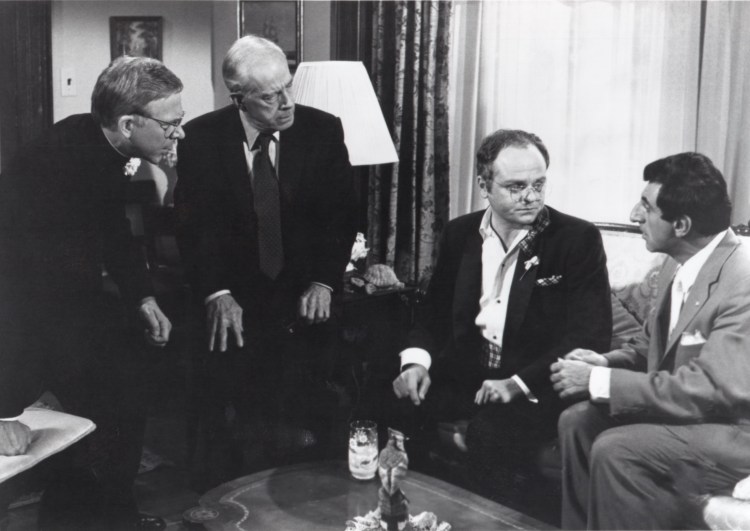
I will argue that the first twenty episodes of AfterMASH were a solid start. Dr. Pfeiffer learns that the world isn’t as clear cut as he thought. Potter learns that being in command at a VA hospital is not the same as a MASH unit. Klinger and Soon-Lee struggle with married life. And all of this happens as patients in the VA hospital come and go. This sounds like a typical medical drama such as Trapper John, M.D. or a more modern show such as ER. However, as AfterMASH‘s ratings slipped, changes were made to the series. The first change occurred after the sixteenth episode of the first season. Dr. Pfeiffer was gone with no fanfare, and a new doctor took his place. Dr. Boyer was a veteran who was injured in Korea, and he had a big chip on his shoulder. Boyer is an interesting character, but I have an issue with how the character change took place. M*A*S*H had several cast changes, and they were handled with grace and dignity for the character. In this case, Dr. Pfeiffer was there one episode, and gone the next. There is no explanation, and he was never mentioned again. The humanity that M*A*S*H brought to character changes was completely stripped away.
Unfortunately, the changes continued. Late in season one, they brought back Radar in an attempt to increase ratings and launch another spin-off series, W*A*L*T*E*R. It was too late. Mildred Potter became a punch line instead of a person by the end of the first season. Then, in season two, the actress was changed to better match the “dumbed down” Mildred. There were other character changes in the second season that didn’t do the series any favors, but by far the worst change was made to Klinger. In the final episode of season one, he and Soon-Lee attempt to buy a house. They’re conned by the salesman, so Klinger takes matters into his own hands by assaulting the salesman. Instead of owning up to his mistake (and crime), the second season of AfterMASH focuses on Klinger’s trial and him being declared insane. He is put in the VA hospital’s psych ward, and he is occasionally back in dresses. Seeing Klinger in a dress at the 4077th to get out of a war zone is understandable to some degree, but seeing him wear a dress to get out of being convicted for a crime we know he committed…that is an insult to Max Klinger. The focus of the second season of AfterMASH was in the wrong place. The focus on the patients was gone, and the series became what the show runners of M*A*S*H never wanted it to become.

So what went wrong with AfterMASH? The first issue was time. M*A*S*H was not popular in its first season, and it wasn’t discovered by the audience until reruns. Had AfterMASH continued with episodes like “Fallout,” which were focuses on the patients and their struggles, the show might have bounced back in the off season. Instead, the quick drop in ratings led to desperate changes that went against the ethos of M*A*S*H. Which leads to the second issue. M*A*S*H itself. AfterMASH was put in an impossible situation to live up to the hype of the show from which it came. Did it open atop the ratings? Yes. Did it drop after the first few episodes? Yes, but it was still solidly in the top 20 for most of its first season. That is more than can be said for M*A*S*H in its first season. The series wasn’t given a fair chance. Had AfterMASH continued the vein of another M*A*S*H spin-off, Trapper John, M.D., and focused on serious topics such as the patients, racism against Soon-Lee, sexism, and the use of veterans as a prop, the show might have found a receptive audience. Instead, AfterMASH was struggled by having M*A*S*H in its name and then was tarnished by constantly changing characters and character attributes. It was never going to live up to the standard M*A*S*H set because of the setting in the Korean War, but AfterMASH did have a story to tell.
In 2026, it is easy to look back and point out the issues and inconsistencies with AfterMASH and come up with imaginary solutions. Instead, I want to come to a conclusion about AfterMASH as it exists. As I write this post, nearly a week after finishing my rewatch of the series, I still struggle to come up with my true feelings. There are some great episodes in season one. “Fallout” stands out, and was even nominated for an Emmy award. For me, the first 20 episodes of the series are good and worth watching. After that, however, the characters begin to morph into something that most M*A*S*H fans won’t recognize. If the show had continued to develop along the path of the first 20 episodes, AfterMASH might be remembered differently today. The series might have still been cancelled after the first season or early in its second season, but the show would have stuck to its ethos. Instead of AfterMASH appearing on a list of “worst spin-offs,” it could have been on a list of “underrated spin-offs.” But the pressure of living up to the M*A*S*H name was too great.
 The M*A*S*H Historian