
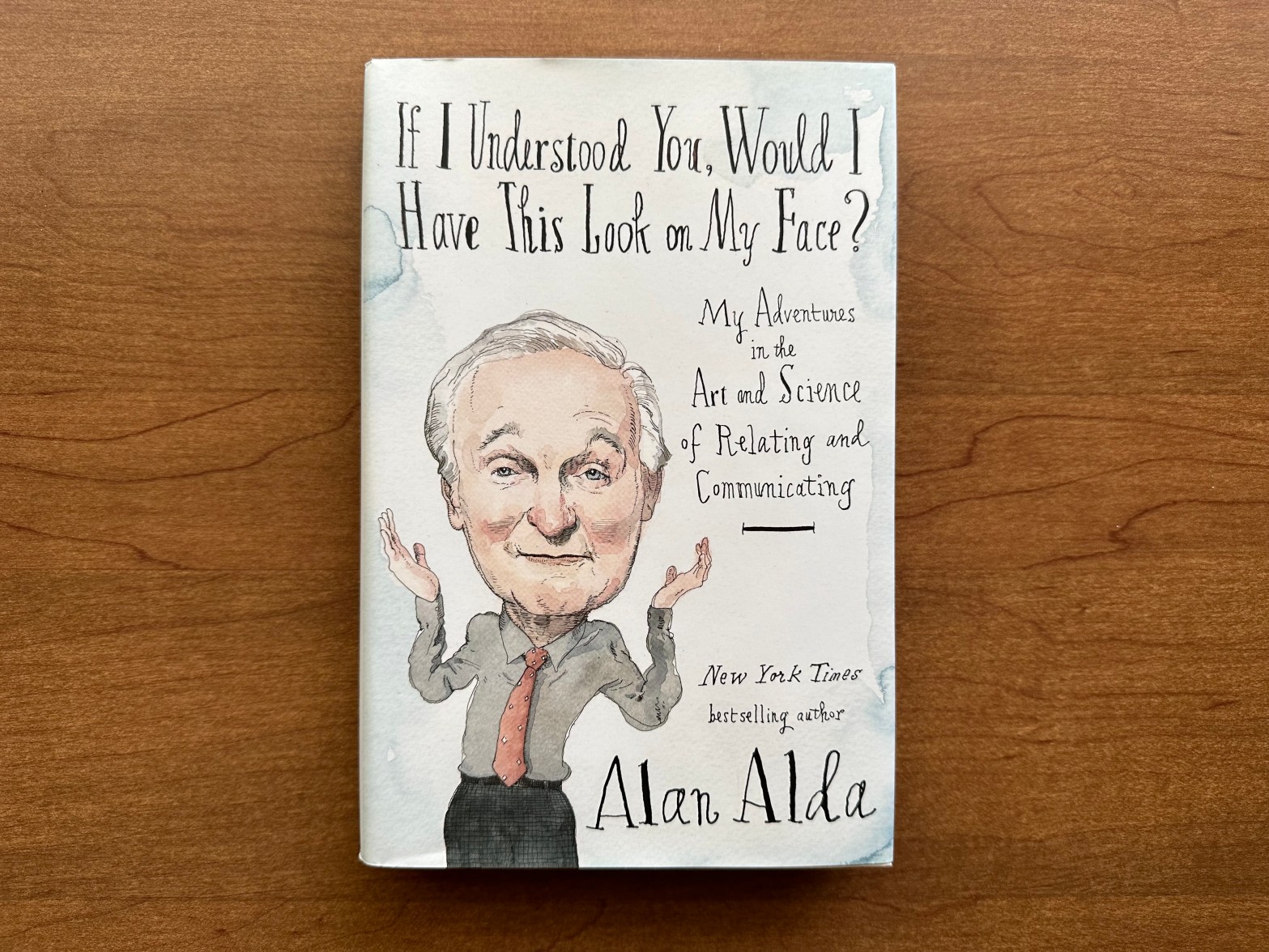
What is it?
Alda, Alan. If I Understood You, Would I Have This Look on My Face?: My Adventures in the Art and Science of Relating and Communicating. New York: Random House, 2017.
Why should M*A*S*H fans care?
Alan Alda was one of the creative forces behind M*A*S*H, and his work after the series ventured into the realm of science and communication. While this book is not about M*A*S*H, it does offer some insights into Alda’s career after 1983 and his current focus.
As a M*A*S*H fan, what part(s) should I read?
In this book, Alda does discuss M*A*S*H briefly and how the cast related behind the scenes. It is only a few pages, but he wrote more about M*A*S*H in his book The Last Days of M*A*S*H.
TL;DR Review
Alda’s most recent book takes a completely different tone from his first two memoirs. While those were focused on his life and lessons learned, If I Understood You, Would I Have This Look on My Face? takes a deeper dive into relating and communicating, since that has been Alda’s focus for more than a decade. In his typical fashion, Alda offers important lessons in relating, communicating, and listening while being witty and thoughtful.
Full Review


A decade after his second memoir, Alan Alda published If I Understood You, Would I Have This Look on My Face?: My Adventures in the Art and Science of Relating and Communicating, a book that takes the lessons he learned in his career and on PBS’s Scientific American Frontiers and offers suggestions for communication. While his first two books (Never Have Your Dog Stuffed and Other Things I’ve Learned and Things I Overheard while Talking to Myself) were memoirs, Alda offers lessons on how to better communicate, relate, and listen to others. Using lessons he learned from improv, he offers a framework that ensures that we are fully connected and listening before responding, something most humans have a hard time doing. Alda learned while hosting the PBS series that some scientists had a hard time communicating their findings to a general audience, and as a patient, he realized that doctors struggle to relate to their patients. Alda offers solutions for both, and he founded a non-profit center that helps scientists and doctors better relate to the general public.
Over eleven seasons of hosting Scientific American Frontiers, Alda regularly interviewed scientists, doctors, and professionals who were experts in their field. He was interested in the topics himself, but it was his job as host to ensure that the person he was speaking to presented their research and/or information in a way that was digestible by the public. In addition, Alda had learned through personal experience with doctors that their ability to relate to their patients was often lacking. This led him to become more interested in the art of relating to people and communication. Using tools he learned in improvisation, Alda founded the Alda Center for Communicating Science at Stony Brook University in 2009. In publishing this book eight years after the founding of the center, he discusses what he learned and the techniques that help people better relate and communicate.

There are a number of pointers that Alda provides throughout the book. One of the things he quickly learned hosting Scientific American Frontiers is that explaining a topic is done better when jargon is avoided. For scientists, it’s far easier to explain a concept using common terms instead of using jargon that would only be understood by someone in the same field. This is also true for doctors. Explaining a diagnosis goes far better when the doctor speaks plainly and empathizes with the patient. That is another key take away: the ability to empathize with others. Doctors have a difficult job. Telling a patient that they have cancer, for example, is not an easy task. Some doctors distance themselves from it by being less personal, but Alda argues that is the opposite of what a patient needs in that moment. The patient is learning something upsetting, and when that information is delivered in a sterile and overly technical way, it can come across as confusing and uncaring.
One of the key takeaways I took from the book is the importance of listening. In the scenario with the doctor above, the doctor should ask whether the patient has questions, then listen to what they have to say. Listening goes beyond the spoken word, however. We should pay attention to the other person’s body language and facial expressions. That’s where the improv technique of “yes, and…” comes into play. In the exercise, two or more people make up a scene by building on what each other acts out. If one person is not paying attention, they will throw off the entire scene. When you are truly listening to the other person, you should not be formulating the next thing you are going to say as the other person is speaking, but wait until they are finished. Alda used this skill as an interviewer, and he has been able to use the Alda Center for Communicating Science to help doctors, nurses, and scientists relate better to the people they work with on a daily basis.
Of course, there are a few references to M*A*S*H in the book. Alda discusses how the cast of the series didn’t retreat to their dressing rooms between takes. Instead, they sat together and talked, laughed, and related. It was that togetherness behind-the-scene that, Alda argues, translated into the show. Today, Alda continues to interview people on his podcast Clear+Vivid. He bills the conversations as being about “connecting and communicating,” and he regularly interviews scientists, authors, actors, activists, and many others using the same skills he advocates for in this book. If I Understood You, Would I have this Look on My Face is filled with lessons that Alda learned and that everyone can apply to the personal and professional relationships in their lives. As always, he writes in a humors and charming way that proves why Alda himself has become a master communicator. The book is still in print and can be purchased on Amazon, Barnes & Noble, or other booksellers. You can also pick up pre-owned copies, in hardback or paperback, online.
 The M*A*S*H Historian
3 thoughts on “From the M*A*S*H Library 34: “If I Understood You, Would I Have This Look on My Face?””