
What is it?
Javna, John. The TV Theme Song Sing-Along Song Book: Volume 2. New York: St. Martin’s Press, 1985.
Why should M*A*S*H fans care?
The M*A*S*H theme song, “Suicide is Painless,” is never played with its lyrics throughout the show’s eleven year run. This is a great way to get both the words and sheet music for the series’ theme (as well as the themes for dozens of other popular shows).
As a M*A*S*H fan, what part(s) should I read?
I highly recommend reading through all the facts about the shows and reviewing the words to the well known theme songs, but if you only want to read about M*A*S*H and “Suicide is Painless,” it is on pages 23 – 25.
TL;DR Review
For fans of television shows from the 1950s into the early 1980s, this book will bring back many happy memories. This wasn’t just the golden age of television, it was also the height of the television theme song. Whether it was a sit-com or classic western, each show’s theme tune alerted the viewer to what was about to air. In this book, a collection of classic television theme songs are presented with full sheet music and information about each show. It is a great way for fans of classic television to revisit their favorite shows, learn more about the theme song, and “sing along.”
Full Review


How many times have you heard a song and wondered what’s its lyrics are? Or have you ever read lyrics to a song only to realize realized that you’ve been singing it wrong for years? Sheet music and books of music are a great way for fans to connect to the music that shaped their lives. For television, especially television shows from the 1950s and into the 1980s, the theme songs were well written and bring back a wave of nostalgia. Each show’s theme either told a story or introduced the show in a unique way. This is certainly the case for M*A*S*H as the helicopters, loaded with wounded, are visible against the mountains. On the ground, the doctors and nurses rush to their stations. As “Suicide is Painless” plays, we see the 4077th unload the helicopter and bring the wounded to the hospital. John Javna’s book, The TV Theme Song Sing-Along Song Book: Volume 2, presents a collection of popular theme songs with some facts about each show, sheet music, and each song’s lyrics. This was unique for M*A*S*H since the lyrics to “Suicide is Painless” were never played during the eleven years the show ran.
The theme song of a television would often get stuck in someone’s head, and that was part of the marketing goal. The theme song was a way to captivate the audience. Collecting classic TV theme songs into a book is a great idea, and Javna’s book, The TV Theme Song Sing-Along Song Book: Volume 2, has the shows categorized by theme in the table of contents. This is volume two of a set of theme song “sing along” books written by Javna, and it includes the music for classic sit-coms such as Cheers, I Dream of Jeanie, and Gilligan’s Island. There are also theme songs for westerns such as Rawhide and The Lawman. Other theme songs included are for The Carol Burnett Show, The Jetsons, The Flintstones, Zorro, and even some commercials. I would be surprised if none of those theme songs started playing in your mind as you read the names! It is fitting that this book is branded as a “sing along” because it is impossible to not sing (or whistle) some of these songs!
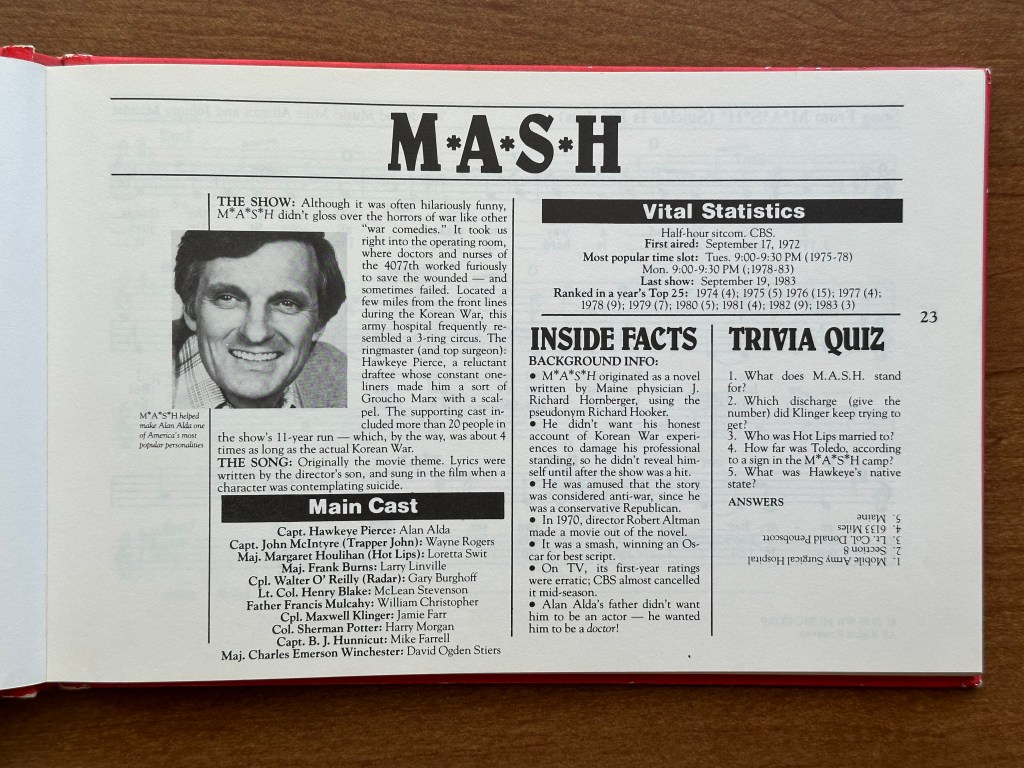

Since this is The M*A*S*H Historian, I am sure you guessed that M*A*S*H is included in this volume of the book. For M*A*S*H, Javna gives a brief overview of the series, provides a list of the cast, and includes some fun facts (see if you can spot the error he made under “Vital Statistics”). He also outlines the most popular time slots for M*A*S*H on CBS, and includes some information about the show’s ratings. There are five trivia questions that are fun as well (see the photo above to try your luck)! He briefly discusses the origins of the song “Suicide is Painless.” As I wrote in 2022, the theme song was written by Robert Altman’s son, and the music was composed by Johnny Mandel. It played a role in the original M*A*S*H movie, but only the instrumental version played on the eleven seasons of M*A*S*H. The series made the song popular, but since the lyrics never aired on CBS, many people were surprised to learn it had lyrics, let alone the dark topic the song is about. Javna’s book includes the sheet music along with the lyrics to all the verses, so if you’ve ever wanted to know the full lyrics to “Suicide is Painless,” this is a great book to have.
Fans of television often cite the theme songs as one of their favorite parts of a show. There are some classic themes such as the ones from The Andy Griffith Show, Gilligan’s Island, Cheers, Growing Pains, of course, M*A*S*H. Javna’s book is great for those nostalgic for classic TV theme songs, something that has largely gone away today. Theme songs aren’t as important to television producers and executives, so they are not the same. The 30 – 60 seconds taken up by a theme song can be better used for advertising purposes. While I understand the economics of television in 2024, it is sad to see the theme song virtually disappear for shows that are not on a streaming platform. For those who also miss theme songs, and want to relive some fan favorites, you can pick up this volume, as well as volume one, of television theme songs and add it to your collection. While it is no longer in print, there are pre-owned copies available second hand. I think it is a worthy addition to a M*A*S*H and/or television library.
 The M*A*S*H Historian