
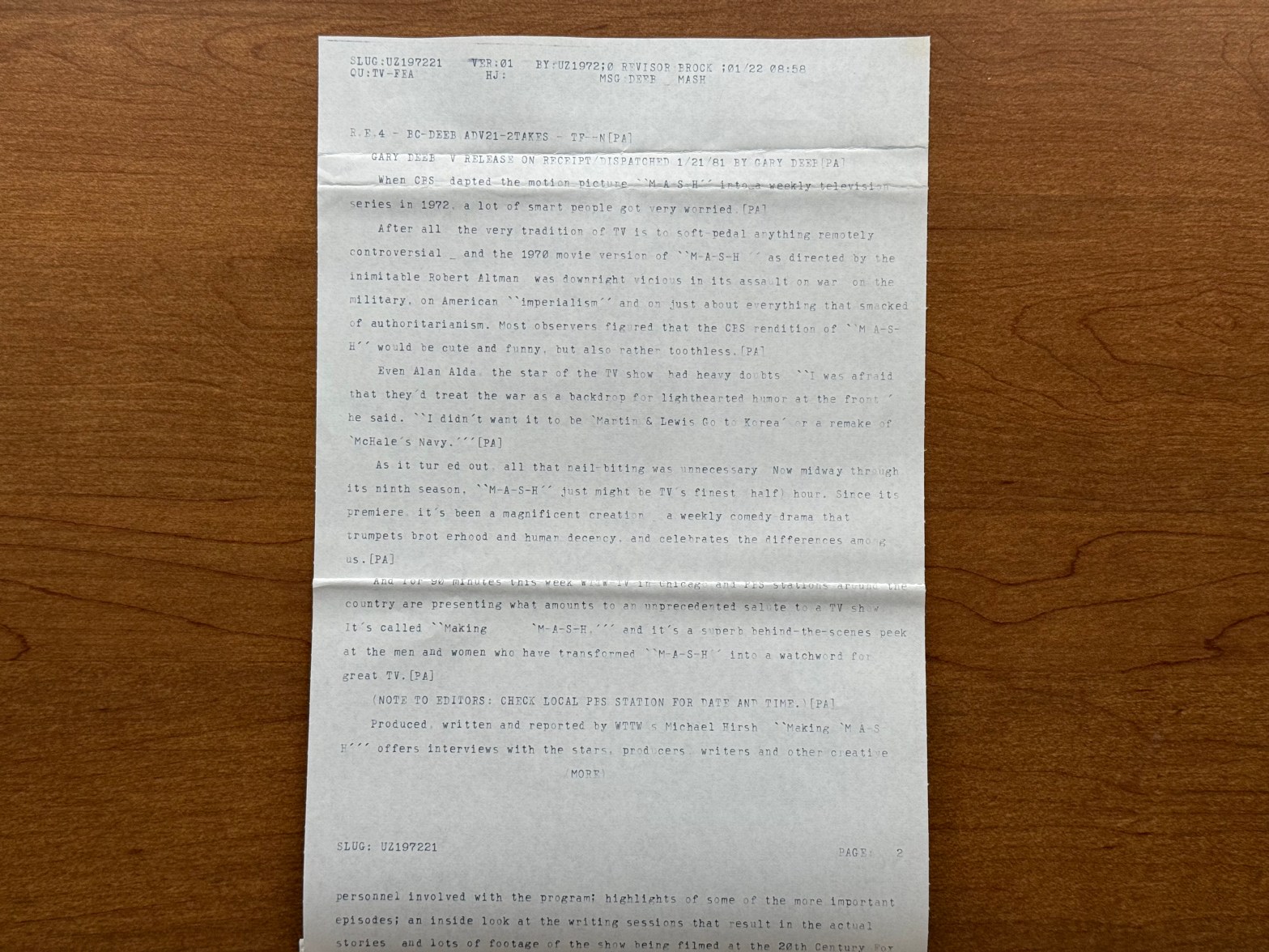
In January 1981, PBS aired a 90-minute documentary called Making M*A*S*H. Filmmaker Michael Hirsh followed the production of M*A*S*H, talked to cast members, and offered a behind the scenes look at how the series was produced (in 2022, I wrote about a press release announcing the documentary). The documentary was successful, but this post is not about the documentary. Instead, it is about a review of the documentary written by columnist Gary Deeb. Deeb was a Chicago area syndicated columnist who reviewed television and wrote a column that appeared in newspapers across the country. He started out at the Chicago Tribune and later worked of the Chicago Sun-Times, and he had a reputation for being a fierce critic. For Making M*A*S*H, and in this case, M*A*S*H in general, he had nothing but kind things to say (although he does admit that seasons eight and nine of M*A*S*H had not been as good as seasons one through seven).
Since Deeb’s column was syndicated, his column was transmitted to the various newspapers across the country. The article would arrive like the one in this post with informational headers, page numbers, and formatted text. It would then be prepared to appear in the newspaper, and in this case, it was to be printed in a newspaper in Houston, Texas. This column appeared the day after Making M*A*S*H aired, and it offered much more than just a review of the documentary. Deeb offers a brief history of M*A*S*H. How it came to be on television, and the concerns of Alan Alda that M*A*S*H would “treat the war as a backdrop for lighthearted humor at the front.” Deeb has high praise saying, “M*A*S*H just might be TV’s finest half hour. Since its premiere, it’s been a magnificent creation; a weekly comedy-drama that trumpets brotherhood and human decency, and celebrates that differences among us.” I believe this gets at the heart of M*A*S*H, and it is one of the primary reasons the series is still relevant today.
Deeb quotes Hirsh and discusses the documentary, which he believed ran a little long (I disagree as I could easily watche two hours of behind the scenes film from M*A*S*H!). Proper credit is given to Larry Gelbart and Gene Reynolds for creating the series, and developing the tone that M*A*S*H is known for. Deeb also discussed the cast changes up to that point (this article is from season nine), particularly the death of Col. Henry Blake. He acknowledged the controversy Blake’s death stirred up in 1975, and while he does not give his opinion on Blake’s death, he doesn’t seem to have been offended by it.
Deeb praised the series for allowing characters to grow, especially Margaret. He points out that female writers brought on to M*A*S*H helped develop her character. He also has kind things to say about Harry Morgan, Jamies Farr, Gary Burghoff, and David Ogden Stiers. Interestingly, Deeb spends a paragraph on Larry Linville. He points out that Frank Burns was the one character that never developed beyond the pilot episode. Deeb quoted Linville saying, “To a very large degree, my character was a technical contrivance. Frank Burns was never allowed to grow. If he suddenly became liberalized or humanized or acquired a genuine sense of humor, the character would dissolve and change into what is no longer a technical comedic contrivance.” This is a very astute point because it would be hard to imagine Frank, Hawkeye, and B.J. being friends in the series, and Frank was not as good as an adversary as Winchester. In his final season, Frank Burns felt out of place. Margaret was allowed to grow and was engaged, and it seemed like the battle became two against one (B.J. & Hawkeye vs. Frank) instead of two against two (B.J. & Hawkeye vs. Frank & Margaret). It was unbalanced.
Deeb’s syndicated column appeared in newspapers across the country at a time when fans of television relied on their local newspapers for TV listings and reviews of what was on television. It is hard to imagine a time when you had to wait for your daily newspaper (or the weekly TV guide) to find out what was on television each day. That was the reality of the 1970s and 1980s. Newspapers and print magazines were the top source of news because this was before the height of cable television. The press was the means for networks and celebrities to communicate to its audience, which is in stark contrast to today’s world of direct contact with celebrities and show runners on social media. The syndicated column is largely a relic, but it is a very nostalgic reminder of the days of “must see TV.” When everyone watched the same shows and talked about them the next day at school or work. Ironically it is reruns of shows like M*A*S*H that spark many of those conversations today.


What a cool find! That was a fascinating read. Thank you so much for sharing.
LikeLiked by 1 person