
The M*A*S*H collection consists primarily of objects related to the original movie, series, and its spin-offs. There are scripts, press materials, licensed products, promotional items, and more. Because of the show, I developed an interest in MASH units and their use in Korea. M*A*S*H is a pretty accurate portrayal of MASH units, battalion aid stations, and the treatment wounded soldiers received in Korea. There are other military themes that run throughout the series that caught my interest. In the episodes “The Army-Navy Game” (01×20) and “There is Nothing Like a Nurse” (03×10), we see the use of propaganda leaflets by both the United States and North Korea. The use of propaganda in war is a long tradition that predates the United States. Propaganda, such as posters calling on the public to support the troops, can be used to encourage the public. However, propaganda can also be used to demoralize the enemy, and that is what we see in both instances in M*A*S*H. This practice was used in Korea, o when I was able to acquire two original propaganda leaflets used by the United States in the Korean War, I was anxious to learn more. These are not props from the show, but they are real propaganda flyers created by the United States government to drop over enemy lines.
June 15, 1952
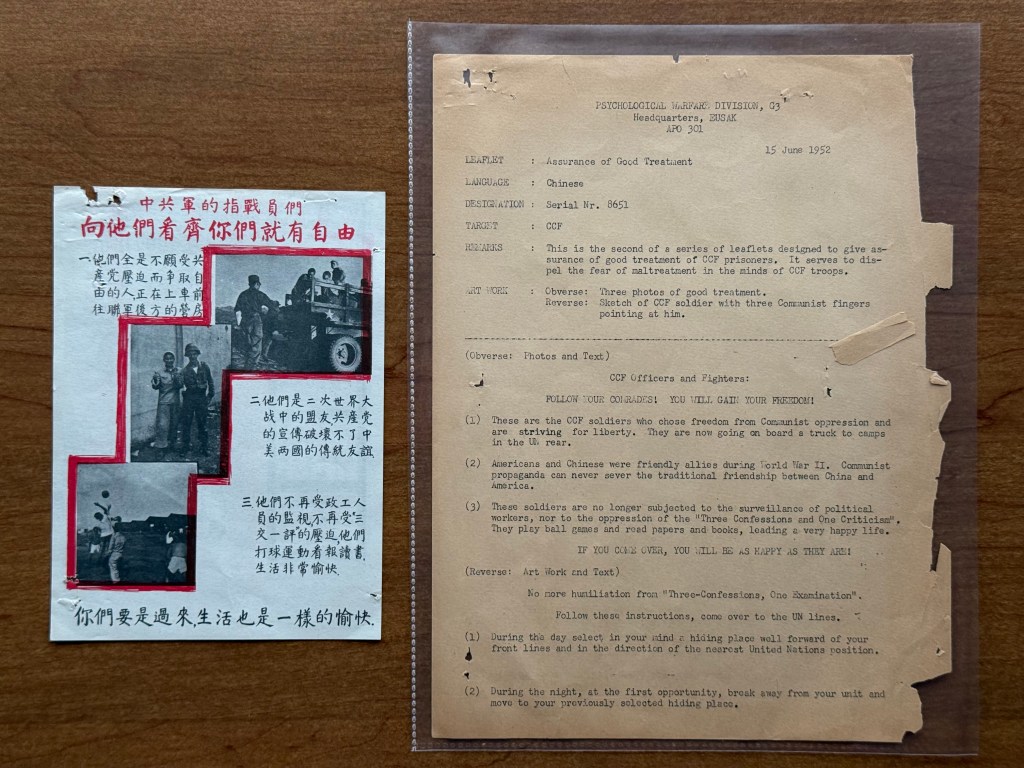
The first leaflet was generated by the Psychological Warfare Division of G3 on June 15, 1952. It shows photos of Chinese soldiers who previously surrendered receiving good treatment from the United Nations forces. The Chinese were told that they would be treated poorly if captured, so the UN forces wanted to reassure them that they would be treated well, if not better than they were in their current conditions. The leaflet was titled “Assurance of Good Treatment,” and G3 summarized that the leaflet was “designed to give assurance of good treatment of CCF [Chinese Communist Forces] prisoners. It serves to dispel the fear of maltreatment in the minds of CCF troops.” This is an instance where UN propaganda was being used to refute the propaganda fed to Chinese soldiers during the war.
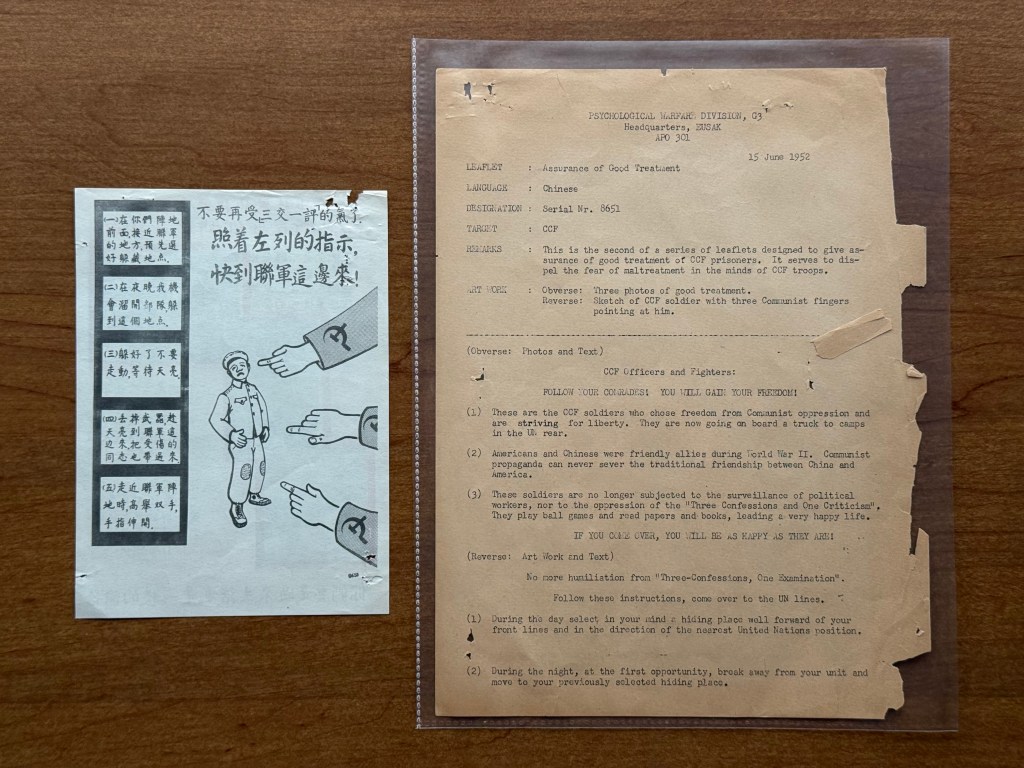
Along with the images on the front and back of the leaflet, there were instructions in Chinese script. On the first side, the leaflet discusses the fact that the United States and China were allies during World War II, and that communist propaganda cannot sever that relationship. The leaflet says that the people of the United States separates the Chinese people from the Chinese communist government, and they assured the Chinese soldiers that they could also enjoy the same freedoms as Americans including playing games, reading books, and leading a happy life without surveillance. The other side of the leaflet provided step-by-step instructions on how a Chinese soldier could desert their unit and surrender to the UN forces. The steps included:
- Locate a hiding place in the direction of the UN front lines
- Break away from their unit at night and go to that hiding place
- Stay hidden until the following morning
- Dispose of all weapons, bring any wounded comrades, and head toward the UN lines
- Keep your arms over your head with fingers widespread
The instructions on how to surrender are what I find to be most interesting. The Chinese joined the war in late 1950, so they had been fighting for nearly as long as the North Koreans, South Koreans, and United Nations forces. The war was a stalemate by this point, and they hoped this would encourage some Chinese soldiers to defect.
February 2, 1953

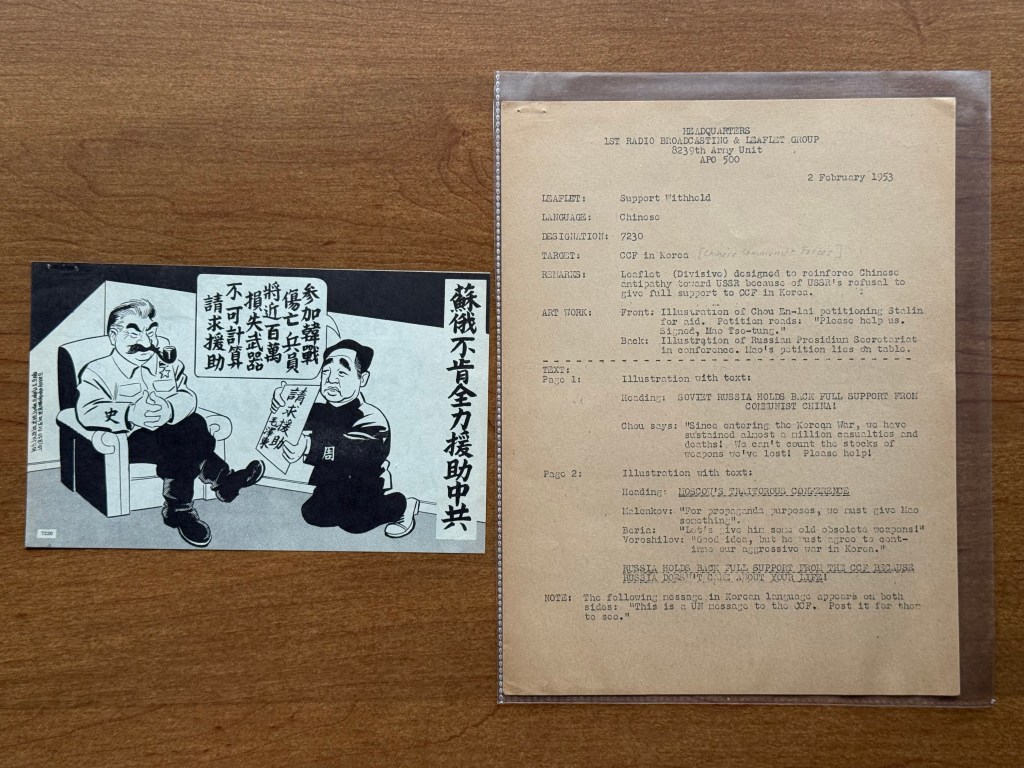
The second propaganda leaflet was created by the 1st Radio Broadcasting and Leaflet Group of the 8239th Army Unit on February 3, 1953. This was late in the war, and there had been signs of tension between China and the Soviet Union. The United States took advantage of that in this leaflet titled, “Support Withhold.” The goal of the leaflet was to “reinforce Chinese antipathy toward USSR because of USSR’s refusal to give full support to CCF in Korea.” As I discussed in my post for the 70th Anniversary of the End of the Korean War, the Soviet Union withdrew its support of Chinese forces in Korea following the death of Joseph Stalin on March 5, 1953. This leaflet was created about a month before his death, but there was already concern in the Soviet Union because the Korean War had become a stalemate.
On one side, the leaflet portrays the Chinese Foreign Minister begging Stalin for continued support while the other side shows Stalin and his cabinet discussing plans to provide China with “obsolete weapons” and to pull back their support. The large text on the front of the leaflet shouts, “Soviet Russia holds back full support from Communist China!” And the other side took it a step further by proclaiming, “Russia holds back full support from the CCF because Russia doesn’t care about your life!” Unlike the other leaflet which encouraged the Chinese to surrender to UN forces, this leaflet is delivering news that the Chinese soldiers would not have heard otherwise. Propaganda certainly goes both ways, so the Chinese leaders would have been feeding the soldiers their own propaganda, but if these leaflets planted a few seeds of doubt, it could have an effect on morale.


When Hawkeye and Trapper are unable to defuse the bomb in “The Army-Navy Game” and it explodes with leaflets, it gets a big laugh from the…laugh track. And again when 5 O’clock Charlie drops propaganda leaflets in “There is Nothing Like a Nurse,” there is a big laugh. But propaganda is a big part of war. Whether it was leaflets, radio shows, television shows, etc., there were units within the United States military tasked with creating propaganda. What I find most interesting about these two leaflets is that they are so different. The leaflet from 1952 encouraged Chinese soldiers to surrender and reassures them that they will be treated well, if not treated better than they were by their own commanders. The step-by-step instructions on how to surrender is probably not what most people have in mind when they think of propaganda. However, the leaflet from 1953 is exactly what most people would think of as propaganda. The exaggerated caricatures of political leaders with kernels of truth that were designed to make the enemy question what they were being told and lower their morale. Sadly, I don’t have any evidence as to whether either of these leaflets were ever used, but they are interesting piece of Korean War history.
 The M*A*S*H Historian
One thought on “M*A*S*H-ish 14: Korean War Propaganda Leaflets”