What is it?
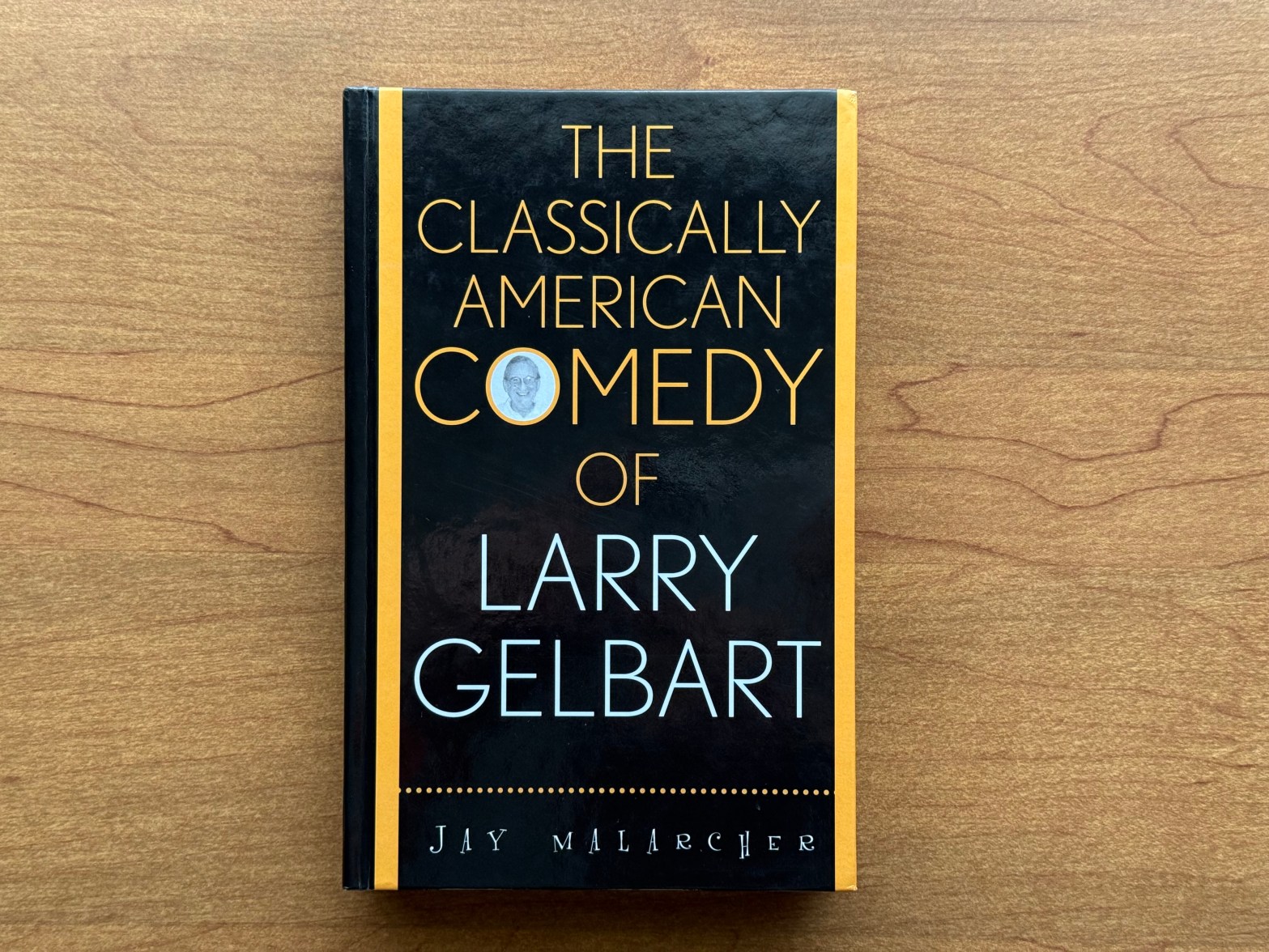
Malarcher, Jay. The Classically American Comedy of Larry Gelbart. Lanham, MD: The Scarecrow Press, Inc., 2003.
Why should M*A*S*H fans care?
Larry Gelbart was the co-creator of M*A*S*H and was the executive producer of the series for the first four seasons. While he left the series before it ended, his influence was felt for all eleven seasons. Gelbart’s career went well beyond television, and it is interesting to read about Gelbart’s journey to M*A*S*H and beyond.
As a M*A*S*H fan, what part(s) should I read?
The series plays a major role in this book, but the bulk of the M*A*S*H material is in chapter five and in the conclusion. As always, I recommend reading the whole book because Gelbart’s writing style found on M*A*S*H is reflected throughout his body of work.
TL;DR Review
There are few writers that have found success in writing for radio, film, television, and theater. There is one writer that did: Larry Gelbart. As a writer, director, and producer, he was able to find humor and humanity in every project he worked on. In his book, The Classically American Comedy of Larry Gelbart, Jay Malarcher explores the career of Gelbart and connects the many threads across his six decade career.
Full Review

Larry Gelbart’s writing has influenced writers for television, film, and stage for decades, and there are prolific writers who credit Gelbart for their own writing style, such as the writer Aaron Sorkin. Gelbart’s well mastered writing style is chronicled by Jay Malarcher in The Classically American Comedy of Larry Gelbart. Unlike Gelbart’s memoir which is more focused on the personal stories associated with each of his projects, this book looks at Gelbart’s anthology of work as a whole to find connections and draw conclusions. The influence of Larry Gelbart on television, movies, and the theater is unique considering one writer was able to master all three mediums.
There are not many writers who can say that they have been successful when writing one liners, sketches, half-hour television, full length movies, and musical theater, but Larry Gelbart can. He got an early start as a writer for Bob Hope, and even completed a tour of Korea as a writer for Hope in the early 1950s. Gelbart also worked in radio before making the jump to television and theater. On television, he wrote for Red Buttons and Sid Caesar. For the stage, Gelbart worked with Burt Shevelove and Stephen Sondheim to write A Funny Thing Happened on the Way to the Forum in 1962. He also worked on a few smaller films before he began writing M*A*S*H in 1971. Gelbart left M*A*S*H in 1976, and he continued to write for television, stage, and film. He wrote several movies including Oh, God (1977) and Tootsie (1982). For the theater, he wrote the satirical comedy City of Angels which ran on Broadway for over 800 performances, had a successful U.S. tour, and ran on the West End in London. In 1983, he returned to the M*A*S*H universe as the producer and writer for AfterMASH. Gelbart published his memoir, Laughing Matters: On Writing M*A*S*H, Tootsie, Oh, God! and a Few Other Funny Things, in 1997.
Thankfully, Malarcher spends quite a bit of time discussing Gelbart’s work on M*A*S*H. He tells the familiar story of Gelbart’s start with M*A*S*H, and how he was in London when he wrote the pilot episode. Gelbart didn’t want M*A*S*H to be another military sitcom like Hogan’s Heroes, and it was his personal experience in Korea, and his connections with writers and directors, that helped make M*A*S*H successful in its early seasons. Gelbart was responsible for bringing in writers such as Laurance Marks and Sheldon Keller in season two and the writing pair of Jim Fritzell and Everett Greenbaum in season three. Gelbart had also previously worked with director Hy Averback, who also joined M*A*S*H and directed 20 episodes.
Gelbart’s attention to detail is a major factor in M*A*S*H‘s success. When the sensors fought back against the language used in M*A*S*H episodes, he would point out that All in the Family used similar, if not the same, language. He also fought back against the networks objects to seeing blood in the series. Then, there were the interviews. Gelbart’s trip to Korea with Gene Reynolds in 1974 filled binders with material that the writers of M*A*S*H would reference for nearly a decade. It was his careful attention to detail and focus on the human condition that made M*A*S*H the perfect balance between comedy and drama, even when it killed a major character. Gelbart left M*A*S*H after season four because, as Malarcher puts it, Gelbart “could not find any more ways to say, ‘war is hell.'” Knowing when to walk away from something, especially when it is successful, is a special skill.
Gelbart’s success is not limited to M*A*S*H or television. He found success in just about every medium he entered. From his days writing for Bob Hope to his work on the big screen and theater, Gelbart never shied away from a challenge. After reading this book, I came away with my own conclusion about Gelbart. Actors are often said to have a “voice.” Morgan Freeman has his voice as do actors such as Tom Hanks, Alan Alda, Bette Middler, and Kristin Chenoweth. They bring a distinct personality to every character they play. The difference between their voices and that of a writer like Gelbart is that the voice of an actor is paired up with a face. A writer is not seen, but their voice is heard throughout a work. Gelbart found his voice early, and he never lost. His style of comedy mixed with humanity, and the right amount of anti-authority, is a big part of what made M*A*S*H, and many of his other successes, popular with audiences. This book is part of The Scarecrow Filmmaker Series which features in-depth studies of studios and genres of film as well as individual contributors including David Lynch, Charlie Chaplin, Mae Clark, and several others. There are over 100 books in the series, and The Classically American Comedy of Larry Gelbart honors a man who found success across many mediums. The book is available on Amazon and used copies are also available online.
 The M*A*S*H Historian