
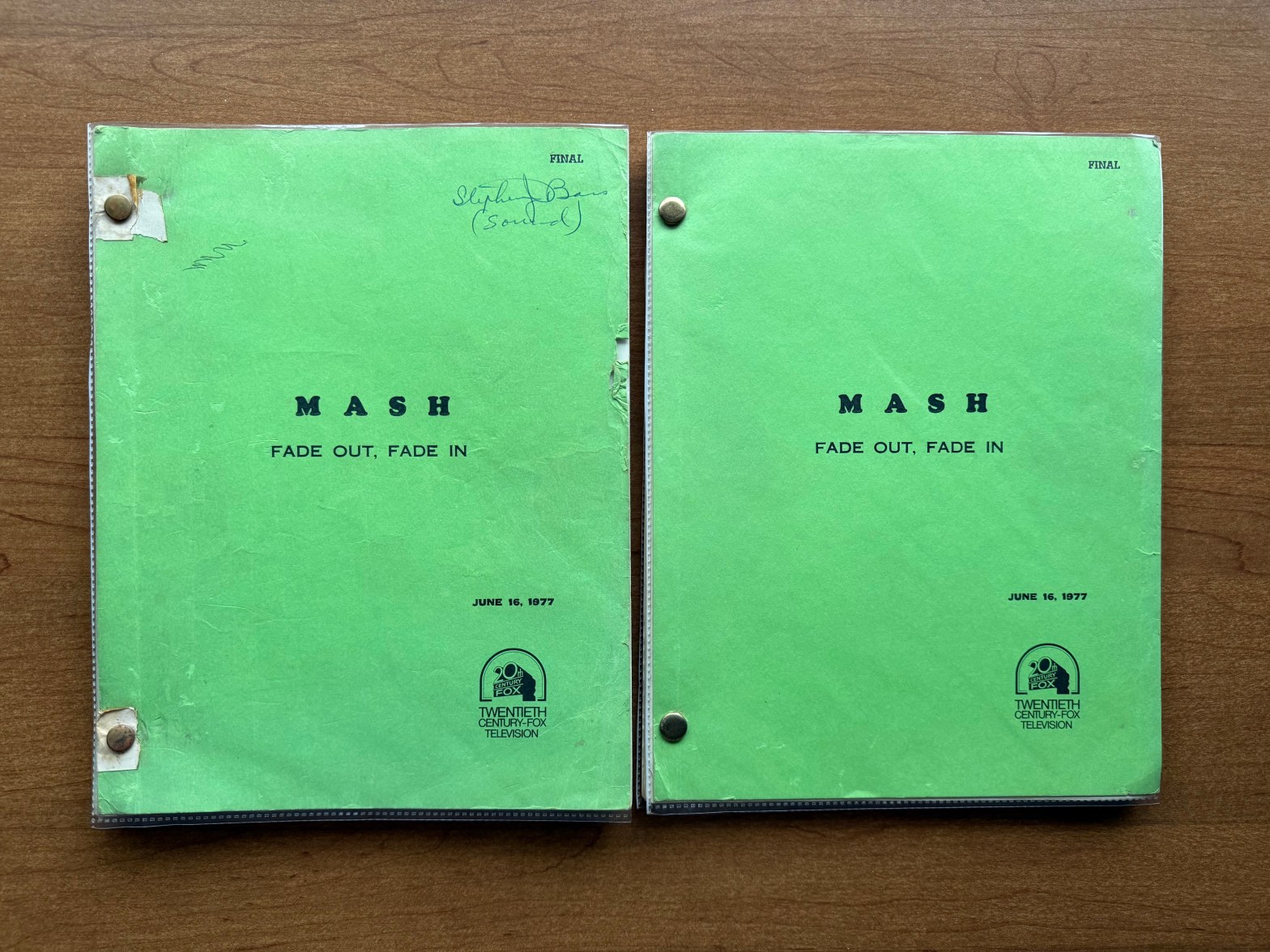
As part of my 2025 rewatch, season six is on my agenda in June. So fr this year, I have featured a script from the season I am rewatching that month. For season four, I wrote about the script for “Change of Command” (04×02) since it was in that episode that we met Colonel Sherman T. Potter. For season six, I believe that it is fitting that I focus on another character introduction by discussing “Fade Out, Fade In” (06×01). Of course, we meet the infamous, high class Major from Boston: Charles Emerson Winchester III. This is the third season in a row that season premiere of M*A*S*H wan an hour long episode, and it was also the last. When I went to the script cabinet, I was excited to see that I had two scripts for this episode, but of those two, there is definitely a better copy with some production documents and revised pages. In this week’s post, we review the script for “Fade Out, Fade In,” say goodbye to Major Frank Burns, and welcome Major Winchester to the 4077th.
The Script

This copy of the script is a final draft dated June 16, 1977. The episode was the season premiere, and it aired on CBS on September 20, 1977. “Fade Out, Fade In” was written by the writing team of Jim Fritzell and Everett Greenbaum. They are credited with writing a total of 24 episodes in seasons three through six. This is the first of five episodes this season. The episode was directed by prolific M*A*S*H director Hy Averback. He directed 20 episodes, most of which were in seasons one through three. However, Averback returned to M*A*S*H to direct this episode in season six and another three episodes in season ten.
As I mentioned in the introduction, this copy of the scripts contains a number of production documents. While there are no Call Sheets, the script does contain the Shooting Schedule and a contact information sheet for each of the cast members. Since this was an hour long episode, it took more time to produce than the typical four days. The episode was filmed July 12 – 15, 18 – 20, 1977, and scenes were filmed on both Stage 9 and at Malibu Creek State Park. This script belonged to sound engineer Stephen Bass, and he saved the memo cover sheets that came with the sets of revised pages. For example, there is a set of revised pages dated July 12, 1977, and it informs everyone to replace the pages in their scripts with the new pages. They were instructed to discard their old pages. Most of the cast and crew followed directions, but thankfully, there are a few who didn’t so we can see how each of the pages changed (see an example with a script for “Dear Dad” (01×12)).


Revised pages are not uncommon with production scripts. In fact, they are a good way to authenticate a script because the revised pages were different colors than the initial pages printed for the script. In this script, there are five sets of revised pages. The pages are dated: June 23, 1977 (blue), June 30, 1977 (pink), July 11, 1977 (green), and July 12, 1977 (yellow). Interestingly, there are two sets of revised pages dated July 11. Since that was the day before filming began, they were likely working on the script, rehearsing, and making changes as needed. For an hour long episode, there aren’t as many revised pages as you might expect. Sadly, this script does not have the pages that the revisions replaced as it would be interesting to see what changed.


Since “Fade Out, Fade In” was the first episode of the season to be filmed, this would have been the first time that the cast and crew were back together since the end of season five in early January 1977. I am sure, for them, it felt like a “back to school” moment as they all returned to begin filming another season for six months. Scripts like this were a witness to those events on set, and were an invaluable tool to the cast and crew alike. Each person on the set, and by this point there were well over 100 people on the M*A*S*H crew, had a job to do to ensure that the filming of each episode was well planned, on budget, and on time because they had 23 more episodes to produce after this one. I’ve said countless times that each script tells a story, but really, each script tells multiple stories when you take the time to read between the lines. Each stage direction meant something to a member of the crew. Each line had to be memorized by an actor. And the production documents ensured that both the cast and crew were on schedule.
The Final Episode


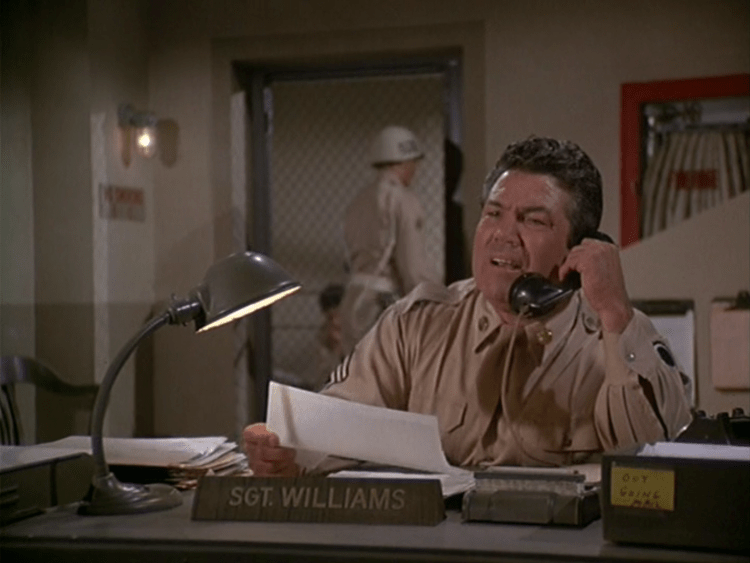


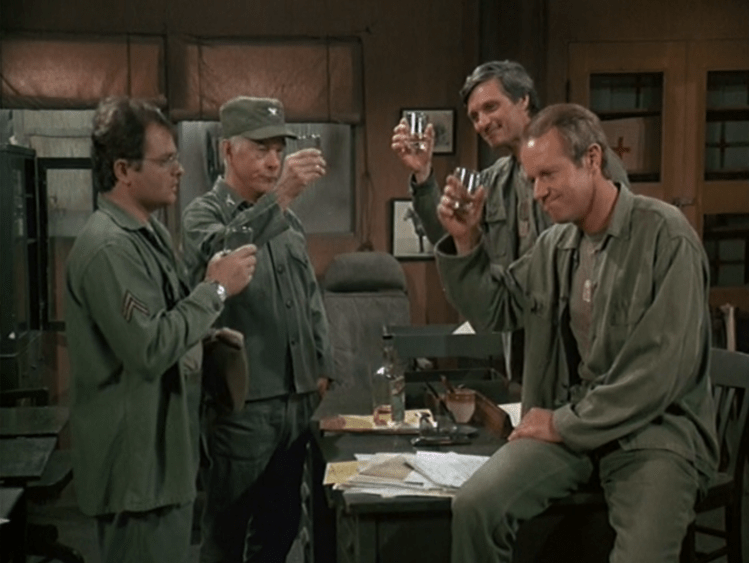
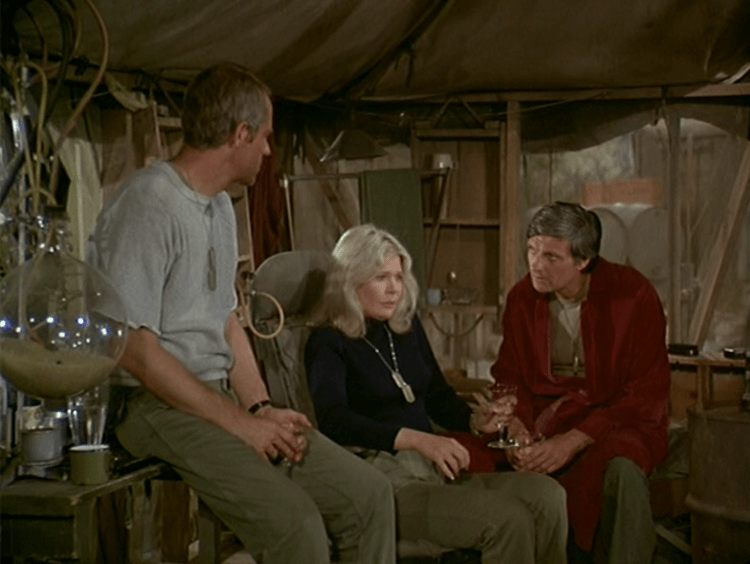
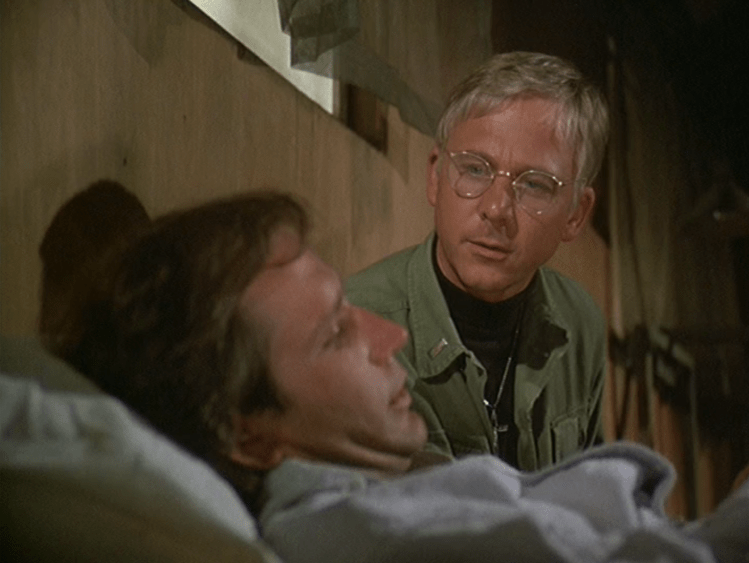


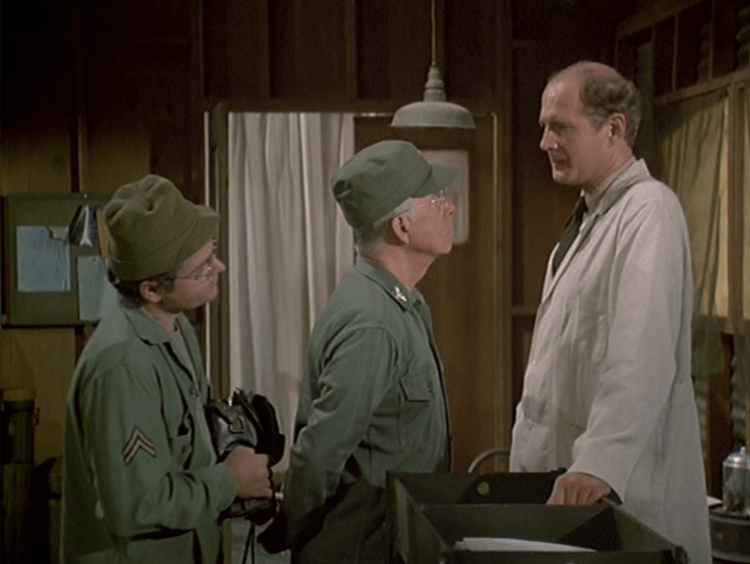

The episode opens with Radar on the helicopter pad waiting for the return of Frank from R&R. Margaret is still on her honeymoon, so the 4077th is down a surgeon and nurse. The wounded begin rolling in, and Potter puts in a request for a temporary surgeon. They get one from Tokyo: Major Charles Emerson Winchester. Margaret returns early from her honeymoon, and jumps in and helps with the influx of patients, but something seems off. She later confides in B.J. and Hawkeye. Winchester arrives, and it is clear that he is the opposite of Frank. He is a skilled surgeon fresh from Boston. Hawkeye has a patient who is not likely to survive, but Winchester is familiar with the surgery the patient needs. He operates and saves the patient. Frank is finally caught by MPs in Seoul after a series of escapes that makes it clear that he has gone off the deep end. Frank is transferred out of 4077th, and Potter arranges to make Winchester a permanent replacement for Frank. Hawkeye and B.J. talk to Frank one last time and find out that he is being transferred to a veterans’ hospital in Indiana and promoted to lieutenant colonel. Charles does not take the news to being transferred to the 4077th well, and he struggles to adjust to meatball surgery. In the midst of everything else, Klinger meets a lawyer in post-op who tells him that he can help Klinger with his Section 8. Unfortunately for Klinger, his “lawyer” is crazier than him!
After introducing two new characters in season four, the writers of M*A*S*H pulled off another great character introduction. Immediately after meeting Charles, there is already quite a bit we know about him. He is a talented surgeon, pompous, and sophisticated. In short, he is everything Frank wasn’t. Seeing a very skilled surgeon have to adapt to “good enough” surgery is a great angle, and I appreciate that the writers made it clear that the shortcuts the doctors of the 4077th have to make greatly offend Charles. But that was life in a MASH unit. Frank’s send off is funny and, sadly, fits the character. Frank had gotten more and more paranoid in seasons four and five, especially after his relationship with Margaret ended. Sending him home with a promotion is a great touch, but I think it would have been funnier if Frank had gotten a Section 8 instead of Klinger in this episode.


Following along in the script with this episode, I noticed something that I’ve never had happen before. I am missing a page from the script! Overall, the script, with its revised pages, closely matches the episode. There are some scenes that were in the final episode that are not in this script, however, so I must be missing a set of revised pages. The scene where Charles tries to have Radar call Col. Baldwin is missing from this copy of the script. That is a shame because his “You can’t break the spirit of a Winchester” speech is iconic! The script is also missing the scene between Charles, B.J., and Hawkeye in the scrub room where Hawkeye and B.J. decide to “avoid the rush and start hating him [Charles] now.” Another great scene that I am glad that they added. I am not missing any other pages, so these scenes were added in another revision. There were a few changes between the script and final episode worth noting. In this draft, the early scene in the O.R. before Charles arrives is longer (page 14), the initial scene between Klinger and his “lawyer” was longer (page 26), and a scene between the wounded sergeant and B.J. was cut (page 59). This is interesting because the resolution of that character’s story arc was cut from the episode. But the biggest difference between this draft of the script and the final episode is one of the most quoted lines of the season. Hawkeye’s “Goodbye, Ferret Face” line is not the same in the script (page 41). It is similar, but I can’t imagine it written any other way!
As I mentioned in my wrap-up of season four and my review of “Change of Command” (04×02), it is very difficult to replace a character on a successful TV show. The new character always gets compared with the character they replaced. Or if the show recasts the same character, then the new actor gets compared to the previous actor. Where M*A*S*H succeeded with its three major character replacements is they didn’t try to find a “new” Henry, Trapper, or Frank. They created new characters from scratch, and that allowed the writers to develop the new characters and develop new relationships for the existing characters. Unlike Frank, Charles is not an inferior surgeon. In fact, he challenges Hawkeye and B.J. by having skills that they do not possess. That makes Charles more interesting, and as I continue to rewatch season six throughout June, I look forward to seeing whether the writers are able to match the success of introducing B.J. and Potter in season four. Overall, “Fade Out, Fade In” is a really good episode of M*A*S*H because it successfully continued where season five left off, introduces a new character, and is well balanced between the comedy and drama.
 The M*A*S*H Historian
I can recite Winchester’s speech from memory now:
“You can cut me off from the civilized world, you can incarcerate me with two moronic cellmates, you can torture me with your thrice-daily swill, but you cannot break the spirit of a Winchester! My voice shall be heard, and I shall be delivered from this fetid and festering sewer!” All this followed by a nice half-smirk. 🙂
LikeLiked by 1 person
It’s a great speech! I kept flipping pages hoping it was somewhere in that script! 😂 Thankfully, the scene is in the other copy of the script that I have!
LikeLiked by 1 person