
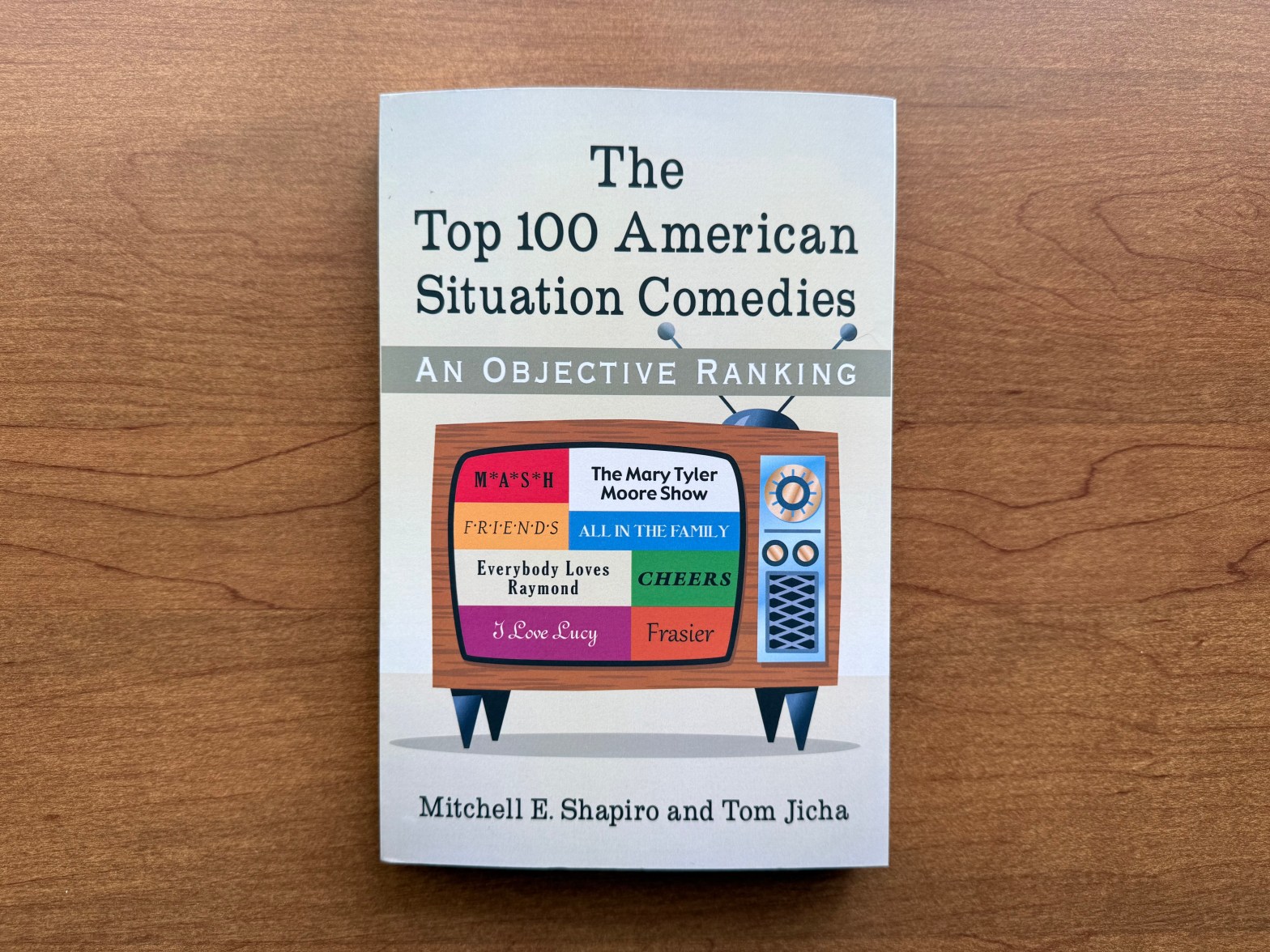
What is it?
Shapiro, Mitchell E. and Tom Jicha. The Top 100 American Situation Comedies: An Objective Ranking. Jefferson, NC: McFarland & Company, Inc., Publishers, 2015.
Why should M*A*S*H fans care?
As lists of “top shows” or “top sit-coms” are released, M*A*S*H is typically included. That is no different in this book. But the authors’ “objective” measure of what makes a show successful is what makes this book unique, and it places M*A*S*H near the top!
As a M*A*S*H fan, what part(s) should I read?
As always, I recommend reading the entire book because the authors do a great job of listing and describing the top 100 sit-coms of all time. The information on M*A*S*H is confined to three pages, but the shows that M*A*S*H shared the air waves with make the top of the rankings as well.
TL;DR Review
Authors Mitchell E. Shapiro and Tom Jicha reviewed 377 American sitcoms spanning the history of television to objectively rank them based on a number of factors including duration and ratings. While M*A*S*H does not take the top spot, it is close to the top, and in their wrap-up of the series, they argue that what made M*A*S*H successful was that it strayed away from the “sit-com” troupe by focusing on the human cost of war. While the authors do deep dives into the top 100 sit-coms according to their “objective” ranking, they list all 377 shows they reviewed in an appendix. They did their homework for this book.
Full Review

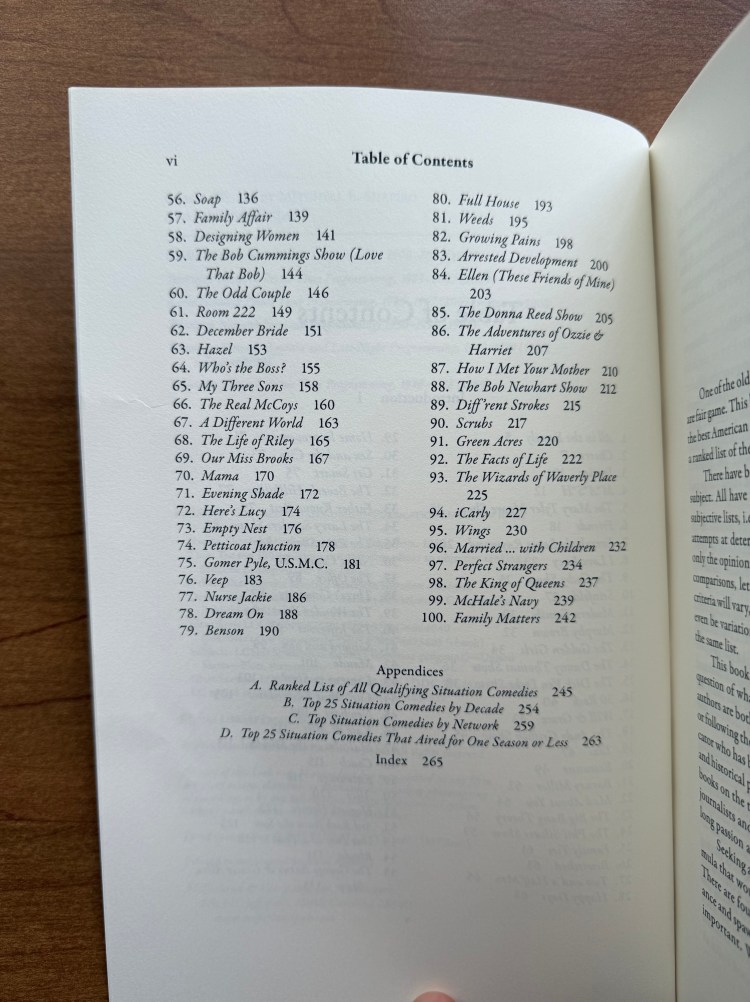
It seems that once a week, I see a list of “top television shows of all time” that was published by an online source or publication. The majority of these rankings are subjective, and they tend to follow the same formula. The rankings end up being a popularity contest, and if a show is having a moment in popular culture, they magically move up the rankings. In 2015, authors Mitchell E. Shapiro and Tom Jicha sought to change that by coming up with an objective way to judge situation comedies. They reviewed 377 series from the 1950s to the 2010s, and their book summarizes the top 100 shows based on their formula.
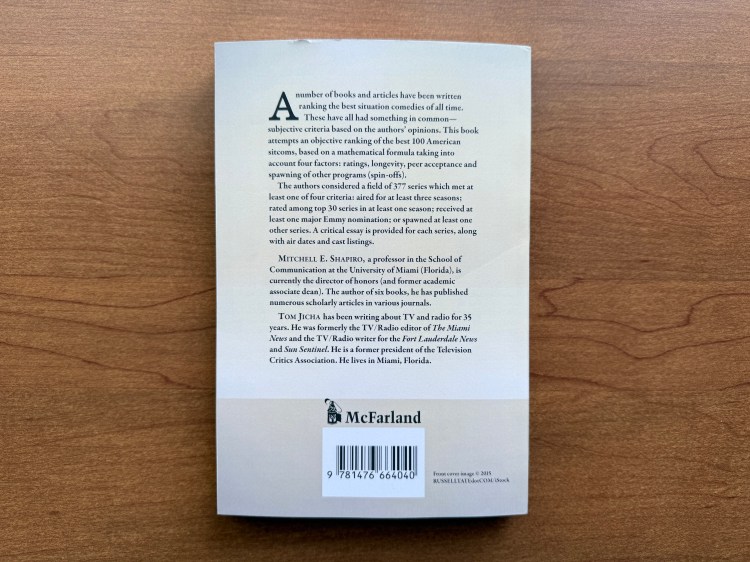
When the subtitle of a book is, “An Objective Ranking,” it is very easy to be skeptical of that assertion. Most of the online rankings of television shows claim to be objective, but you can tell that the author is ranking the shows that they have seen or they include shows for clicks. For their book, Shapiro and Jicha reviewed 377 situation comedies (sit-coms), and they provide a full list of the shows they reviewed in an appendix to the book. When it comes to their objectivity, they discuss their methods in their introduction, and I believe they did a good job of describing how they arrived at their rankings. First, we have to consider the authors themselves. Both have written extensensvily on the history of television, and Jicha is the former president of the Television Critics Association. Next, they developed a formula that considered four factors:
- Ratings: Using the Nielsen ratings, they considered how the series fared each season in the ratings compared to other programs airing in the same era.
- Longevity: The authors considered both how long the series aired and how many episodes were produced.
- Peer Acceptance: This factor considers the voting of the National Academy of Television Arts and Sciences for the annual Emmy Awards. Only the major Emmy categories were considered (those airing in the Primetime Emmy Award Ceremony). Both the number of nominations and wins were taken into account, but winning counted 5x more than being nominated.
- Spawning other programs (spin-offs): Finally, they considered whether the series contributed to the history of television by spawning spin-off series.
As the authors discuss, these four criteria are considered separately for each series, but they also factor in to each other. For example, a show that does well in the ratings will likely last longer and could potentially lead to awards and spawn spin-off series. So, according to the formula, who makes the top 10?
- All in the Family
- Cheers
- Fraiser
- M*A*S*H
- The Mary Tyler Moore Show
- Friends
- Everybody Loves Raymond
- I Love Lucy
- The Cosby Show
- Seinfeld
M*A*S*H is solidly in the top ten of Shapiro and Jicha’s ranking, and there are several factors that contributed to that conclusion. M*A*S*H had solid ratings for ten of the eleven seasons. The lone exception is season one in which it didn’t even make the top 20. The series also dipped to 14th in season four; otherwise, M*A*S*H was in the top ten the other nine seasons. Then, of course, there were the ratings for “Goodbye, Farewell and Amen” (11×16) which broke every viewing record for a scripted television show. For longevity, the series last for eleven seasons and 251 episodes. That is three times the length of the Korean War that the series portrayed. Over that eleven year run, M*A*S*H was nominated for 93 Emmy awards and won 14 times. It was nominated all eleven seasons for Outstanding Comedy Series, but it only won the award once. Alan Alda, Loretta Swit, Gary Burghoff, Harry Morgan, Larry Gelbart, Gene Reynolds, Jackie Cooper, and Stanford Tischler and Fred Berger all won Emmy awards for M*A*S*H. Finally, M*A*S*H did produce spin-offs. AfterMASH ran on CBS from 1983 – 1985, and while it wasn’t as successful as M*A*S*H, it did have three original M*A*S*H cast members. Shapiro and Jicha do not count Trapper John, M.D. as a M*A*S*H spin-off, but the character references the 4077th and his time in the Korean War at a MASH unit, so I think it should count.
There are some M*A*S*H fans who will object to M*A*S*H being called a “sit-com,” but that is how it was envisioned when it debuted in 1972. Like the characters in the series, M*A*S*H evolved throughout out its eleven year run. Nevertheless, it is great to see M*A*S*H ranked high on this list because it was a groundbreaking television program. It wasn’t a traditional sit-com, and it broke that mold as the series progressed, killed off a main character, introduced new characters, and ended a war. I am not surprised to see M*A*S*H near the top of the list because, if you look at the other shows in the top ten, several of them featured ensemble casts like M*A*S*H. All in the Family, Cheers, Frasier, The Mary Tyler Moore Show, Friends, and Seinfeld all had “lead characters,” but you can’t imagine any of those shows without the cast that surrounded them. It was the interaction of the characters on screen that resulted in the show being successful. I would argue then that the formula presented by Shapiro and Jicha is successful. The top shows all did well in the ratings, they all ran for five or more seasons, they all won Emmy awards, and several spawned other shows. It’s notable that there aren’t any shows on this list from the 2000s or later because today’s audience is too fractured, so it is going to be much more challenging to evaluate today’s programming since it is so balkanized. Maybe that’ll be Shapiro and Jicha’s next project, and I believe that they would be up to the challenge. You can add a copy of The Top 100 American Situation Comedies: An Objective Ranking to your library by purchasing a copy from Amazon.
 The M*A*S*H Historian