

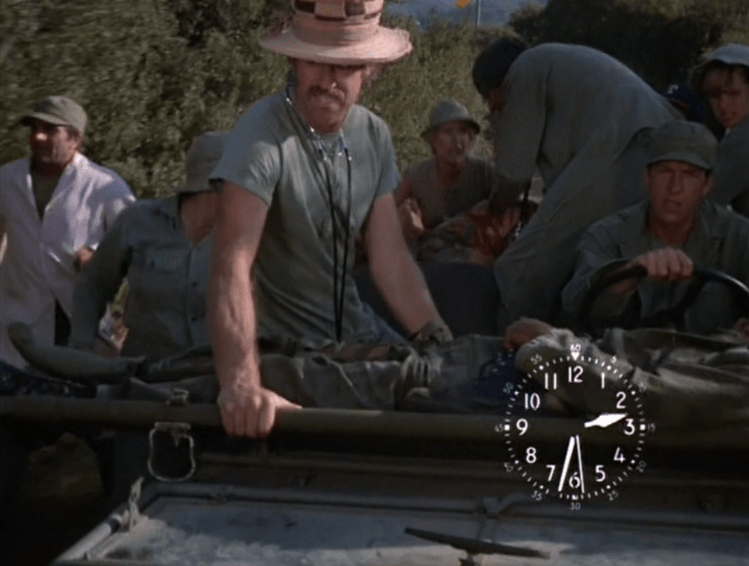
As I scanned the list of episodes of season eight for this month’s review, one jumped out at me. I had to double check because I was sure I already wrote about it. However, I did not, so it was an easy choice! “Life Time” (08×11) is consistently rated among the top episodes of M*A*S*H. After rewatching the episode this week, it is easy to see why. It is dramatic, takes place in real time, and the addition of a clock on the bottom corner of the screen amped up the tension. It felt like an episode of a medical drama from the 1990s or even today. In fact, several medical shows I watched have mimicked this concept, and it works well. The race against time to save a life is compelling, and M*A*S*H did it in 1979. As the series became more popular, they could experiment more with episode concepts, and in season seven, we saw “Point of View” (07×10). Although that episode tends to be more divisive in the M*A*S*H community, “Life Time” is nearly universally appreciated.
The Script

The script in the collection is a final draft dated August 24, 1979. The episode originally aired on CBS on November 26, 1979. It was written by Alan Alda and Dr. Walter Dishell. Dishell was a medical advisor for M*A*S*H, and in an episode with so much at stake, it made sense that he played in a larger role in its writing. Dishell served as a medical advisor for other shows including AfterMASH, House Calls, Knots Landing, and Trapper John, M.D. This is the only M*A*S*H episode for which he received a writing credit. The episode was directed by Alda, who is credited with directing 32 episodes.
Sadly, this script does not include any of the production documents. There are no Call Sheets, and I don’t have a Shooting Schedule. I would really like to see a filming schedule for this episode because I am curious whether it took a full four days to film. Quite a bit of this episode takes place in the O.R., but we do see other sets including the office, the Swamp, the Officers’ Club, and the helicopter pad. Filming the helicopter pad would mean a trip to Malibu Creek State Park, so it probably took the full four days to film. While there are no production documents, this script does include two sets of revised pages. They are dated August 31, 1979 (blue) and September 4, 1979 (pink). I do not know who this script belonged to, but they discarded the outdated pages in their script when they received the revised pages.
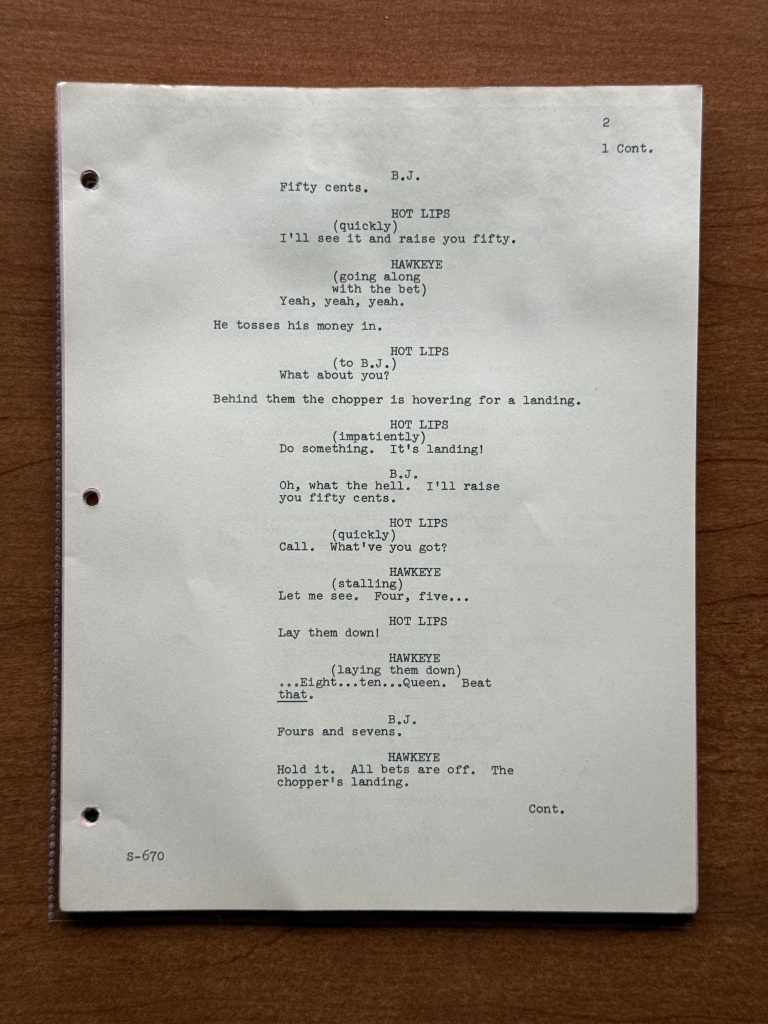
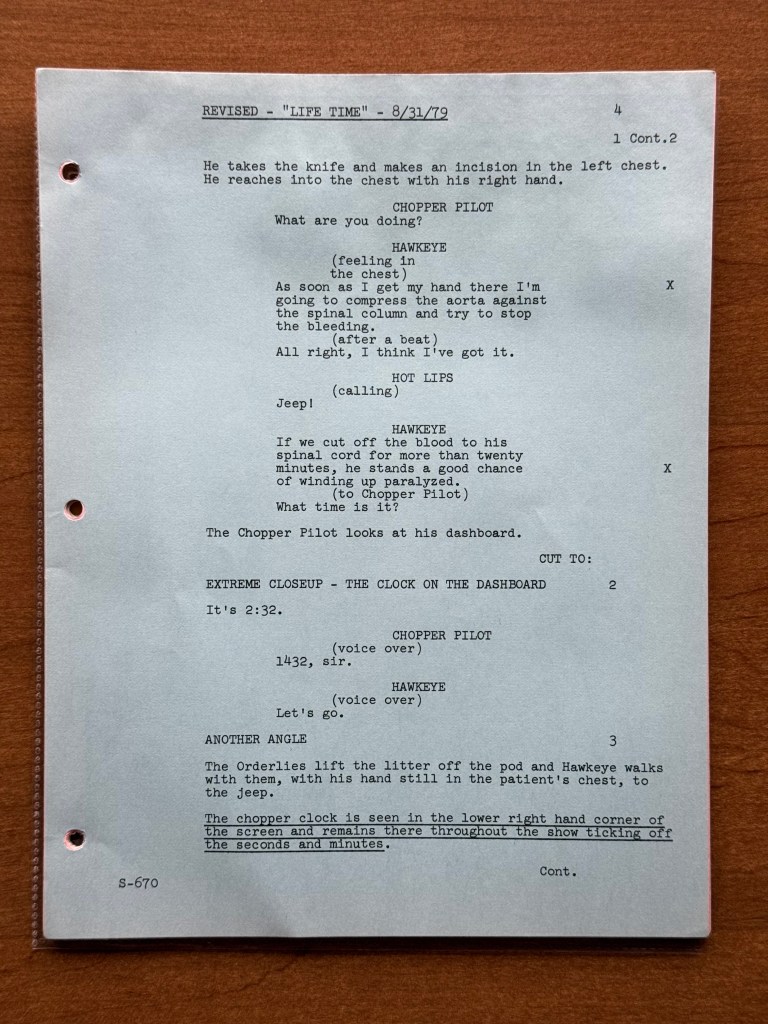
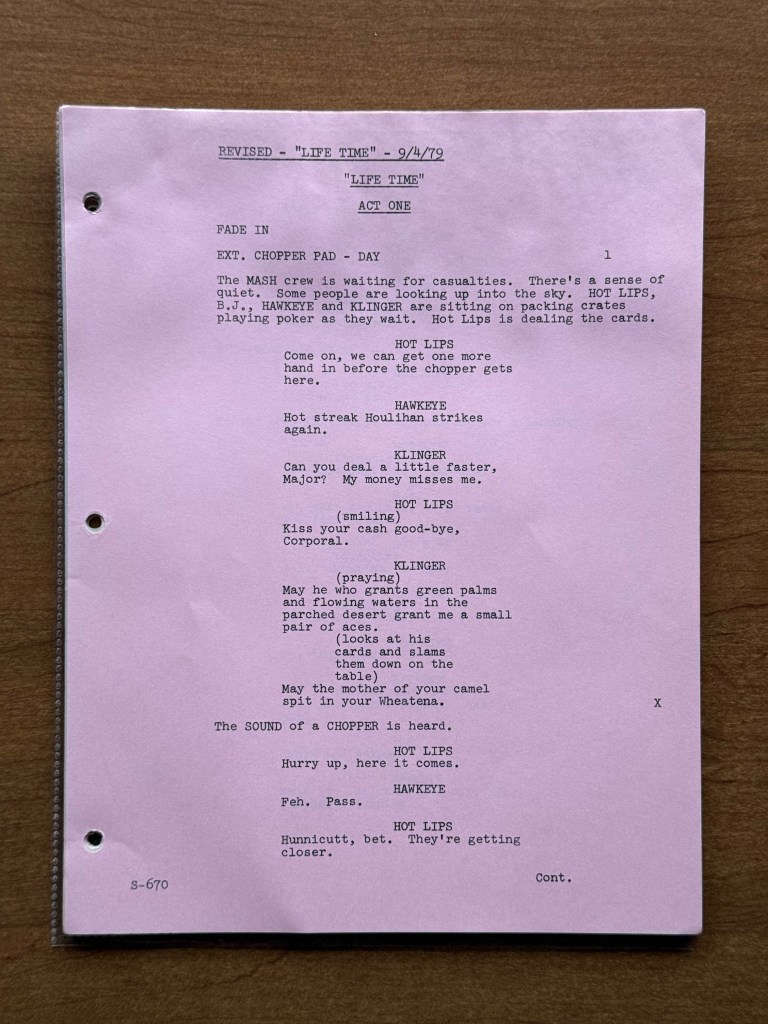
After reviewing this script, I find it interesting how the script is very normal for such an unusual episode. The addition of the clock in the lower corner of the screen makes this episode so compelling, and yet, its inclusion is reduced to a single sentence in the script. It is there for 20 minutes, but one sentence is all it took to explain. It might be easy to be disappointed about what this script is missing, but I greatly appreciate what it has. The dialogue in this episode is very well written. And the situation the doctors find themselves in is not uncommon. Transplant patients wait on a list for someone to pass away and donate an organ, and in that case, the organ donor chose that position. Mulcahy explaining to the dying man’s buddy that he is saving someone else is such a well written, empathetic scene that is fitting for a priest. Of course, the script is just words on a page. What makes M*A*S*H so great is that the actors, and especially William Christopher in this episode, take the ink on the page and create soothing dialogue. That is the true magic of the movies and television.
The Final Episode



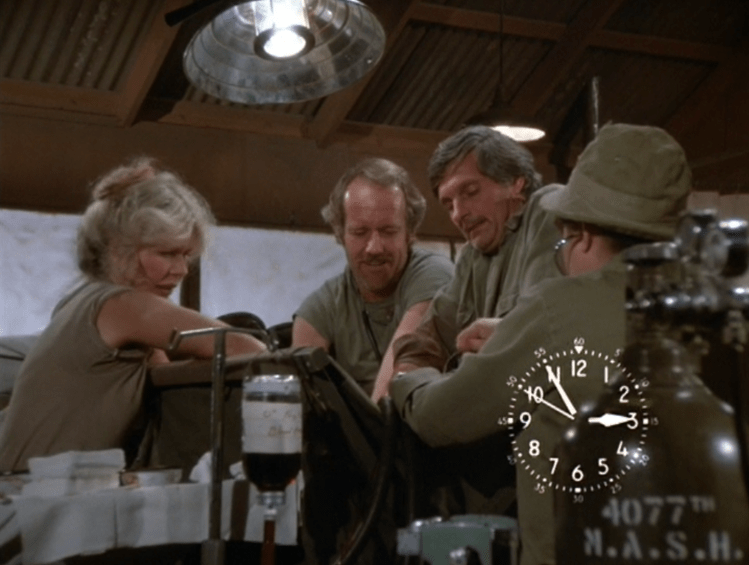

Margaret and the doctors are playing poker on the chopper pad as they wait for wounded to arrive. Margaret wins the hand just as the chopper lands. There is a severely wounded man (George) on the chopper who is missing part of his aorta, and Hawkeye thinks they can fix it. He has to stop the bleeding with his hand as they move the man into the O.R. They put George in ice hoping to slow his heart rate and the blood flow. They have just over 20 minutes to replace the aorta, otherwise he will end up paralyzed or with kidney failure. Kellye brings in a sampling of artery grafts, but none are big enough. When the bus arrives with additional wounded, another patient, Harold, is brought in who is not going to make him. B.J. has to wait for him to die before they can take his aorta for Hawkeye’s patient. Harold’s buddy is upset when he learns that the doctors are waiting for him to die to take an artery. After he passes away, B.J. is able to get the aorta as Hawkeye has prepped George for the graft. They compete the operation, but it took a few minutes too long, and they are concerned that George may have lasting damage. In post op, they are able to get George to move his toes, and the operation was successful.
Wow. This is an intense episode, and it is genius how they included the clock at the bottom corner of the screen to heighten the tension. This is the only episode of M*A*S*H to take place in real time, and this would have been a new concept in 1979. Other medical shows have done something similar to this, but I think M*A*S*H was the first. There is not a lot of comedy in this episode, and the comedy takes place outside of the O.R. Since most of the episode takes place in O.R. and waiting for a man to die, jokes would feel out of place. The lighter scenes with Klinger impersonating Potter and Charles donating his blood work well, and I am glad that they didn’t take the jokes too far. The use of the clock at the bottom of the screen was a great idea, and it was written into the script in a single sentence (page 4). The clock did not stay on the screen during the commercial break (that technology wasn’t available in 1979), but the clock did skip forward four minutes after returning from the commercial break. Before rewatching it, I forgot how intense this episode was, and it so well acted. Harold’s buddy being angry at B.J. for waiting for him to die felt real, as did B.J.’s guilt. Doctors save lives, and while they were saving someone in the process, B.J. never forgot that one life was lost to save another. The actor who played Roberts, Harold’s buddy, Kevin Brophy, did an amazing job portraying someone who is going through the grief of losing his friend, but realizing that his friend was doing good.

There aren’t any major changes between this draft of the script and the final episode. I think this is a credit to the tight writing of Alda and Dishell at this point in the series. They knew the episode needed to take place in around 20 minutes, and that was almost the normal runtime for an episode of M*A*S*H. This is one of those groundbreaking episodes of the series that kicked off at the end of season three with the death of Henry Blake. M*A*S*H began as a comedy, and the network was concerned about the drama and blood presented at a medical unit during a war. The show was allowed to grow as the seasons progressed, and that allowed the writers to try new things. The audience was open to this as well, and as the show got more popular, they continued to try new things. That can be a huge risk and could have alienated the network or the audience, but their willingness to push the envelope paid off with episodes like “Life Time.”
 The M*A*S*H Historian
I have most all the scripts of M+A+S+H 4077 that I had worked on from 1978 to 1983. I was the Special Effects Technician Standby.
LikeLiked by 1 person
That’s awesome! What was it like to work on the show? I think our understanding of “special effects” has changed with computers. What did they consider special effects then?
LikeLiked by 1 person
Hello, Eric!
A couple of nights ago, I was writing an Email to a longtime dear friend of mine, and I made a reference to me having a drink in each hand at the 4077th. Then I thought: Wait! Where was that? The Officers’ Club? What was a young punk like me doing in the Officers’ Club? And what episode was that in? So, I started some Internet searches and eventually surfed the Internet to your blog here.
I found that the episode in question was ‘Blood And Guts’ (1982), which featured the actor Gene Evans. And then tonight, by pure coincidence, happenstance & Twilight Zoneishness, I happened to watch ‘The Men That Corrupted Hadleyburg’, a 1972 episode of ‘Alias Smith & Jones’ (unquestionably the greatest Western TV series ever filmed!) and there was the actor Gene Evans again! I took that as a sign that I oughta leave a comment here.
Brother, you’ve got quite an extensive blog, and your collection of M*A*S*H memorabilia is doggone impressive! In fact, you’ve got far, far more stuff than I have, and I worked on the show for nearly half of its lifetime. (I believe I have only one script and maybe two or three call sheets.)
About 14 years ago, I wrote a rather extensive blog bit about my time spent on the MASH sets from 1978-1983. If you’re inclined to check it out, I think you may find it fairly interesting, considering your great interest in the show:
M*A*S*H – S*T*U*F*F*S (Or, “YES, WE PLAY REQUESTS”)
http://stephentmccarthysstuffs.blogspot.com/2012/02/mash-stuffs-or-yes-we-play-requests.html
Bless And Be Blessed, Brother!!
~ Stephen
LikeLike
Thank you, Stephen! I greatly appreciate your comment, and I always enjoying hearing from someone who was directly involved with M*A*S*H! “Life Time” is such a creative episode, and being there for its filming sounds like it was quite an experience. I read your blog post, and you were there for some major events. It says a lot about the cast and crew of M*A*S*H that you rarely hear of anyone having a bad experience on set. I think that the care and dedication that went on behind the scenes is reflected in the show itself, and that is a major reason it continues to stand the test of time!
LikeLiked by 1 person