
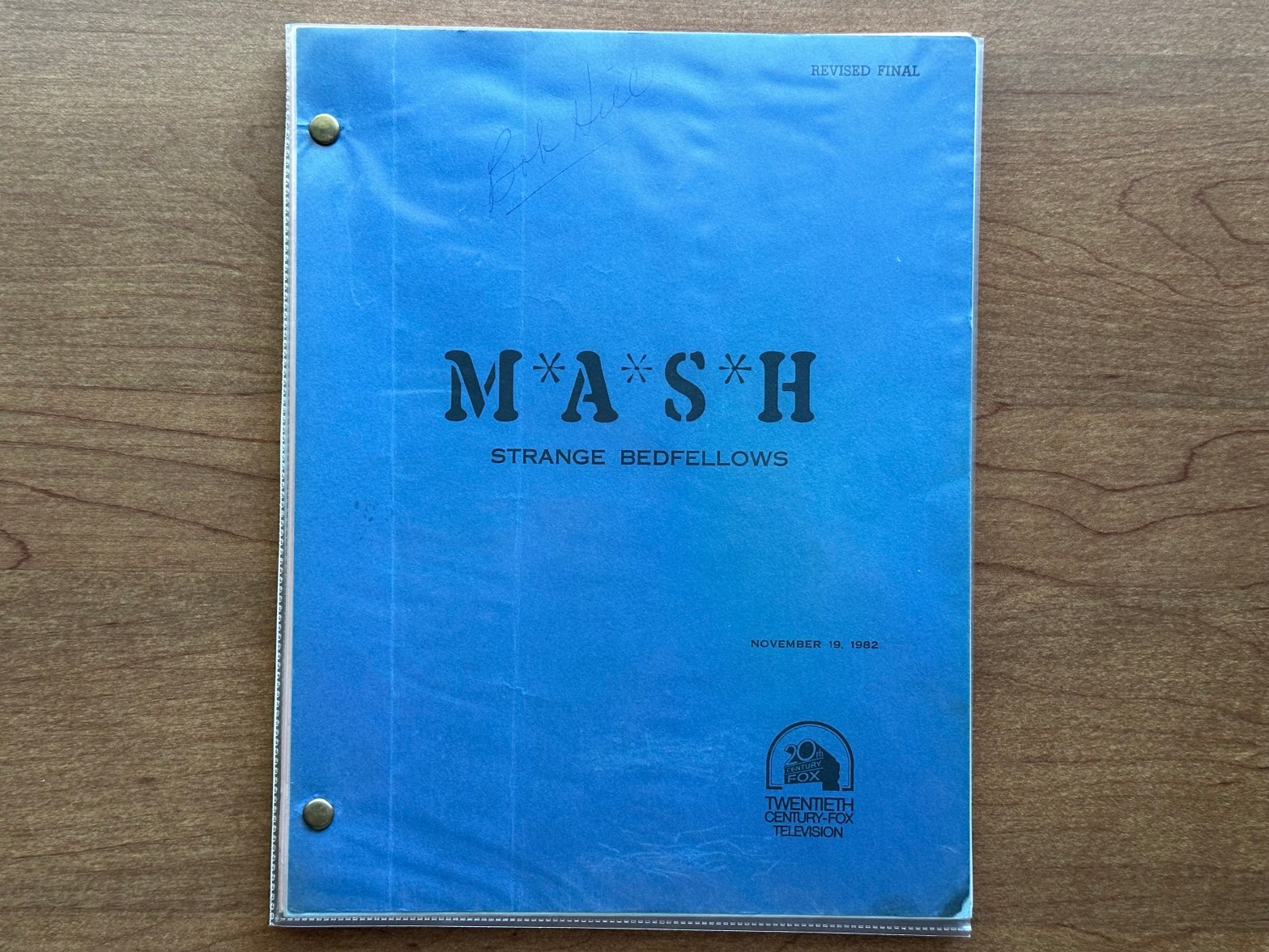
It is already November, which means that I am in the final season of my M*A*S*H rewatch. It has been quite the journey rewatching M*A*S*H this year, and I am looking forward to finishing the series and sharing my thoughts later this month. Meanwhile, I knew I had to find an episode from season eleven to review this month, and that was hard. I’ve already written about a few of them, and there were only 15 half-hour episodes this season. I looked at the list, and “Strange Bedfellows” (11×11) jumped out since I have an interesting copy of the script and the episode had a good balance between its storylines. Let’s get in to the script and the episode itself!
The Script

This copy of the script is a Revised Final draft dated November 19, 1982. The episode aired on January 10, 1983, and it is the eleventh episode of the final season. The script was written by Karen Hall, who wrote seven other episodes of M*A*S*H, and she served as a story editor for seasons ten and eleven. M*A*S*H is one of Hall’s first writing credits, and she went on to write, produce, or serve as a creative consultant for other popular shows including Roseanne, Grace Under Fire, Judging Amy, and The Good Wife. The episode was directed by Mike Farrell, who directed a total of five episodes of M*A*S*H.
This script belonged to Bob Hill who served as a stand-in for Farrell in the final few seasons of the series. Because he was on set most days, his scripts often include Call Sheets and the full Shooting Schedule. There are a few interesting things I noted as I reviewed these documents. First, the Call Sheets were daily, and they included all the information about each day’s work. Details outlined included which scenes were filmed, who was needed on set, what materials are needed on set, etc. There are only three Call Sheets for this episode. Then, looking at the shooting schedule, there are only three days of filming listed as well. So instead of the usual four days, this episode was filmed in three. I believe several factors contributed to them being able to complete this episode in three days with the biggest being the fact the entire episode was filmed on Stage 9. Nothing was filmed at the outdoor sets, which saved time and effort getting everyone and everything out to Malibu Creek State Park. After watching the episode, I noticed that most of the scenes took place in a few locations, so that would make filming easier as well since there were fewer sets to prepare.

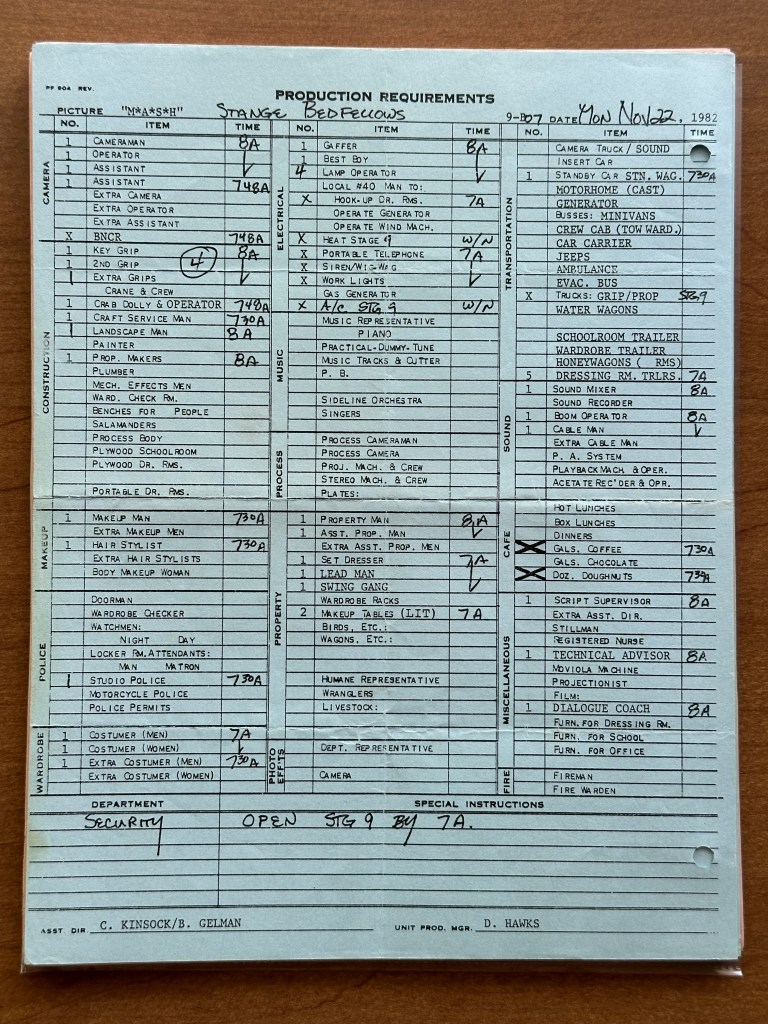
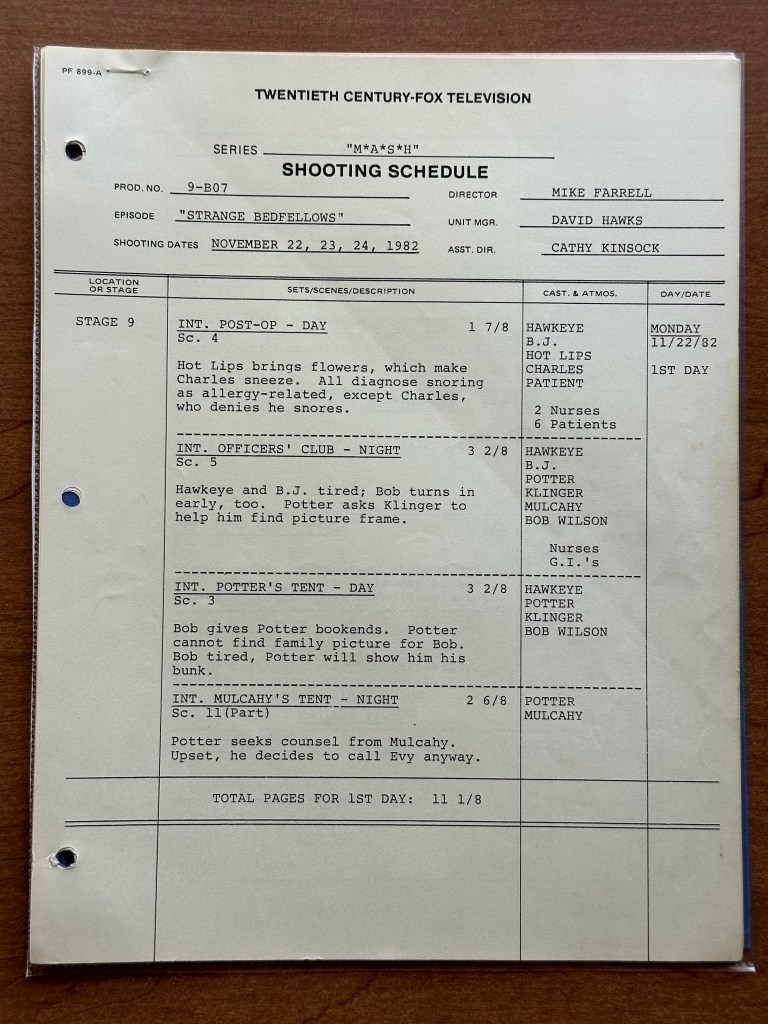
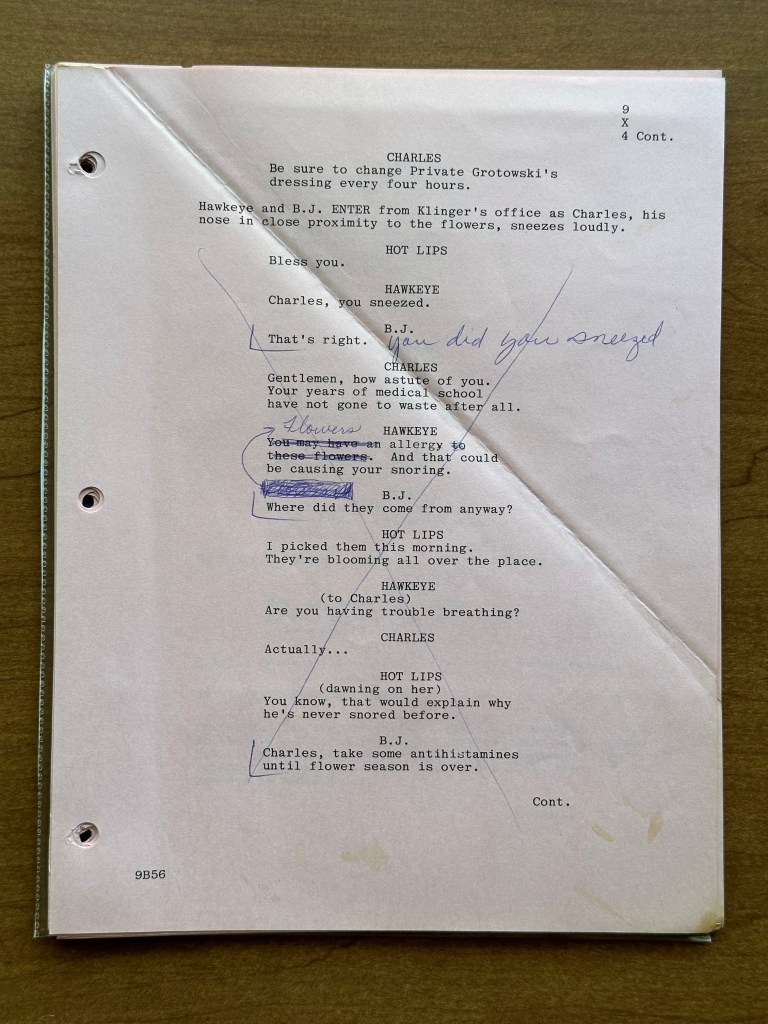
I regularly say that each script tells a story, and I love scripts that have a backstory. I know who owned this script, his job on set, and he saved all the production documents. In some of his scripts, he also kept the original pages when there were revised pages released. That allows us to see what changed between each version of the script. These may seem like very minute details to focus on, but they are what fascinate me the most. I began the collection with scripts, and they are my favorite objects in the collection. These documents were on the set and are what became the episodes we all love. Of course, they may “just be words on a page,” and it takes an actor to take those words and bring them to life, but the script is where each episode began. Every script tells a story, and I never get tired of learning something new with each episode’s script.
The Final Episode
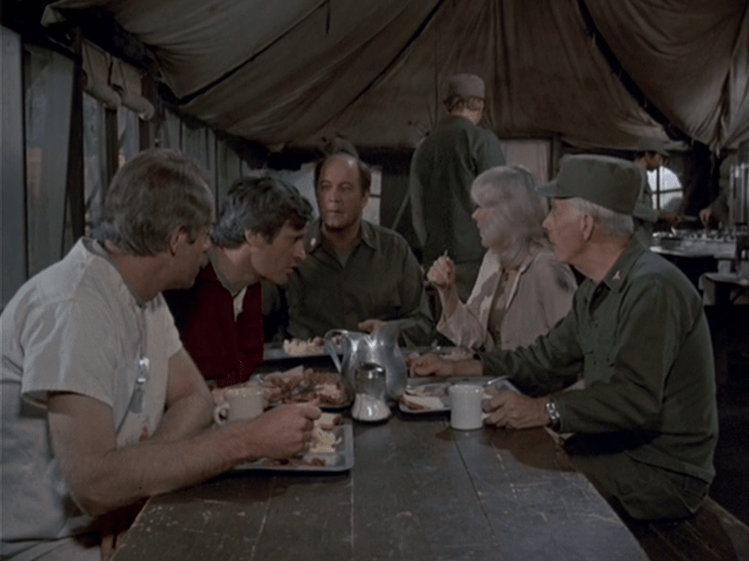


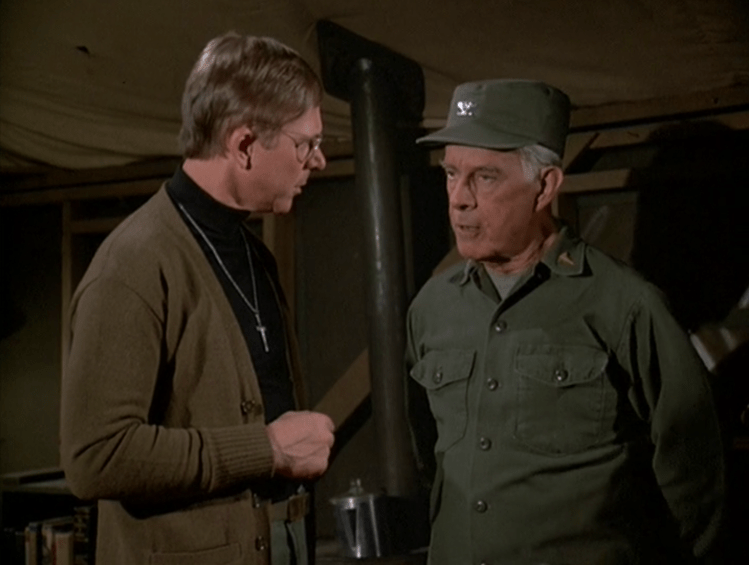

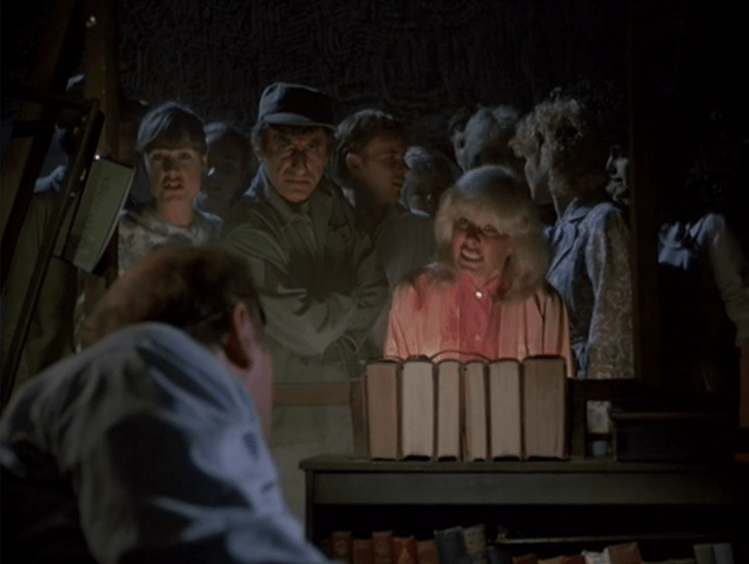

B.J. and Hawkeye come in to the mess tent for breakfast, and they look like they haven’t slept. They explain to Margaret and Col. Potter that they can’t sleep because Charles has started snoring. Charles denies that he snores, but they tell him that it is likely due to an allergy. Charles gets mad at the insinuation that he could snore like a “commoner,” and he talks to Father Mulcahy about it. That doesn’t go well, and Mulcahy tells Charles he isn’t better than anyone else. When he finally concedes that he does snore, the snoring goes away, but B.J. begins talking in his sleep! Meanwhile, Col. Potter’s son-in-law, Bob, visits the 4077th while on a business trip in Korea. Everything is going well until Potter gets a call from a hotel in Tokyo that “Mrs. Wilson” left her nightgown at the hotel. Potter is upset that his son-in-law had an affair and talks to Mulcahy about it. Mulcahy advises Potter to think before he calls his daughter. Potter talks to Bob about an affair he had decades before. Something he hadn’t told anyone. Potter tells Bob that, even if a mistake remains a secret, there is always someone who knows the truth…you.
As I’ve been rewatching season eleven, I’ve noticed the same trend that I noticed with season ten. The episodes are either primarily dramatic or primarily funny, and there are fewer episodes that strike a balance between the two. “Strange Bedfellows” is an exception in the later seasons that did strike that balance. The storyline of Charles’ snoring issues is funny and well balances the heavier storyline of Potter’s son-in-law’s affair. The revelation that Potter himself was unfaithful to Mildred was an interesting addition to Potter’s character, and it also explains why he thought twice before ruining the marriage of his daughter and son-in-law. Whether one might deem his actions right or wrong, it is a great example of a scenario that isn’t necessarily black and white. Life contains grey areas, and M*A*S*H did a great job of showing the human element within war. Humans make mistakes.
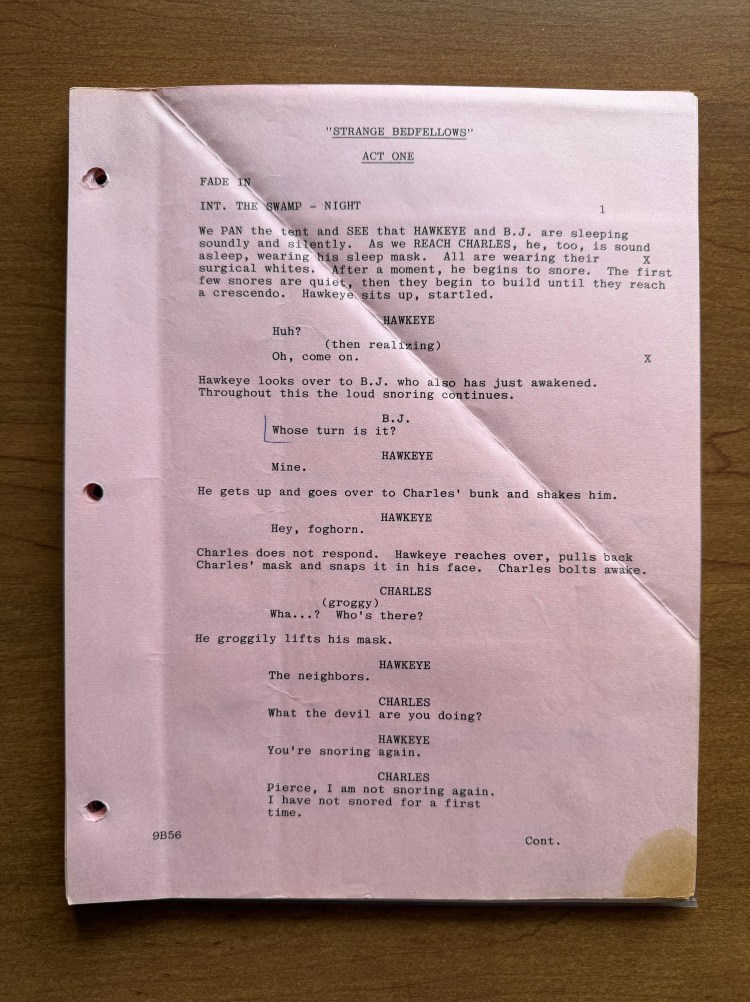
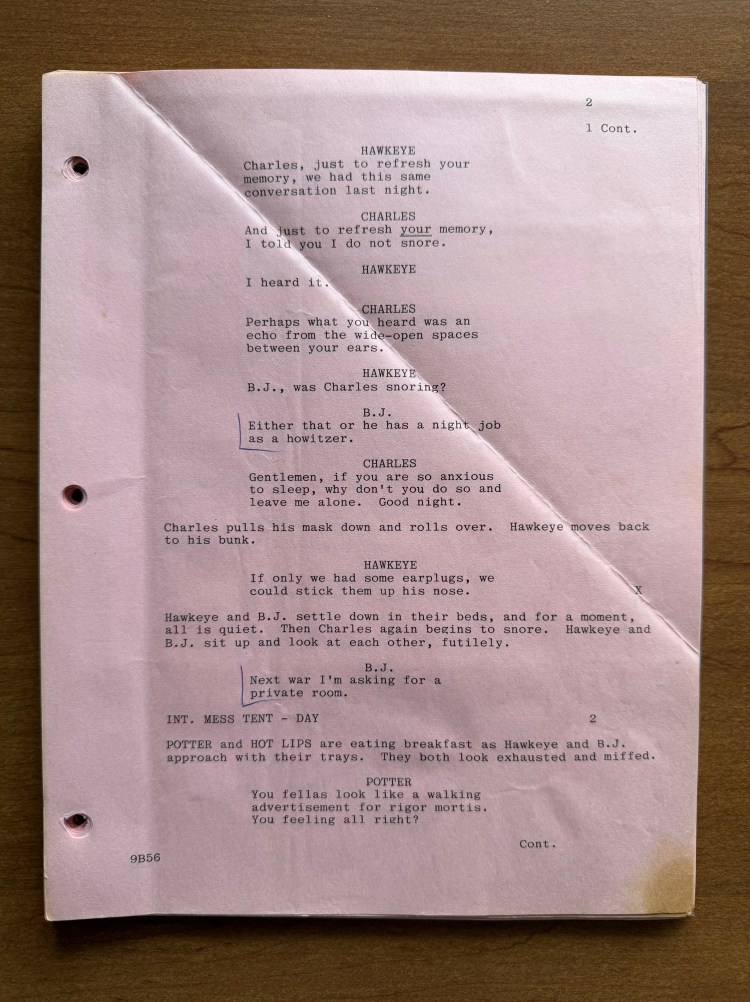
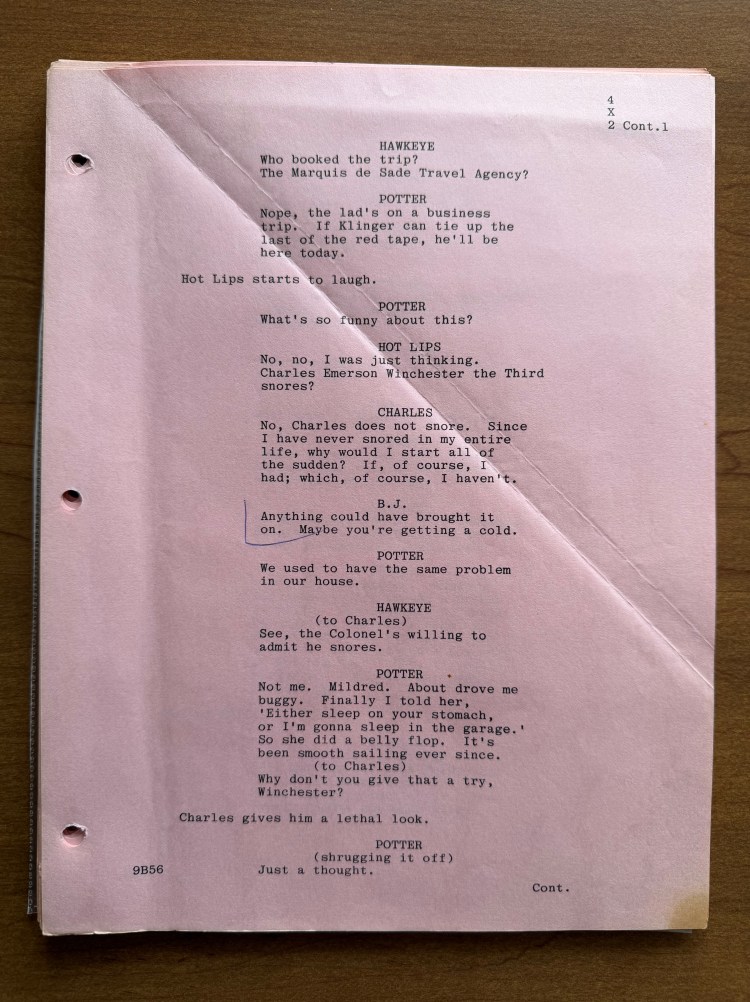


Since the script didn’t have any revised pages, there are several changes between this version of the script and the final episode. From the beginning, there is a different opening scene (pages 1 – 2) in which Charles’ snoring is introduced before the scene in the mess tent. Then, in the mess tent, after Charles joins the group, the scene was longer with Hawkeye and B.J. suggesting that Charles might have an allergy (page 4). Later in the episode, after Bob leaves the officers club, there was a scene where Klinger sits down and briefly talks to Col. Potter (page 13). Then, after B.J. and Hawkeye record Charles’ snoring, the scene in the script contains several additional lines of dialogue (pages 14 – 15). After the commercial break, the beginning of act two originally included a scene with B.J., Hawkeye, and Charles (page 17). Finally, the scene where Charles talks to Father Mulcahy was originally written to be longer (page 22). Since there were no scenes added to the episode beyond what is in this script, these scenes were likely tightened up and/or removed for time.
Overall, I rate “Strange Bedfellows” as a pretty good later season episode of M*A*S*H. There is a good balance between the two storylines, and we learn about something from Col. Potter’s past that he regrets. We don’t often see Col. Potter make, or admit to, mistakes, and it humanizes him. M*A*S*H wasn’t a show that ignored difficult topics, and it even evolved on topics such as extramarital affairs. In the earlier seasons, infidelity was fairly open at the 4077th with Frank and Margaret, Trapper, and Henry. By season eleven, infidelity was not a subject for the sake of comedy, but one to discuss in a serious manor. Serious topics were dealt with in a serious way, and I believe that this is why M*A*S*H is still relevant today. It didn’t date itself like other shows that remain relics of their time. M*A*S*H is timeless because its message is timeless. I have realized that more and more during my 2025 rewatch of the series. M*A*S*H stands the test of time because it stuck to a central, relevant message that focused on the human cost of war.
 The M*A*S*H Historian
One thought on “Script Spotlight 50: “Strange Bedfellows””