
What is it?
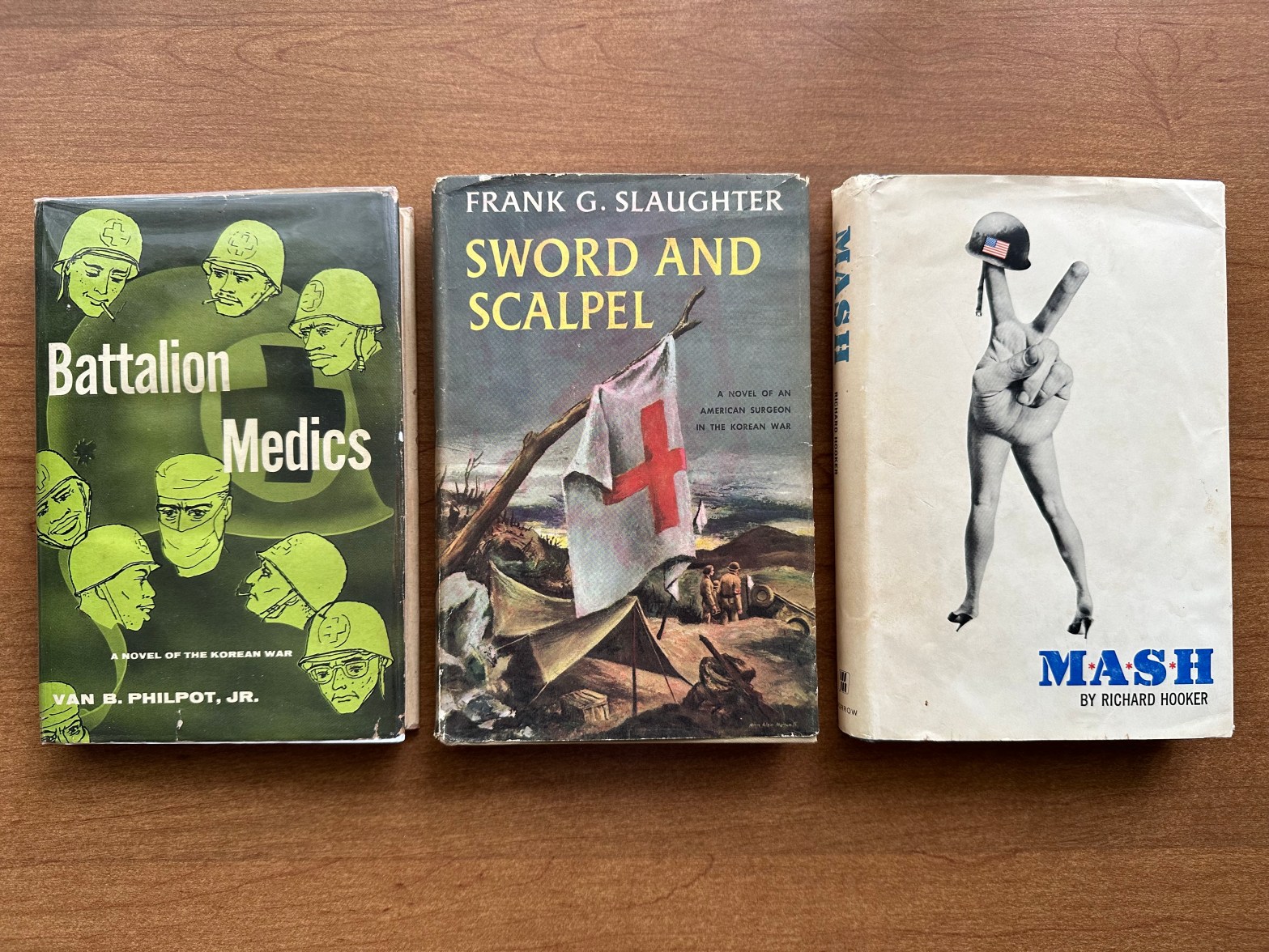
Philpot, Van B., Jr. Battalion Medics. New York: Exposition Press, 1955.
Slaughter, Frank G. Sword and Scalpel. Garden City, NY: Doubleday & Company, Inc. 1957.
Why should M*A*S*H fans care?
Slaughter and Philpot each wrote a novel about vastly different experiences of doctors in the Korean War. The novels pre-date Richard Hooker’s M*A*S*H by almost 20 years, and they provide a different perspective.
As a M*A*S*H fan, what part(s) should I read?
These novels may not be for everyone, but if you have an interest in historical fiction, or the Korean War in general, these are both great reads.
TL;DR Review
Battalion Medics and Sword and Scalpel offer different perspectives on the Korean War than Hooker’s M*A*S*H. While one shows a doctor coming to terms with his own prejudices, the other balances war with a courtroom drama. They are very different from the dark comedy presented in M*A*S*H, but that is likely due to the twenty year difference in publishing dates and the change in Americans’ attitude towards war between the 1950s and the late 1960s.
Full Review
When we think a novel about doctors at the front during the Korean War, the first, and likely only, novel to come to mind is M*A*S*H. Richard Hooker’s novel (Hooker was the pen name of Dr. H. Richard Hornberger Jr.), published in 1968, spawned the Robert Altman film and the series of the same name. The characters of M*A*S*H were relatable to an audience in the early 1970s. But M*A*S*H was not the first novel written about doctors in the Korean War. In fact, it wasn’t even the first novel about doctors in the Korean War written by an actual doctor who served in the war. Battalion Medics was written by a battalion aid surgeon and was published 13 years before M*A*S*H. Then, Sword and Scalpel, another novel that pre-dates M*A*S*H by a decade, told the story of a doctor during the war who was put in a very difficult position after he was captured by the enemy. Why are these two books often overlooked, and why didn’t they catch the pubic’s attention like M*A*S*H? Let’s take a look.
Battalion Medics
Battalion Medics was published in 1955 and was written by Dr. Van B. Philpot, Jr. Dr. Philpot was born and raised in Mississippi and went on to study at the Tulane School of Medicine where he earned his M.D. From 1951 to 1954, Dr. Philpot was an Army medical officer and battalion aid surgeon for the First Field Artillery Observation Battalion in Korea. He was awarded both the Bronze Star and the Army Commendation Ribbon for meritorious service. Like Hooker later, Dr. Philpot wrote a novel to share his experiences of the Korean War.

The novel follows Captain Clyde Hendricks, Jr. as he serves as a battalion aid surgeon in Korea. Being from Mississippi, Captain Hendricks quickly learns that he has to get past his prejudices from home. He witnesses the bravery of Army soldiers, black and white, as they fight the war and work together. Growing up in the Jim Crow era in Mississippi, Captain Hendricks learns that his bigotry was learned, and he has to get past it in order to do carry out his duty. After he serves his time and goes home, Captain Hendricks recognizes the narrow mindedness of the white supremacy around him in Mississippi. After defending a young black girl, he finds himself ostracized by his family. His medical practice is also in danger as he is threatened by a community he once felt a part of. Captain Hendricks must choose between the life he once had and recognizing the basic humanity of others.
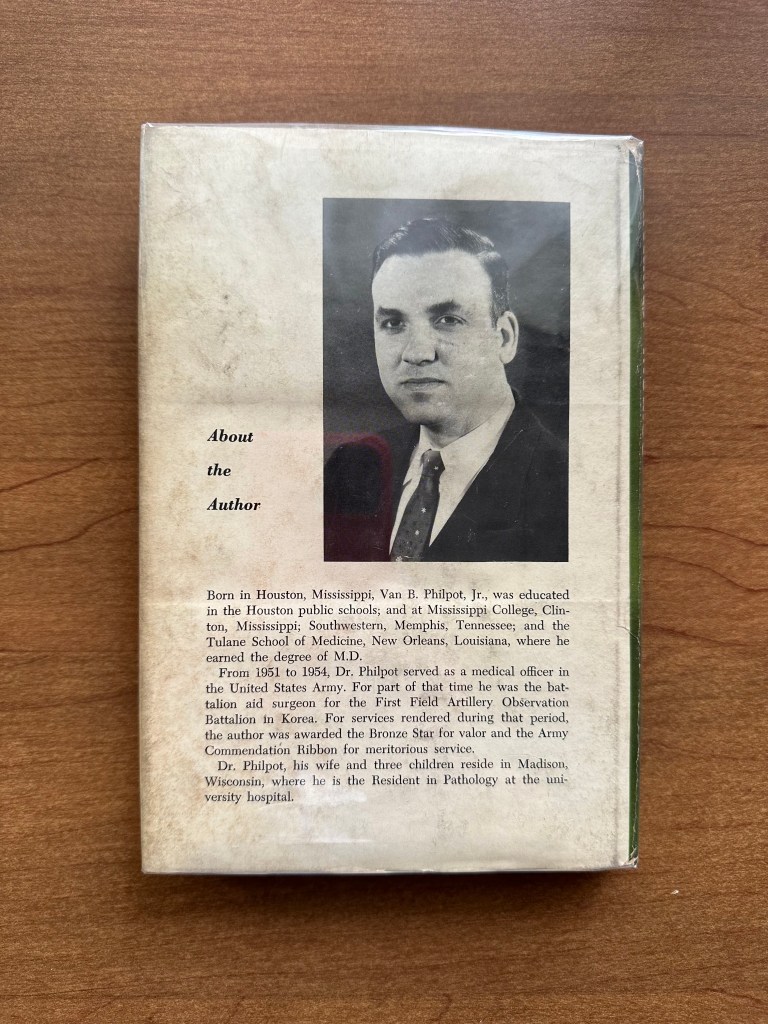
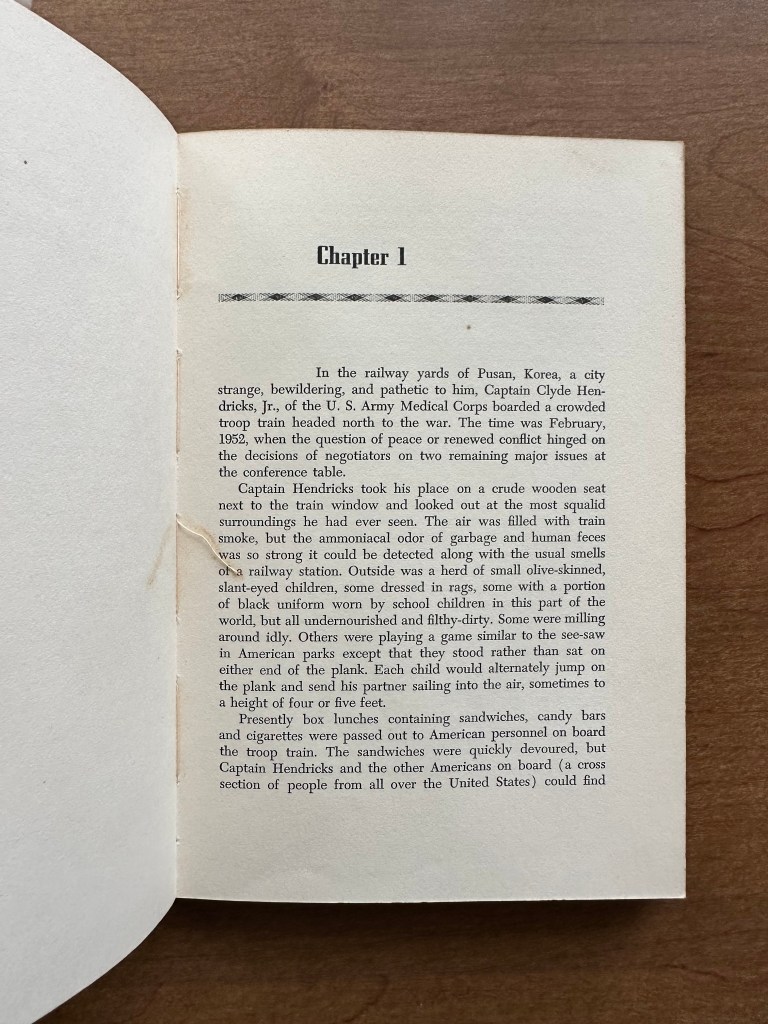
Given that this book was published in 1955, I am sure there are parts of the country that it was not widely read or accepted. Given the similarities between the main character and the author, I read this as somewhat autobiographical. I have not found many reviews or much more information on Dr. Philpot to confirm this, but it feels like he was coming to terms with his own experiences in Korea. This book is a short read, and it is very well written. In some ways, Battalion Medics feels more connected to the M*A*S*H series than the actual M*A*S*H novel does. The series often focused on the human impact of war and recognized that everyone has value.
Sword and Scalpel

The comparisons between M*A*S*H and Battalion Medics are strong, and this is also the case for Sword and Scalpel. Like Hooker and Dr. Philpot, Frank G. Slaughter was also a surgeon, but I cannot find any record of Dr. Slaughter serving in the Korean War. In addition to being a surgeon, he was an avid writer and published over 60 works of fiction and non-fiction. The majority of his books were historical fiction, and he would often draw on his experience as a doctor and his interest in history to craft his novels.
Sword and Scalpel, published in 1957, tells the story of Captain Paul Scott, a surgeon in the Army Medical Corps who was captured and held in a Chinese prisoner of war camp. Captain Scott was captured along with his commanding officer, Colonel Jasper Hardin, and his fiancé, Kay Storey. After being released from the POW camp and returning to the United States, Captain Scott faces court martial for treason since he would treat enemy soldiers in the POW camp. Throughout his trial, we learn about his work as surgeon in Korea and his time at the POW camp. The reality of the horrors of war come to light as does the brutality of the enemy camp. In the end, Captain Scott could be charged with treason for helping the North Koreans and Chinese, or his fellow POWs can help him by painting a different picture of the war.


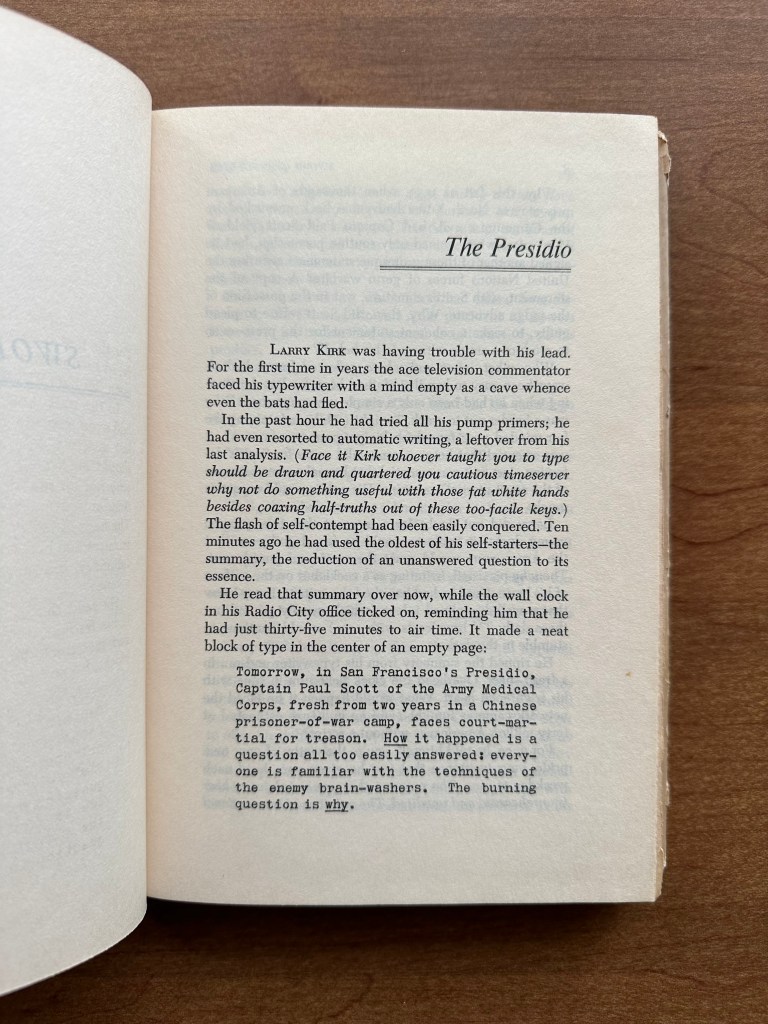
This book is very different from the internal struggles faced by Captain Hendricks in Battalion Medics and the characters of M*A*S*H. Captain Scott is facing treason charges, and the consequence could be death. The setting is vastly different as well since this novel largely takes place during the trial, and it feels like a courtroom drama with the Korean War sprinkled in. The other major difference between this novel and the other two is that Dr. Slaughter is not drawing from personal experience. I believe that the personal connection between the author and the subject matter is what makes M*A*S*H and Battalion Medics compelling. This is a very good court drama, but it is not the best work of Korean War historical fiction.
These novels feel very different from M*A*S*H, and I think that is likely due to the publication date of each. When Battalion Medics and Sword and Scalpel were published, the war was a recent memory. The people who were there had no interest in reading about it, and the public had largely forgotten about it. But the 1960s brought about a cultural change and the Vietnam War. M*A*S*H, a dark comedy satire with an anti-war theme published in 1968, found a more receptive audience. That does not discount the content of either book. I think they both have their merits, but Battalion Medics impressed me the most. The story of a Mississippi doctor struggling with his own racial prejudices in the 1950s was a story ahead of its time. Had that book been published in the 1960s, at the height of the Civil Rights movement, I think it would have found a much larger audience. For fans of the original M*A*S*H novel, I recommend adding Battalion Medics and Sword and Scalpel to your library.
 The M*A*S*H Historian