
What is it?
Farr, Jamie with Robert Blair Kaiser. Just Farr Fun. Clearwater, FL: Eubanks/Donizetti, Inc., 1994.
Why should M*A*S*H fans care?
Jamie Farr was one of the principal cast members of the series. He famously came to set for one episode in season one, and stayed for eleven years. Farr’s memoir outlines how he got to M*A*S*H and his time on set.
As a M*A*S*H fan, what part(s) should I read?
I always recommend reading a full memoir because M*A*S*H is intertwined in Farr’s story, but the primary M*A*S*H content is in chapters 15 – 27. That is about 120 pages, or one third of the book!
TL;DR Review
Through fun anecdotes and stories, Farr presents the story of his life (up to that point) in a memorable memoir. His time on M*A*S*H features prominently, and is arguably the primary focus of the book. Farr’s career on stage, his work on both the big and small screen, and his family life are all detailed in this intimate book from 1994.
Full Review
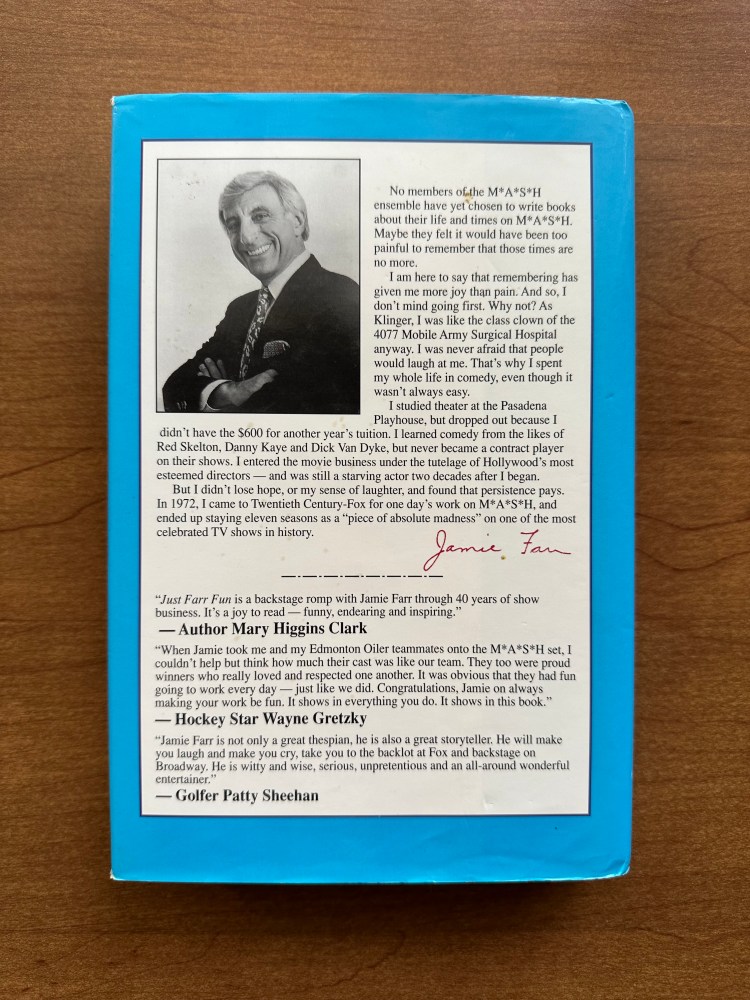
Farr opens his memoir with a line from his wife, Joy, “You know, Jamie, you are one lucky sonuvabitch.” From there, he recounts his early life and career highlighting how his connections and luck led to his successful career. Beginning with his early television work in the 1950s, his stint in the Army in Korea, and then making a comeback in Hollywood, Farr had the support of some important people. It was one of those connections, with Gene Reynolds, that landed him on M*A*S*H. The role of Corporal Maxwell Q. Klinger is likely what he is best known for, but his career on television, film, and stage go far behind our favorite dress-wearing corporal. In Just Farr Fun, we see the journey that led to Farr becoming a household name.


Farr’s story began in Toledo where he was born Jameel Farah, the name he would use in his early theater and television career. When he moved to California, he began performing on stage in theater productions. But it was in the 1950s that he found his way to the to The Red Skelton Show (learn more about Farr and Skelton’s relationship in this documentary) and on television. He only appeared in a few episodes of the show before being drafted into the Army. Farr was sent to Korea where he met Skelton again and was assigned to Skelton’s tour of Korea entertaining troops. He remembered Farr, and Skelton told him that if he had trouble getting back into the business after he got out of the Army, he should look him up. Farr returned to California and found it difficult to get back into acting. So, he contacted Skelton, and true to his word, he helped Farr get back on television where he began making guest appearances on shows such as The Dick Van Dyke Show and The Andy Griffith Show. It was his connection with Skelton that got him on television the first time, and allowed him to jump back in when he got home.
Farr kept getting small roles that paid the bills, but it was appearance on an episode of F Troop that introduced Farr to Gene Reynolds. When Reynolds was casting parts for the television adaptation of M*A*S*H, he thought of Farr and cast him as a one-time character named Corporal Maxwell Q. Klinger. The character kept appearing throughout the first season, and Farr would become a series regular in the show’s fourth season. Farr recounts his time on M*A*S*H, bonding with the cast, and the challenges that the series faced in its early seasons (mostly with the network censors). Farr spends roughly one third of the book discussing M*A*S*H, and he does an incredible job of recounting the story of how the principal actors were cast, how the show balanced comedy and drama, and offering his impressions of the cast and characters.
Farr goes beyond recounting the story of M*A*S*H and its iconic finale. He tells behind the scenes stories, recounts the difficult time some actors had on set, and the challenges of changing cast members. He also provides an interesting assessment of his character, Klinger. He discussed how Klinger’s character borrowed from his own life (being from Toledo, loving Packo’s hot dogs, and being a Mud Hens fan) and was allowed to grow. Klinger began as a joke. Sure, he did his job as a corpsman, but he was often the butt of jokes with his Section 8 schemes and dresses. However, in season eight, Klinger was made the company clerk replacing Radar, and the character evolved. Farr points out that Klinger wasn’t the only character to evolve over the show’s eleven year run, however. Between the sad times (Col. Blakes death) and fun times (the cast’s behind-the-scenes practical jokes), Farr provides insight into life on M*A*S*H.

Just because Farr was a regular on M*A*S*H, he knew the series wouldn’t last forever and he wanted to branch out. Before the series ended, he had started to try new things and seek other roles. He tried being a stand-up comedian, returned to the stage, appeared on game shows, and appeared in several movies, including the cult classic The Cannonball Run with Burt Reynolds. He would also return to Toledo for golf tournaments and fundraisers, support local charities in Los Angeles, and support the Pearl S. Buck Foundation. The foundation supported children of American G.I.’s and local women in Korea, Okinawa, the Philippines, Taiwan, and Thailand as they were often shunned in their societies. Farr discusses how this was an important charity to him and the cast of M*A*S*H. There was an episode about the difficulty half American children faced (“Yessir, That’s Our Baby” (08×15)), and Alan And Arlene Alda donated the proceeds from their book, The Last Days of M*A*S*H, to the foundation.
Since this book was published in 1994, Farr has lived nearly another 30 years, but this book is the definitive account of his life up to the at point. Seeing the connections he made, and how one role led to another, we learn how Farr came to be on M*A*S*H and become a household name. After reading this book, I have to disagree with Mrs. Farr, however, that he was “lucky.” He worked hard and earned every bit of the success he achieved. Farr’s story is a great lesson in how making connections and connecting the dots can lead to a successful career in anything you do. This is a well written memoir, and a great M*A*S*H book. Sadly, it is no longer in print, but used copies of Just Farr Fun are available online. I highly recommend adding it to your M*A*S*H collection.
 The M*A*S*H Historian
Social media is buzzing with a story of an incident that I have not yet been able to independently verify. Can you confirm the incident?
I have never before heard this story. In the late-1970’s, the cast of “M*A*S*H” was on a publicity tour. After interviewing w/ the media and signing autographs, the cast moved on to their 5-star hotel. The hotel staff politely REFUSED to allow Jamie Farr, (“Klingler”), to register into the hotel.
Alan Alda, (“Hawkeye”), was the first to say “If Jamie is not welcome then neither am I”. The rest of the cast quickly followed Alan’s lead and they all turned in their room keys & departed the hotel. The cast stayed together at a less opulent hotel. Emphasist on the word “together”.
LikeLike
I have never heard this story said by any of the cast members. There are a lot of fake stories on Facebook about the M*A*S*H cast getting together, or seeing each other now. But that just isn’t true. They really don’t live near each other, so it would be logistically challenging. In the latest episode of M*A*S*H Matters, Jeff Maxwell and Ryan Patrick address growing number of fake M*A*S*H cast stories circulating on the internet. I highly recommend checking it out!
LikeLike