

In the first season of M*A*S*H, the episode “Dear Dad” (01×12) started a style of episode that would be used a number of times throughout the series. I really like these episodes, and I think they were an effective way to introduce a new character. A “Dear” episode was used for Col. Potter with “Dear Mildred” (04×07), and another episode was used, although not titled the same, for Major Winchester with “The Winchester Tapes” (06×05). Of course, Col. Potter wasn’t M*A*S*H‘s only new character in season four, and the style of episode was used for B.J. with the episode “Dear Peggy” (04×10). In the episode, we learn more about B.J., his family, and his thoughts about the members of the 4077th. The episode was a great way to meet B.J., and the script for this episode offers some interesting insight into some of the processes of ensuring the sets were ready for production. Let’s begin with the script, then we’ll look at the episode.
The Script

The copy of the script in my collection is a final draft dated August 18, 1975. The episode aired on CBS November 14, 1975, and it was directed by Burt Metcalfe. He was an executive producer on the series, but he is also credited with directing 31 episodes from season four through season eleven. The episode was written by the team of Jim Fritzell and Everett Greenbaum, who are credited with 24 episodes. How can you tell they were a writing team as opposed to collaborators for this episode? The names of collaborators are typically separated by the word “and” while writing team members names are separated by an ampersand (Fritzell & Greenbaum, Ken Levine & David Issacs, etc.).
There is no indication of who this script belonged to, but it likely belonged to a production assistant since it has several of the production documents and budget details. There aren’t any daily Call Sheets, but the script does contain the Shooting Schedule. This document broke down the typical four days of filming and which scenes would be filmed each day. The cast required for the day and the filming location (the Fox Ranch/Malibu Creek State Park or Stage 9 on the Fox lot) were also listed for each day of filming. There is another familiar sheet here as well. The Cast Sheet listed each of the actors, their agency and agency’s contact info, their home contact information, and their salaries. Although, the salaries were only listed for the guest cast and extras. This document would have been very important to ensure that the episode’s budget was balanced with its casting needs.
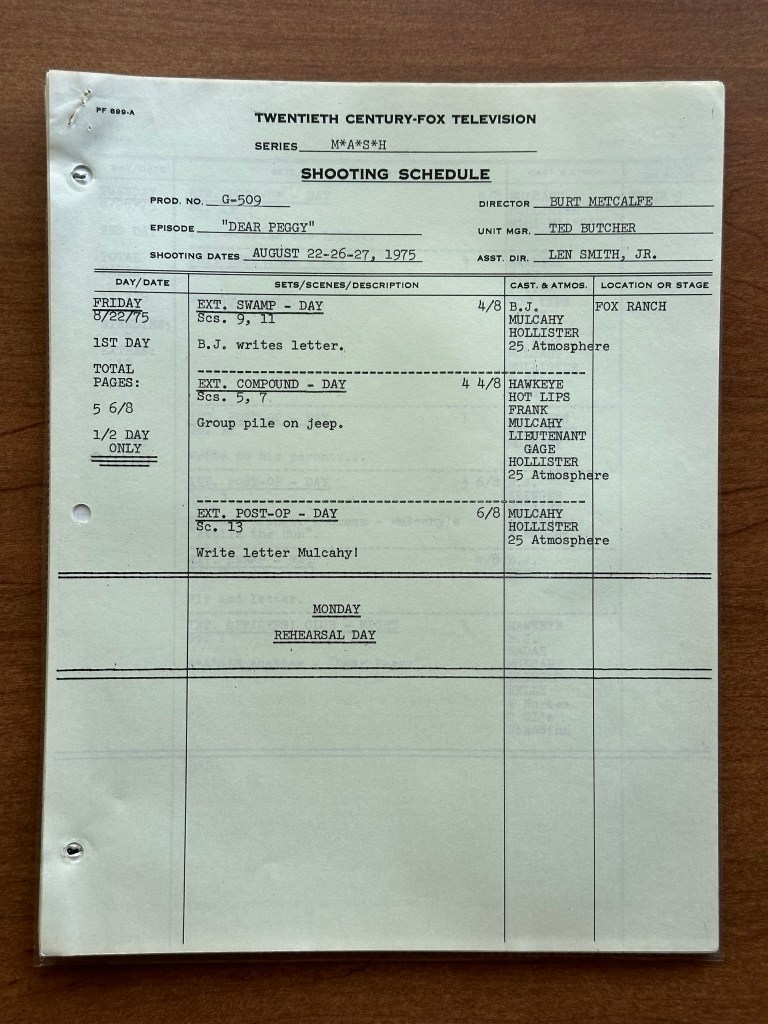


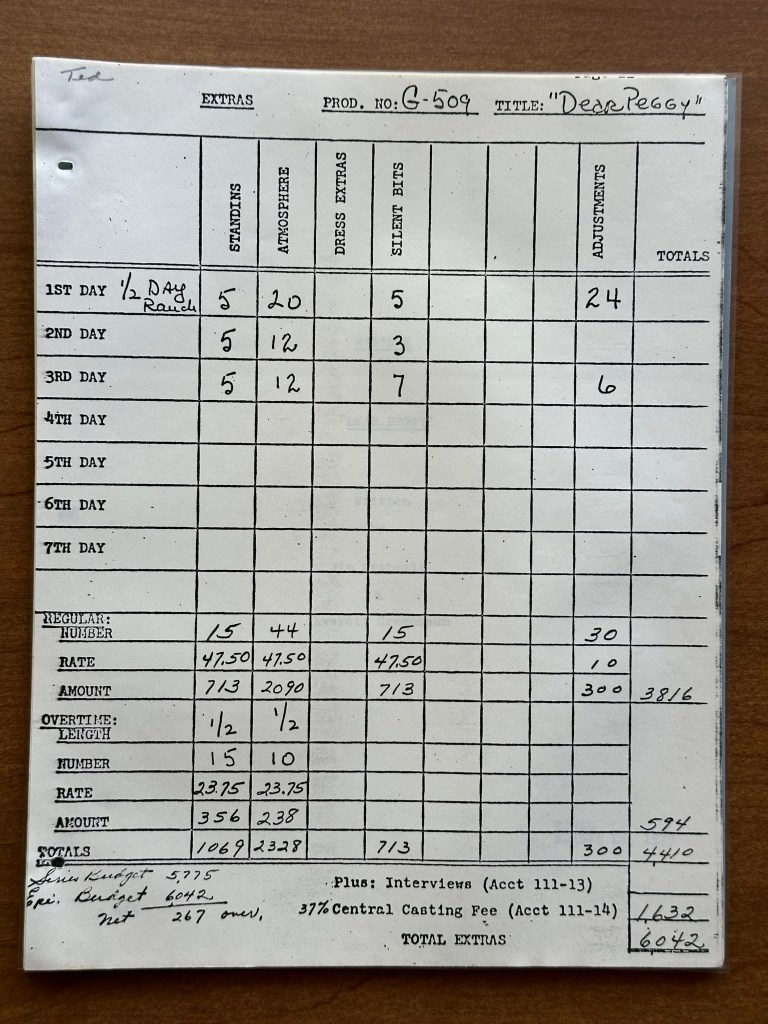
The script includes a few other documents that I have only seen a few times. The first is the Cast Requirements sheet which listed every character in the episode and indicated which days they were needed on set. For this episode, there were five days, and the third day was rehearsal. Filming must have been completed in two days, with the table read and blocking (determining how people and objects were to be arranged for filming) completed the first two days. I find it interesting that Harry Morgan and Jamie Farr were not needed the first two days, but the rest of the primary cast was. Another document in this script was from the art department. It detailed the props and materials needed on set for filming. It also notes the costs incurred by the art department as this would be an important considering to ensure the episode remained on budget. Finally, there is an Extras sheet that detailed how many standins, atmosphere, dress, and silent extras were needed for each day of filming. This sheet also includes the cost, as these actors were paid by the day and a fee set by the actors’ union.
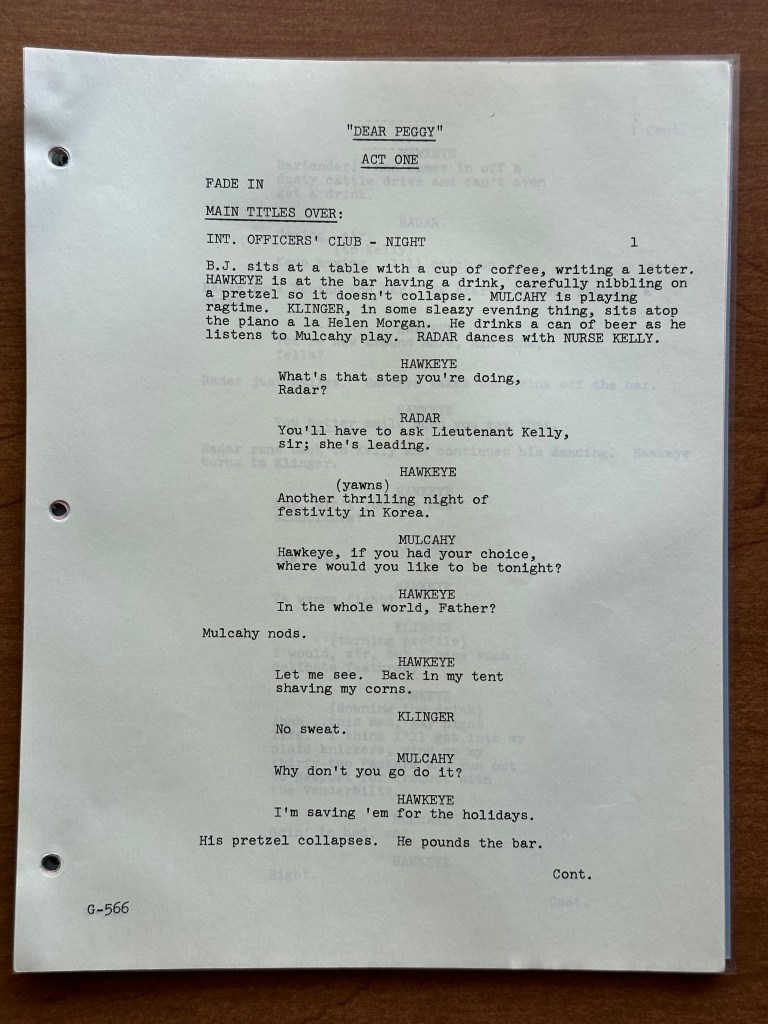
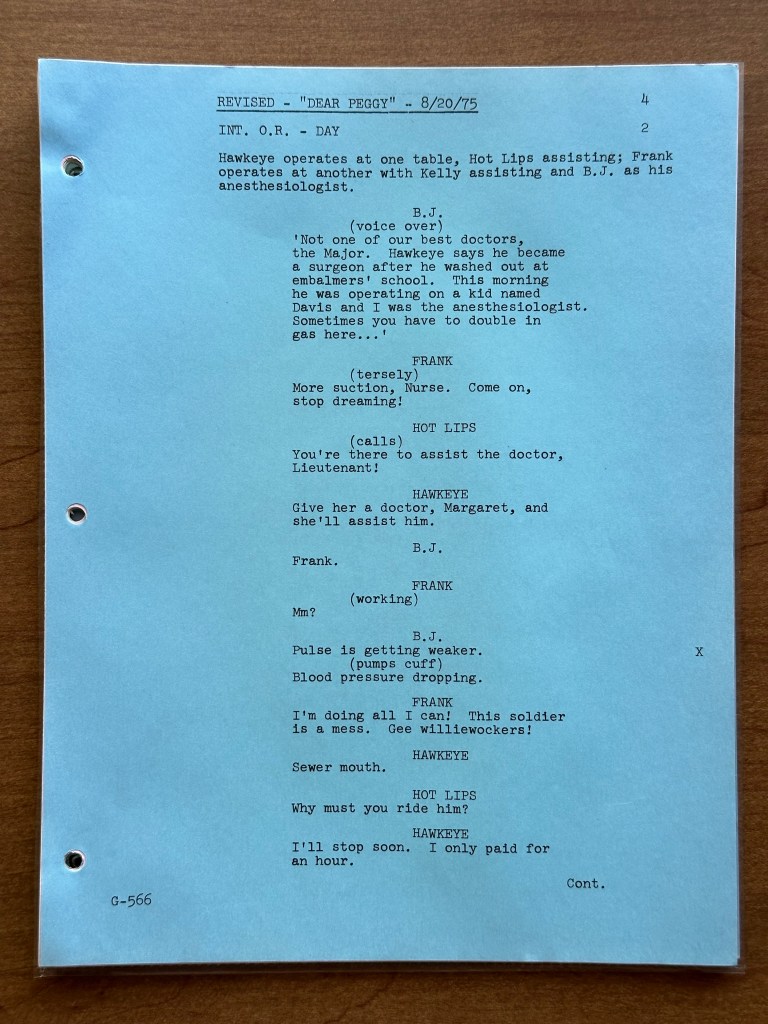


This script is rich in production documents, but the script’s “features” didn’t stop there. It also includes three sets of revised pages. The first are dated August 20, 1975 (blue), then August 25, 1975 (pink), and August 26, 1975 (green). Sadly, the original pages weren’t saved, so I can’t note the revisions, but this script is pretty complete. While it doesn’t have the Call Sheets and it doesn’t have Albert Frankel’s wardrobe pages, this script gives insight into the costs associated with producing a single episode of M*A*S*H. It took a lot of people and money to produce 26 minutes of television. I frequently say that every script is unique, and this script offers some of the most interesting insights into the production of a television series in the 1970s.
The Final Episode

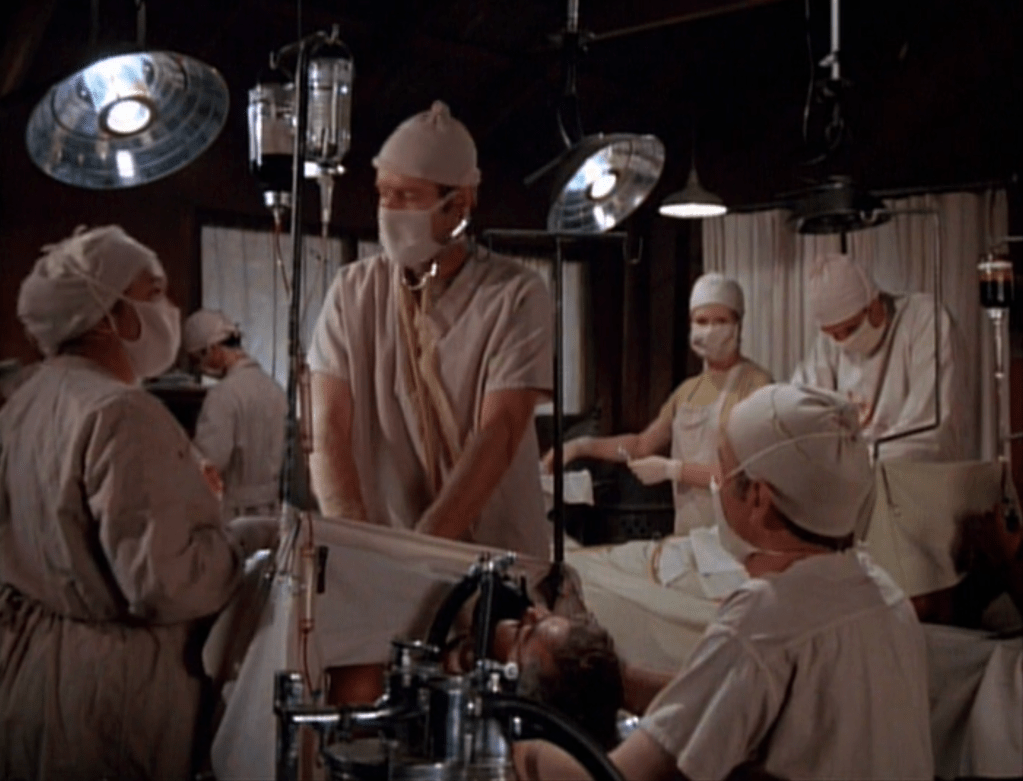

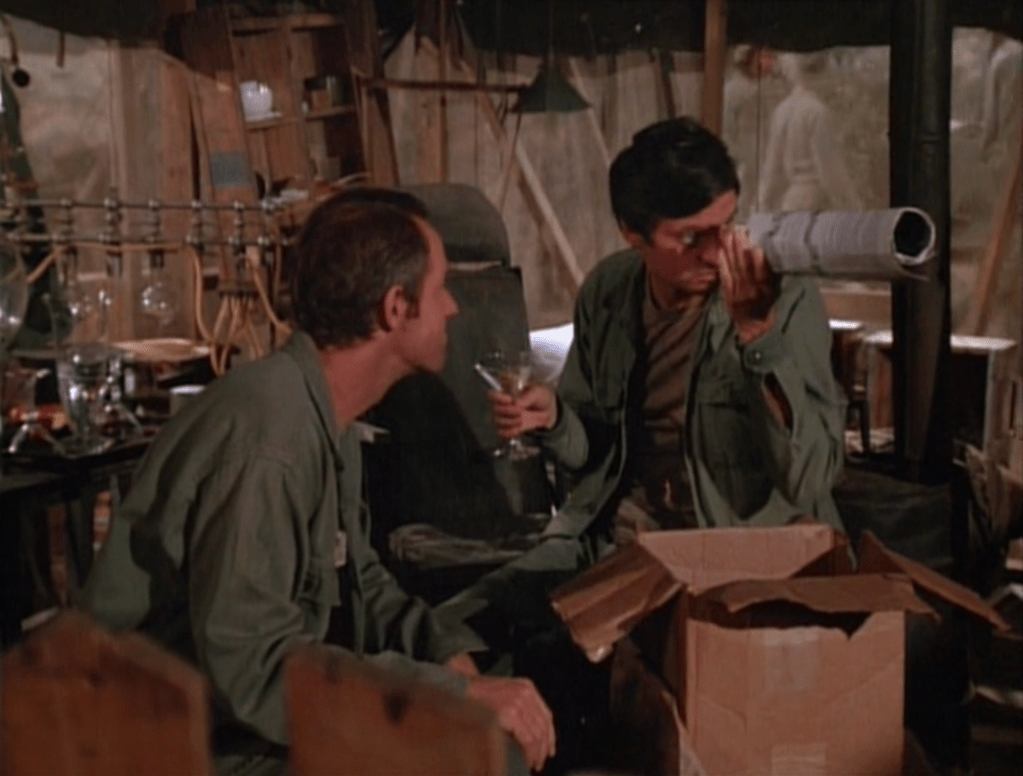
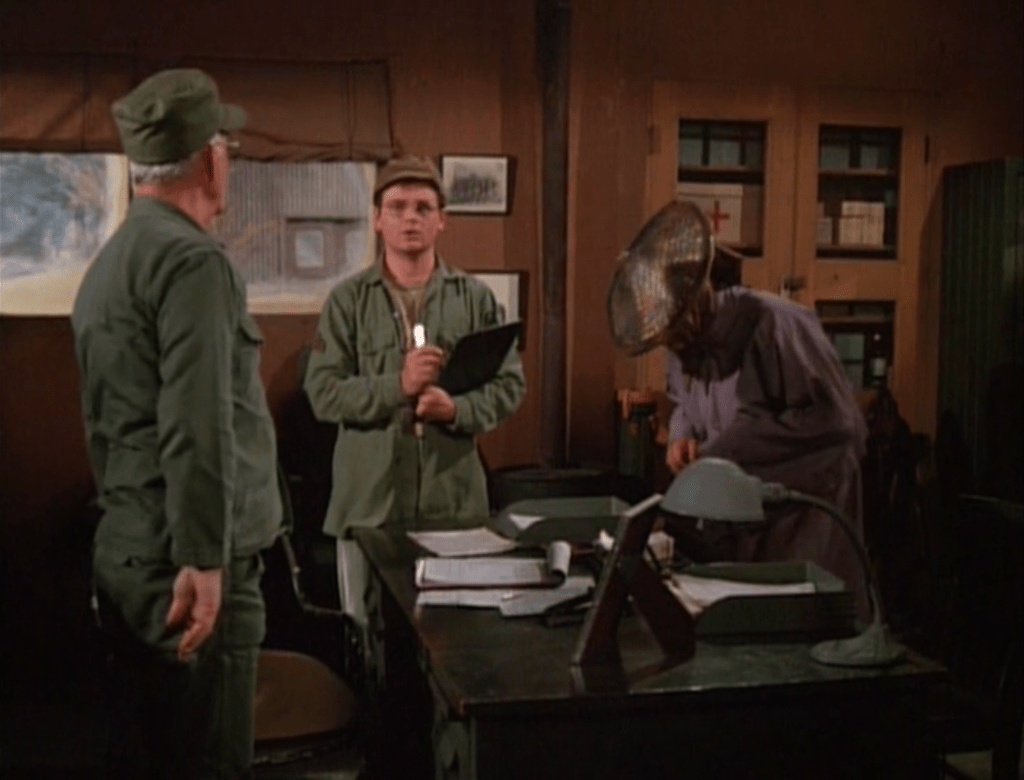


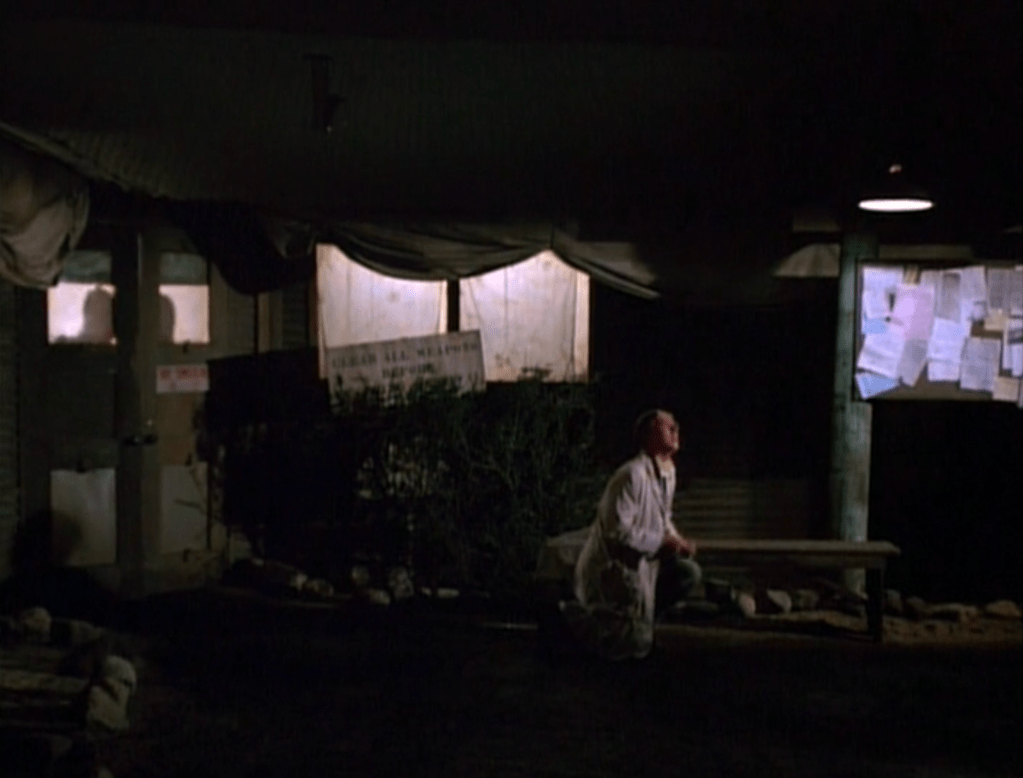
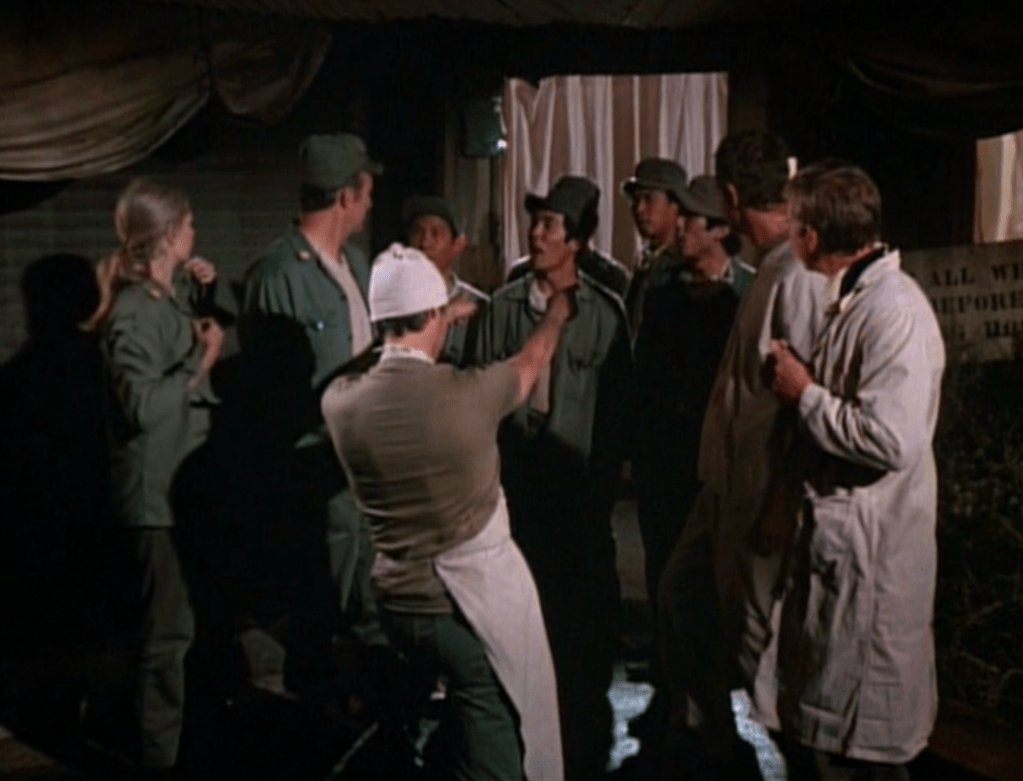
The episode opens in the Officers’ Club, and everyone is bored. Radar is dancing with Kellye as Father Mulcahy plays the piano. Hawkeye is sitting at the bar, and B.J. is at a table in the corner writing a letter home to his wife, Peggy (later shortened to just Peg). In the letter, he tells her about the people at the 4077th and discusses a few recent events. He talks about Hawkeye stuffing people into a Jeep to break a world record and be featured in Life magazine. Klinger is up to his usual antics of trying to get out of the Army. But the main two stories revolve around a patient that B.J. saves named Davis and a visitor coming to inspect Father Mulcahy. B.J. keeps a close eye on Davis’ recovery while Mulcahy prepares for the arrival of divisional chaplain Col. Hollister (Ned Beatty). Unfortunately for Mulcahy, Col. Hollister arrives just as Hawkeye is stuffing everyone into the Jeep…including Father Mulcahy. After Mulcahy’s Sunday sermon (which everyone attends), Col. Hollister tries to get Mulcahy fired up. He would like to see him more assertive, and later, he has Mulcahy write home to Davis’ family that he is going to be okay. Of course, that happens just as Davis needs a second operation, but he thankfully pulls through.
I have mentioned before that I really enjoy these episodes because they feel fast paced and are more episodic. We get glimpses at different things happening at the 4077th with quite a few scenes. This must have been more difficult to produce since there would have been more, shorter scenes to film. The scenes of Klinger’s attempted escapes (as the Korean woman and with the inflatable raft) are classic Klinger! And then, Frank and Hawkeye teaching the Koreans English so they can help in hospital, is another classic moment. Especially when at the end they say “You tell ’em, Farret Face” to Frank! The episode is so well paced and the two primary storylines keep the episode moving and tie together nicely with the letter Mulcahy is forced to write to Davis’ family.
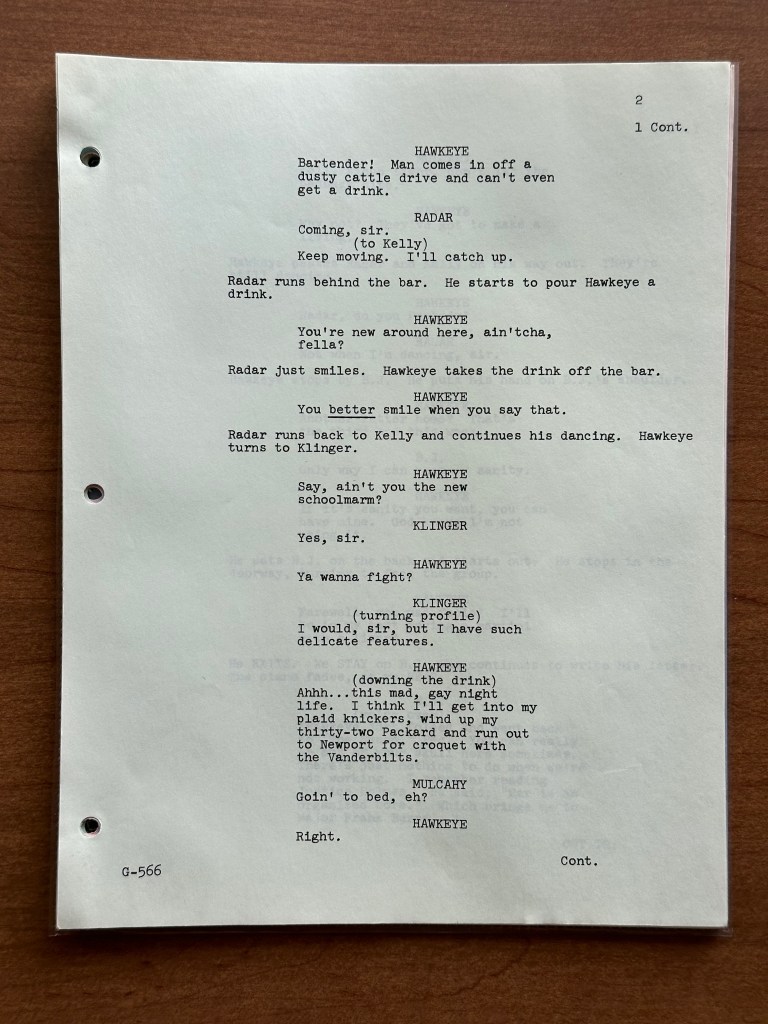


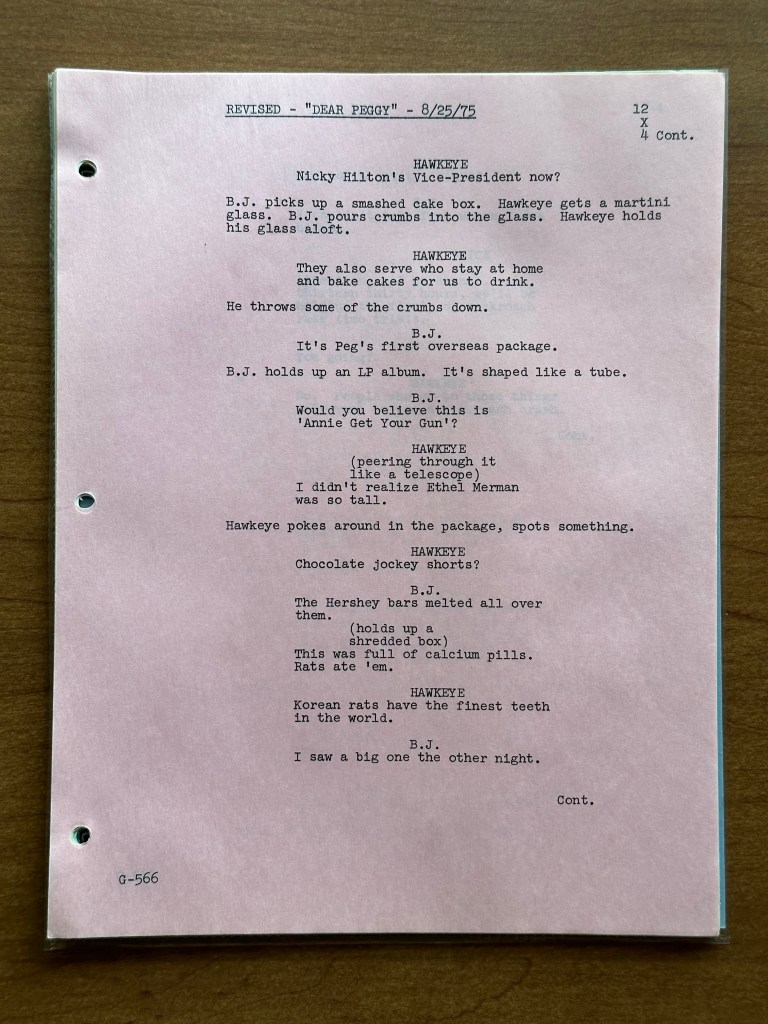
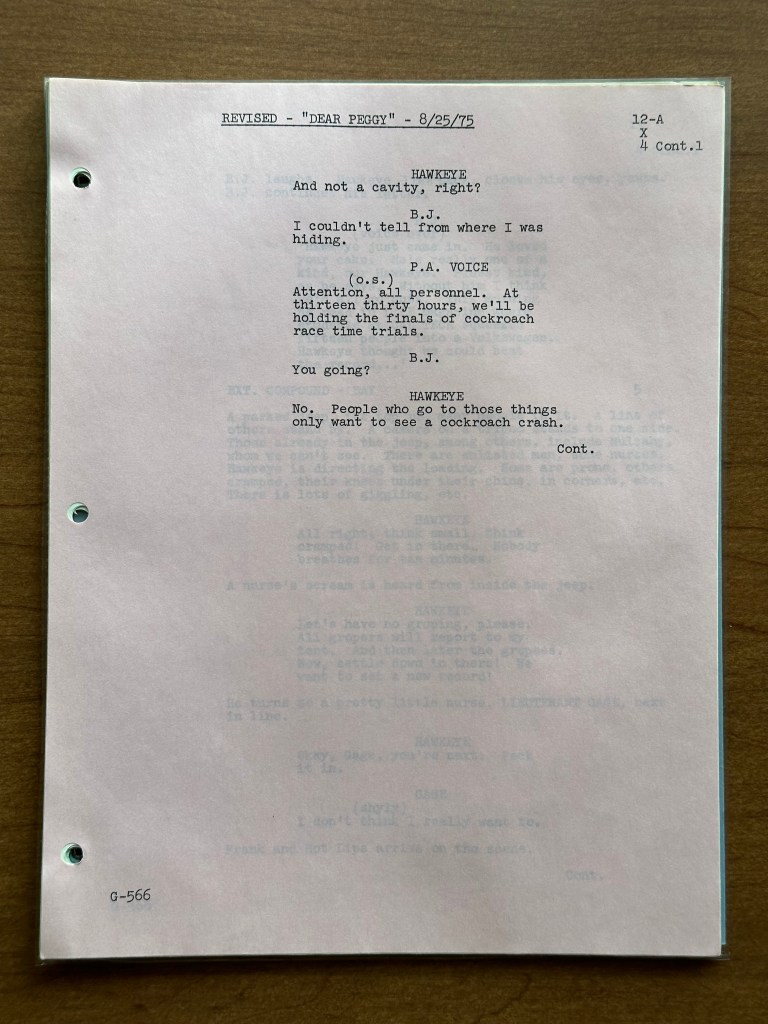

As always, the script and final episode are very close to each other. There were not many changes, and there are very few line variations as well. The actors did a great job of sticking to the scripts as written. There were some scenes that were slightly longer or different between this draft of the script and final episode, however. The opening scene in the Officers’ Club is longer and in a slightly different order in the script (pages 2 – 3). The scene where Klinger is telling B.J. about his dream of going home is slightly different as written (page 8). In the Swamp, when Hawkeye and B.J. are talking, the scene was written longer (pages 12 – 12-A). And there are additional excerpts from B.J.’s letter that did not make the final episode (page 24). While there is no indication of future revisions, it is possible many of these lines were simply cut for time.
As I mentioned in the introduction, I believe that the “Dear” someone episodes of M*A*S*H work well because they introduced the audience to the character’s family, and we got to hear their inner thoughts. We saw what each character thought about the other characters, and how they felt about being at 4077th. “Dear Peggy” is a very good episode because it was only B.J.’s tenth episode in the series, so it was important to get his character established as quickly as possible. That would have been a challenge for the M*A*S*H team as they were introducing two characters at the same time. They made the transition successfully, however, and I still maintain that it was the well executed cast changes that allowed the series to be successful for eleven years.
 The M*A*S*H Historian
I know you have explained this, in the past, but I have forgotten:How have you come into possession of so many scripts?
Edward Barr
LikeLike
I have been collecting the scripts for over 17 years, and I have acquired them from people who were on the show and various auctions. I keep a close eye out for scripts!
LikeLike