

What is it?
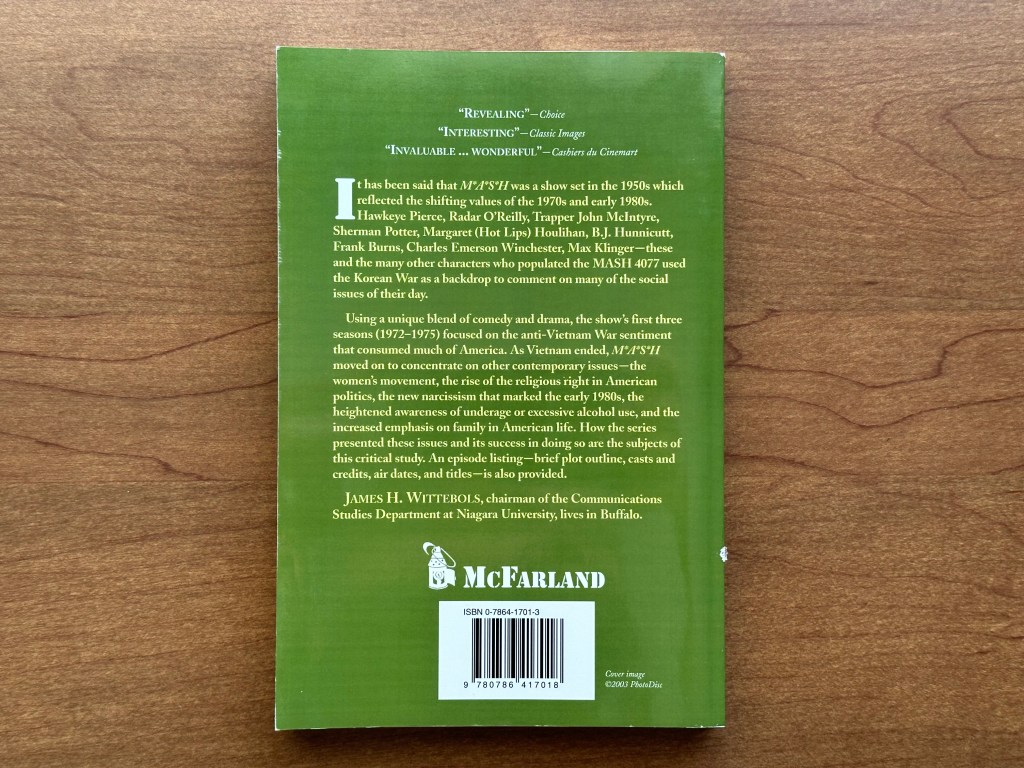
Wittebols, James H. Watching M*A*S*H, Watching America: A Social History of the 1972 – 1983 Television Series. Jefferson, NC: McFarland & Company, Inc. Publishers, 1998.
Why should M*A*S*H fans care?
It has been often said that television shows reflect the culture of the time in which they were produced. Even though the series takes place in the 1950s, there are many themes from the 1970s sprinkled in. M*A*S*H spanned eleven years and part of two decades, and this book breaks the series down into six eras, and explores what influenced the series in each of those eras.
As a M*A*S*H fan, what part(s) should I read?
The entire book is a great read! I love history and placing historical events into a broader context, so I found the book to be really relevant to understanding why M*A*S*H‘s tone changed over the years.
TL;DR Review
M*A*S*H fans have often broken the eleven seasons into three distinct eras based on the cast and the tone of the series. In this book, Wittebols breaks M*A*S*H down into six eras and explains how the events in the United States and in popular culture contributed to the tone and events portrayed in the series. His arguments are convincing, and placing M*A*S*H into historical context helps explain some of the storylines, especially later in the show’s run.
Full Review

Television shows are a reflection of the culture in which they were produced and are an artifact of a time and place. Shows like I Love Lucy and Leave to Beaver are very 1950s while shows like Roseanne and Friends defined the 1990s. Just as the war in Vietnam was winding down, a series about war began on CBS. M*A*S*H debuted in 1972, and gained in popularity. It ran eleven years ending in 1983, which means that it outlasted the war in Vietnam and pushed into a new cultural era. That means that the show had to adapt to the changing culture, and in his book, Watching M*A*S*H, Watching America: A Social History of the 1972 – 1983 Television Series, James H. Wittenbols argues that is part of what made the show successful.
As M*A*S*H fans, we know that that M*A*S*H went through several major changes over its eleven year run. Most of us define the different eras of M*A*S*H by cast changes. But, as Wittenbols successfully outlines, it is important to remember that M*A*S*H didn’t happen in a vacuum. The series was on at the same time as other socially conscious shows such as All in the Family, The Jeffersons, and The Mary Tyler Moore Show. Events such as the Vietnam War, Civil Rights, and the Equal Rights Amendment, influenced the writers and cast of M*A*S*H. If you showed a friend an episode from season one of M*A*S*H, and then watched an episode of season eleven right after, you might think that you were watching a different show. Aside from the obvious cast changes, the tone of the show shifted. This is not necessarily a bad thing. M*A*S*H adapted to what was happening in society and on television. It had to adapt to survive.
Illustrating the changes that M*A*S*H underwent is where Wittebols’ book is the most successful. As I mentioned, he divides M*A*S*H into six distinct eras, and he doesn’t define it based on the cast. He focuses on the changing tone of the series, and he compares the change in tone with cultural events in the United States, and what other shows were doing in primetime television. For example, the novel M*A*S*H by Richard Hooker and the Robert Altman film M*A*S*H were both released at the height of the anti-war protests in the United States. The tone of both the novel and movie are very dark and anti-war. Being on network television, M*A*S*H fought the sensors and toed the line when it came to showing the horrors of war in its first season. However, that changed as time went on. Part of that was in part due to the war being shown on the nightly news on a daily basis. The American population saw real war on television, so seeing blood and operations on M*A*S*H became less of an issue as the series went on. The series never shied away from showing the realities of war. That was a constant theme throughout all eleven seasons, and in the finale, we see how the war took its toll on the members of the 4077th.
The Vietnam War was largely over by 1975, so the tone of the show changed from being anti-war to reflecting the other social changes of the time: Civil Rights and Women’s Rights. The Equal Rights Amendment was a cause that many members of the cast and writers of M*A*S*H supported, and the changes to Margaret’s character illustrates that. She was “Hot Lip” Houlihan in the early seasons and the mistress of Frank Burns. However, by the end of the series, she was more independent, had been divorced, and leaned into her rank in the military. They even dropped using the “Hot Lips” nickname (although they did keep the name in the scripts for all eleven seasons). There were other changes throughout the series as well. As the series progressed, there was less infidelity with the characters, and there was even more discussion around the dangers of alcoholism. Despite the tonal changes, M*A*S*H felt “real” to people because it fictionalized actual events. There was a Korean War. There were MASH units in the Korean War. The stories used in the series were often taken from MASH doctors and nurses. Sticking to the core belief that M*A*S*H should represent the realities of war is what kept the series grounded through societal change.
Fans often have a favorite “era” of M*A*S*H. Some prefer the early years that leaned more into the comedy side with sprinkles of reality. Others appreciate that the show matured and focused more on the realities of where the characters were and their situation. There is still comedy, but it wasn’t the linchpin that held episodes together. Overall, I agree with Wittebols’ assessment that while M*A*S*H was set in 1950s, it reflected the social and political attitudes of the 1970s and 1980s. Even today, M*A*S*H has aged fairly well because the show runner’s never forgot their core value to portray the human cost of war. There are certainly dated attitudes and references in M*A*S*H that would be problematic if the series were being made today, but the central message of the series still connects with people. Part of that is because war is still a relevant topic across the globe, but, more importantly, the human experience is universal. War is horrific. People use humor to cope with horrific experiences. M*A*S*H combines these principles well, and I believe that understanding where M*A*S*H came from really helps put this all in perspective. While Wittebols’ assessment of M*A*S*H may not be for everyone, I think it deserves a spot on the M*A*S*H fans’ bookshelf. It is still in print, and available on Amazon.
 The M*A*S*H Historian
2 thoughts on “From the M*A*S*H Library 38: “Watching M*A*S*H, Watching America””