
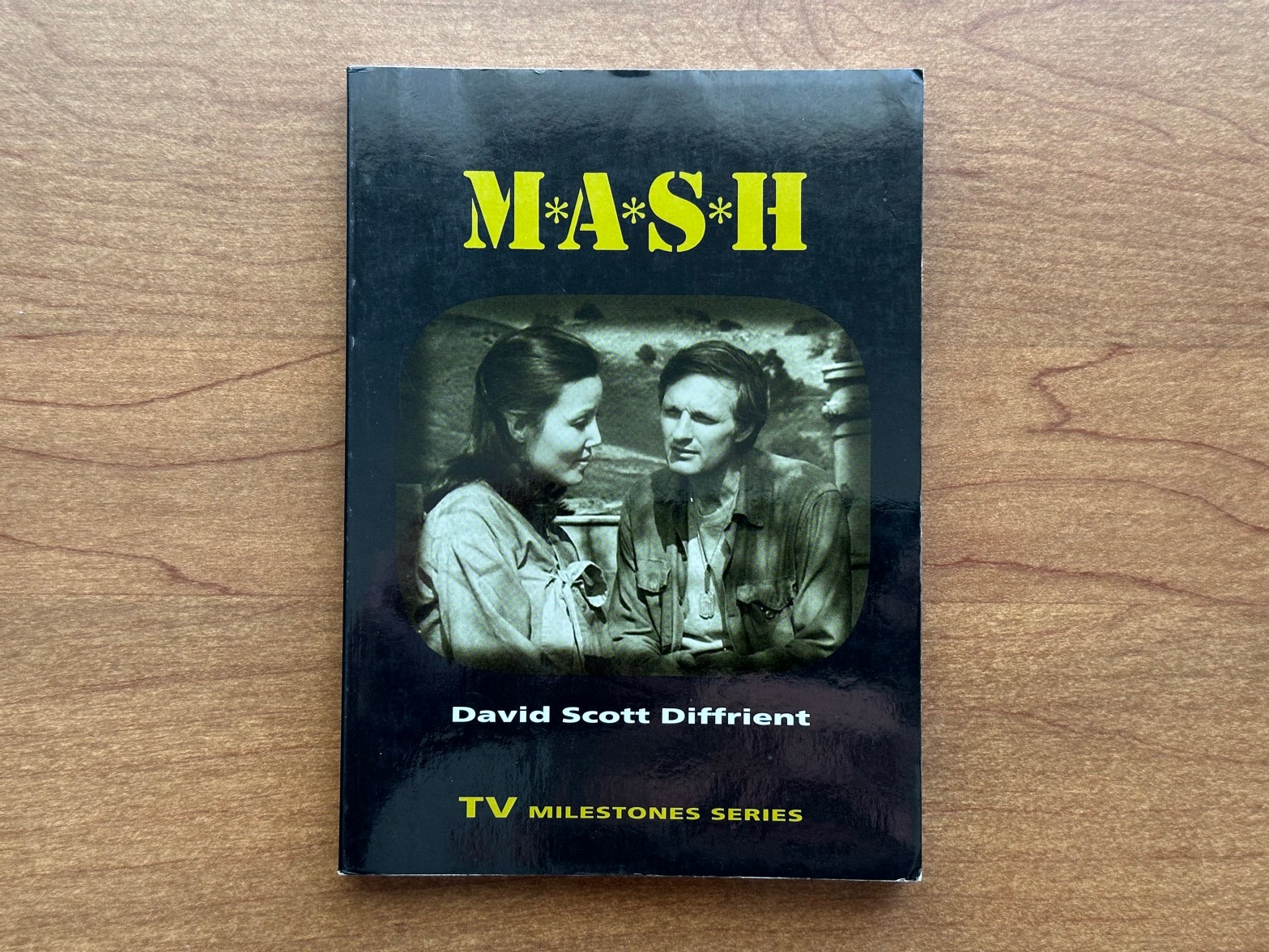
What is it?
Diffrient, David Scott. TV Milestones Series: M*A*S*H. Detroit: Wayne State University Press, 2008.
Why should M*A*S*H fans care?
Now that M*A*S*H, as a complete series, is 40+ years old, there are researchers and historians placing the series into the history of television the greater historical context of their time. In under 150 pages, David Scott Diffrient does this with M*A*S*H. It is a condensed overview of the series, how it fit into the 1970s and early 1980s, and why it is still relevant today.
As a M*A*S*H fan, what part(s) should I read?
As with most books I review, I recommend reading all of it! Each of the eight chapters (not counting the introduction and conclusion) offer interesting insights into the series.
TL;DR Review
Wayne State University Press has curated a collection of retrospective books for television series that have had a cultural impact. M*A*S*H is without a doubt one of those series. In this compact book, Diffrient dives into the themes and significance of M*A*S*H from when it originally aired to the present day. This book is a great way to quickly get an overview of the series and learn about its cultural significance.
Full Review
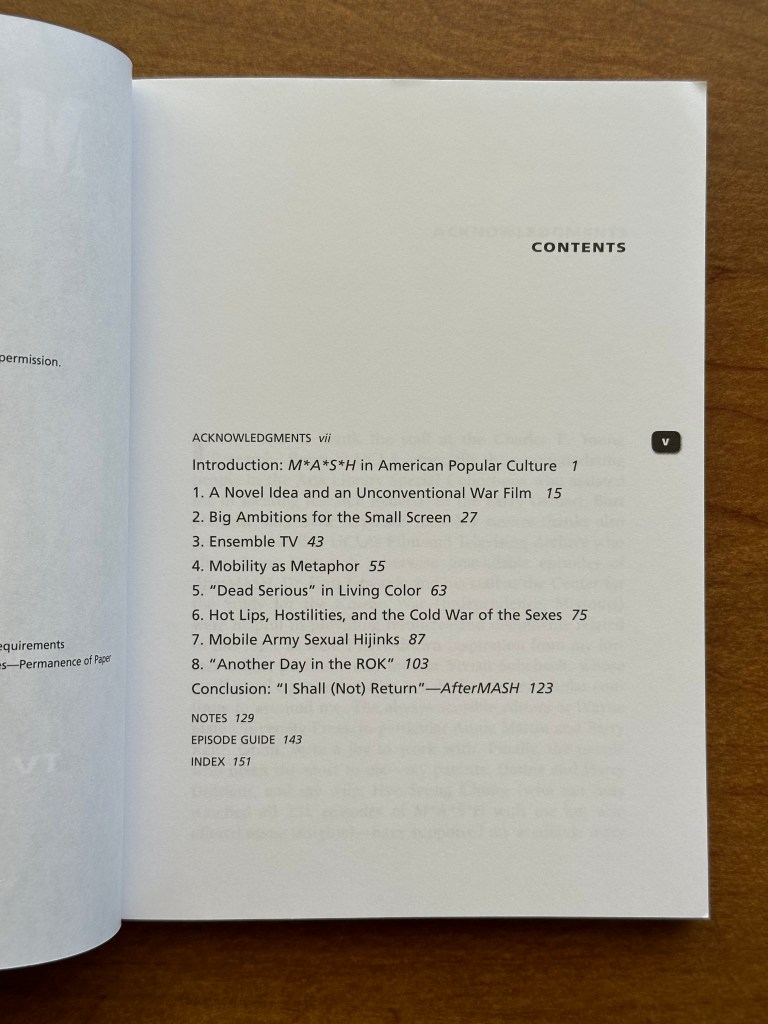
With television shows and movies, it is often hard to tell when they debut whether they will have a cultural impact. It is only when we look back that the significance of certain television shows and movies becomes clear. This has been the case for M*A*S*H and several other series over the history of television. Wayne State University Press has curated a series of books in a “TV Milestones Series” that highlights shows that had real cultural significance. Author David Scott Diffrient wrote the book on M*A*S*H for this series, and it is a great introduction to the series and its place in television and cultural history.
Several months ago, I wrote about the book Watching M*A*S*H, Watching America: A Social History of the 1972 – 1983 Television Series which is a deep dive into the cultural significance of M*A*S*H. It is one of the few “academic” books that has been written about the series. There have been several deep dives into the minute details of the series written for the die-hard M*A*S*H fans (I have written about several including M*A*S*H: The Exclusive, Inside Story of TV’s Most Popular Show, The Complete Book of M*A*S*H, and TV’s M*A*S*H: The Ultimate Guide Book), but there is room in the middle of the series deep dives and the big cultural studies for a book that offers an overview of M*A*S*H from a historical and cultural perspective. This little book (it’s under 150 pages) does just that.
Diffrient begins where M*A*S*H started with the original novel by Richard Hooker in 1968. He wrote the novel based on his experiences at the 8055th MASH unit in the Korean War. The rights to the novel were purchased by 20th Century Fox, and the Robert Altman directed M*A*S*H feature film was released in 1970. Its anti-war attitude and dark comedy made the movie a surprising success. Fox enlisted the help of Larry Gelbart and Gene Reynolds to develop M*A*S*H for television, and the series was born. Diffrient outlines what made M*A*S*H special over the course of its 11-year run. Chief among those were the fact that the show did not make light of war, but instead showed the harsh reality of war when characters would died.

M*A*S*H fans are familiar with the basic outline of the series, and how the show adapted as the cast changed. Diffrient approaches M*A*S*H from a slightly different perspective and explores why the series was successful for so long. He points out that the ensemble cast was a major factor as to why the show worked. Even when the cast changed, the new characters seemed to immediately fit in a way that allowed viewers to be comfortable with the change. He explores how characters were allowed to develop over time, and he focuses specifically on the character of Margaret and how she went from the “butt of the joke Hot Lips” to “take charge Major Margaret Houlihan.” This was not out of the ordinary by the mid to late 1970s with shows with strong female leads such as The Mary Tyler Moore Show. Diffrient explores how the writers’ and producers’ of M*A*S*H advocacy for the Equal Rights Amendment gave Margaret’s character room to grow. He also explores how certain episodes of the series stand out as great experiments on television and how M*A*S*H tackled cultural topics including racism, sexuality, infidelity, and homosexuality.
Die-hard fans of the series likely won’t learn anything new by reading this book, but it might trigger a few “I never thought of it way before” moments while reading. It certainly did for me. When I first picked up this book, I was surprised by its relatively short length versus other M*A*S*H books in the collection. By the end of the book, I was impressed with how much Diffrient was able to accomplish in under 150 pages (actually only 127 pages when you don’t count the bibliography at the end of the book). There are certainly fair criticisms of M*A*S*H, and Diffrient doesn’t shy away from them. The series is a sum of its parts, both the good and the bad. After finishing this book, I want to read others like it. Which is what makes the TV Milestones Series a great concept. I found that there are a number of groundbreaking television shows that have been featured in the series from early television shows such as The Dick Van Dyke Show up to modern shows like The Good Place. As M*A*S*H fans, I think we would all agree that that the series is a milestone of television, and this book highlights why it has earned that distinction in a well written, succinct manner. You can order a copy of the book directly from the publisher or from Amazon.
 The M*A*S*H Historian