
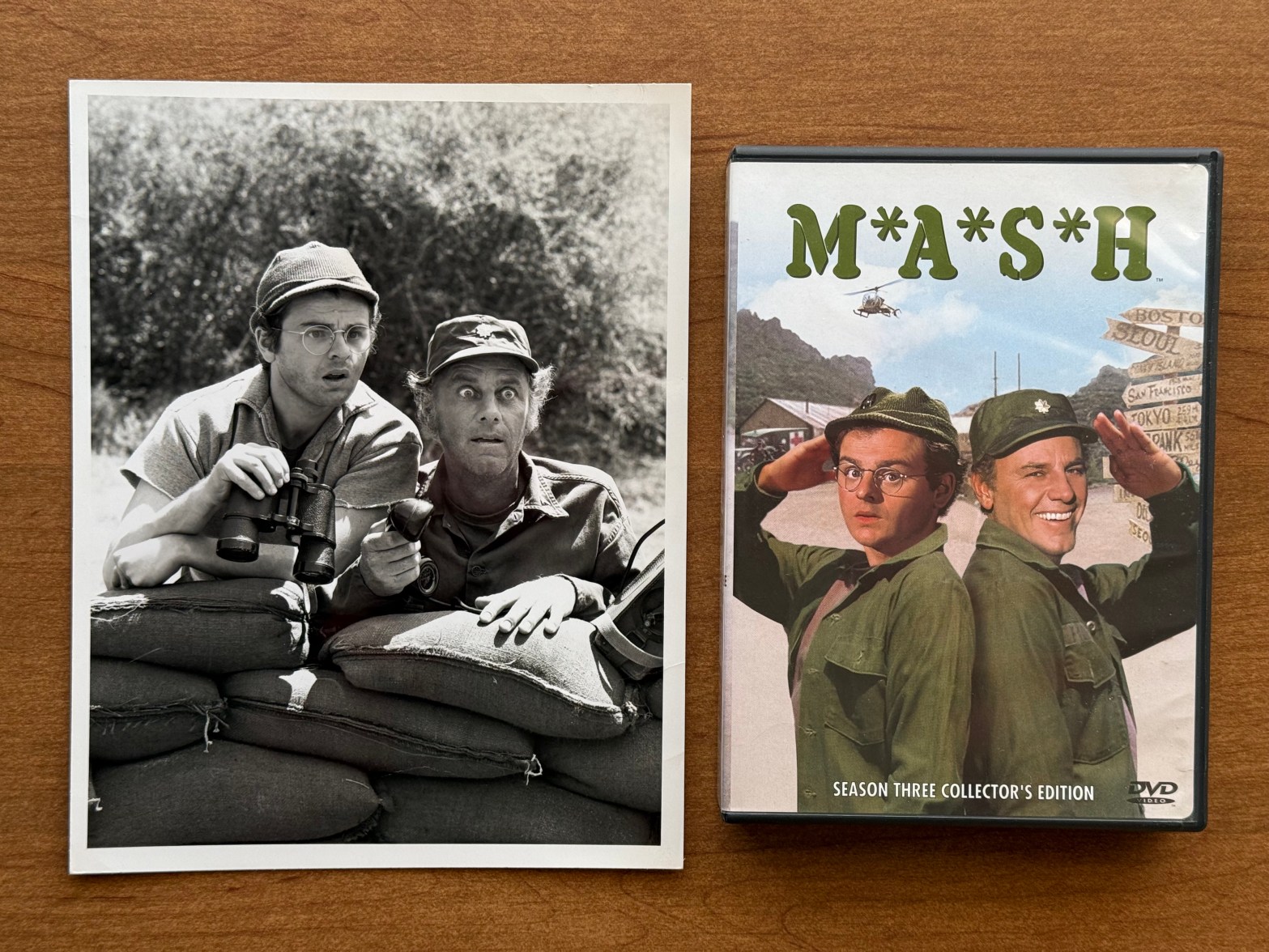
Throughout 2025, I will rewatch M*A*S*H and review each season on the final day of each month. I am rewatching the episodes in broadcast order using the DVDs from the 2000s with the laugh track left on. You can find an archive of these rewatch posts here.
So far, my M*A*S*H rewatch is 2025 has been going well! I was pleasantly surprised by season one, and I have always loved season two. For season three, I initially had a hard time remembering what happened besides the appearance of Harry Morgan in the season opener and the heartbreaking season finale. After watching season three several days ago, I am still not sure how I feel about it. I am not in either of the “Team Early Seasons” or “Team Later Seasons” camps. I like how M*A*S*H adapted as the cast changed over time. That’s why I think season three has me stumped. We see a lot of the same stereotypes from the main characters: Margaret and Frank are the foil to Hawkeye and Trapper, Frank is an incompetent surgeon, Trapper is Hawkeye’s sidekick, Henry is a bumbling commanding officer, etc. Those traits had been in place since season one.
For better or worse, season three is when M*A*S*H became more Hawkeye centric. I believe that is probably what sealed the deal for Wayne Rogers leaving the series (and possibly McLean Stevenson). I would argue that had seasons four and five continued with the same characters as seasons three, the series would not have lasted eleven years. There are some M*A*S*H fans that probably would have been happy with that outcome, but I am not one of them. I like the dynamics that are introduced with new characters. MASH units in Korea would see a constant rotation of doctors, nurses, corpsman, and wounded. Each set of people, as with television characters, bring their unique personalities and interpersonal dynamics. As M*A*S*H went on, characters changed, but the character of the series never did. What does all that have to do with season three? Without the lead up to the end of the season, the death of Henry Blake and Trapper going home, we got to enjoy M*A*S*H longer because the writers had new characters and new relationships to explore. Without the conclusion of season three, M*A*S*H might not be the iconic series it is today.
Season 3 Episode List
Episodes are listed in broadcast order. Hyperlinks direct to “Script Spotlight” posts for that episode.
| Episode # | Season X Episode | Episode Title |
| 49 | 03×01 | The General Flipped At Dawn |
| 50 | 03×02 | Rainbow Bridge |
| 51 | 03×03 | Officer of the Day |
| 52 | 03×04 | Iron Guts Kelly |
| 53 | 03×05 | O.R. |
| 54 | 03×06 | Springtime |
| 55 | 03×07 | Check-Up |
| 56 | 03×08 | Life With Father |
| 57 | 03×09 | Alcoholics Unanimous |
| 58 | 03×10 | There is Nothing Like a Nurse |
| 59 | 03×11 | Adam’s Ribs |
| 60 | 03×12 | A Full Rich Day |
| 61 | 03×13 | Mad Dogs and Servicemen |
| 62 | 03×14 | Private Charles Lamb |
| 63 | 03×15 | Bombed |
| 64 | 03×16 | Bulletin Board |
| 65 | 03×17 | The Consultant |
| 66 | 03×18 | House Arrest |
| 67 | 03×19 | Aid Station |
| 68 | 03×20 | Love and Marriage |
| 69 | 03×21 | Big Mac |
| 70 | 03×22 | Payday |
| 71 | 03×23 | White Gold |
| 72 | 03×24 | Abyssinia, Henry |
Favorite Episodes

These are the top episodes of the season that I believe contribute something important to the series as a whole. The episodes are listed in the order in which they aired.
- “The General Flipped at Dawn” (03×01) – This is a fun episode! I really like seeing Harry Morgan interact with the early cast., and the episode works really well. It’s not the traditional season opener, but it worked.
- “Officer of the Day” (03×03) – This episode reminds me of a “Dear Dad” episode because we see what happens in one day at the 4077th. This is a well balanced episode featuring Klinger’s escape attempts, the treatment of several “Kim Lucks,” and a visit from Col. Flagg.
- “Adam’s Ribs” (03×11) – This is such a classic episode that I think there would be a riot if I didn’t include it on the list! It is a funny and well written episode. Strangely, there isn’t a B-story in this episode. Frank, Margaret, and Father Mulcahy don’t appear either. So while it is a classic episode, it is very Hawkeye centric.
- “A Full Rich Day” (03×12) – This episode could have been titled “Dear Dad on Tape.” Like the other letters home episodes, I like the mixture of storylines including the crazy Turkish soldier, the serious Lt. Smith, and the lost (then found) Luxembourg lieutenant.
- “The Consultant” (03×17) – This episode may not belong on this list, but I like Robert Alda in this episode. I don’t like Dr. Borelli’s second appearance as much, but I really like the scene between Hawkeye and Borelli near the end of the episode when Borelli is too drunk to operate. Later in the series, the shoe is on the other foot when Hawkeye is too drunk to operate in “Fallen Idol” (06×02).
- “Aid Station” (03×19) – I like this episode because it puts together three unlikely characters: Hawkeye, Margaret, and Klinger. We also see them in adverse conditions. Aid stations are dangerous, and all three characters jump right into the task at hand. We see some character development for Margaret, and we are reminded that, while Klinger may wear dresses, he still is damn good at his job and doesn’t take his duty lightly when he is called.
- “Abyssinia, Henry” (03×24) – If I ranked the episodes of the season, this would easily be my top episode. It is what M*A*S*H was all about: finding humor while not forgetting that war is hell. Henry’s death was a shock in 1975 and it still divides the M*A*S*H community today. This is an important episode not just in the history of the series, but in all of television. The farewell to Henry was well written. I just wish Trapper could have gotten a proper goodbye as well.
Least Favorite Episodes
Liking or disliking an episode is subjective, so I have tried to be fair in my criticism of why certain episodes are not my favorites. The episodes are listed in the order in which they aired.
- “Rainbow Bridge” (03×02) – I like the concept of this episode and the scene between Hawkeye and the Chinese doctor on the bridge. What I do not like about this episode is the inclusion of the music from Loudon Wainwright III. I don’t hold anything against him, and I like his appearances later when he is a named character (and apparently a surgeon?), but the random music rips me out of the storyline.
- “Iron Guts Kelly (03×04) – I try to imagine explaining this episode to a friend briefly as, “A general dies while he is in Margaret’s tent, and his aid’s first thought is to get the body to an area where there is fighting so the general can die in combat.” The next question would be, “What?!” I understand that the whole situation is making light of heroic war films, but it is a big stretch.
- “Life with Father” (03×08) – There isn’t really one thing with this episode that bothers me, but I think it is a mix of the storylines. I don’t like the hypocrisy of Henry being upset about his wife potentially cheating on him while he constantly has affairs. The storyline with the Bris is fine, and I really like the storyline of Father Mulcahy’s sister wanting to leave the sisterhood to be a mother. I wish they had focused more on Mulcahy since this episode is called “Life with Father.”
- “Love and Marriage (03×20) – As with “Life with Father,” there really isn’t anything wrong with this episode. I just don’t really like either storyline.
Continuity Errors


There are minor issues in every episode that have been well documented, so I am choosing to focus on ones that really stood out to me.
- Multiple Episodes – Is the supply room in the main building, a tent, or a metal building? It seems to wherever is most convenient for the scene.
- Officer of the Day” (03×03) – When Radar tucks in his teddy bear, he is not wearing a shirt. But in the close-up shot of his arms tucking in the bear, you can see that he is wearing long sleeves.
- “O.R.” (03×05) – The M*A*S*H timeline tells us that season three is in 1952. However, General MacArthur’s homecoming parade was on April 17, 1951. And General Mark Clark was put in command of the UN forces on May 12, 1952.
- “Springtime” (03×06) – The 4077th is only 2,986 square feet?! The Swamp is 16 feet by 16 feet making it 256 square feet by itself.
- “Alcoholics Unanimous (03×09) – Margaret’s father is alive! He was dead in season two.
- “There is Nothing Like a Nurse” (03×10) – Radar has a sister? I don’t recall this ever being mentioned again.
- “A Full Rich Day” (03×12) – When they have the memorial ceremony in the compound for the not-so-dead Luxembourg lieutenant, it would have made sense for Father Mulcahy to perform the ceremony. But William Christopher does not appear in the episode.
- “Bombed” (03×15) – “We have nothing to fear but fear itself” is a quote from President Franklin Delano Roosevelt, not Eleanor Roosevelt.
- “Bombed” (03×15) – If Henry and Father Mulcahy fell into the hole dug for the latrine, wouldn’t they be covered in…well, you know, when they were pulled out?
- “Bulletin Board” (03×16) – Margaret’s father is dead again! And she has a sister?
- “The Consultant” (03×17) – They mention that there are seven tables in the O.R.? I’ve only seen four, maybe five, in the O.R. at a time.
- “Aid Station” (03×19) – Near the end, Trapper ties his tea bag to a nail on the post in the Swamp. It immediately unwinds itself and falls off!
- “Love and Marriage” (03×20) – When the “doctor” visits Hawkeye and Trapper in the Swamp, you can see the fourth wall of the tent has been removed for the camera.
- “Big Mac” (03×21) – After getting the phone call about MacArthur’s visit, why did Radar go outside of his office to get to the O.R.? Aren’t they in the same building?
- “Big Mac” (03×21) – The M*A*S*H timeline…Gen. MacArthur is coming to visit, but it’s 1952. He was relieved of command by President Truman in April 1951.
- “Big Mac” (03×21) – In the scene where Hawkeye tells Frank to stop burning books, the camera is focused on the background actors and not Hawkeye and Trapper.
- “White Gold” (03×23) – When they stitch up Col. Flagg’s head, they didn’t shave the area around the cut?
Season 3 Wrap-Up
Season three of M*A*S*H is very hard for me to summarize succinctly. The last few minutes of “Abyssinia, Henry” completely overshadow the rest of the season. There are some great episodes in season three. “The General Flipped at Dawn” is hilarious. I love seeing Harry Morgan play someone other than Col. Potter, and the chemistry he had with the cast in that single episode were apparent on screen. There are memorable funny moments in the season with episodes like “Officer of the Day” and “Adam’s Ribs.” But the writers began exploring more dramatic and poignant storylines. “O.R.” takes place almost exclusively in the operating room and has no laugh track as result. It gave more than just a glimpse of the operating theater. Throughout the season, several of the surgeons struggle when patients don’t recover as expected. That’s a very human reaction. No one likes to fail, but when it’s a matter of life or death for a doctor, then failure has a completely different consequence. “Love and Marriage” explored how people might take advantage of the American presence in Korea. The writers explored new areas, and that allowed the series to grow.

There are some aspects from season three that we see in later seasons. In “Payday,” Hawkeye gets the extra money he wanted for not being in a civilian practice. But later, in “Back Pay” (08×24), we see him demand the Army pay for his lost wages. In the “General Flipped at Dawn,” General Steele is promoted to get him out of his job after clearly having a psychological issue. A similar ending is given to Frank Burns in “Fade Out, Fade In” (06×01) when he is promoted after having a similar breakdown after Margaret gets married. One of the most striking things that happened in season three that becomes an issue later happened in “White Gold.” Hawkeye and Trapper remove Col. Flagg’s appendix despite him not needing the surgery. Hawkeye does the same thing in “Preventative Medicine” (07×22), and he and B.J. have a tense argument about the morals of removing a healthy appendix even if it does remove one inadequate commander from the field. We now know that Mike Farrell also strongly disagreed with the premise, so they wrote that in the episode (Farrell talked about this in Episode 112 of the M*A*S*H Matters podcast).
It would be impossible to talk about season three without addressing the impact of “Abyssinia, Henry.” The decision by the writers and producers to kill Col. Blake angered fans and still divides fans today. Whether you like the fact that they killed Henry or not, it cannot be denied the impact that decision had on the show, and I would argue, television in general. M*A*S*H explored war, and specifically, the human cost of war. Characters had died in the show before Henry, but killing off a main character was not something that was done in 1975. It was a risk, and Larry Gelbart and Gene Reynolds accepted that risk. It changed television, and it gave the writers of M*A*S*H permission to explore more dramatic storylines. While that may not have made every fan happy, it did keep M*A*S*H relevant for eleven seasons, and for over fifty years. I don’t like that the death of Henry Blake overshadows season three. It’s a good season (not as good as season two), but the death of Henry Blake made it one of the most iconic seasons of a series in television history.
 The M*A*S*H Historian
As a huge fan I adore S3. There is just one episode i tend to skip (even deleted it from my pc) and that is House Arrest. Hawkeye would never punch Franks lights out as the pacifist he is and in the end, the rape joke is just so unbelieveble… Frank wanting to rape that old hag? Try making that joke now in the me-too movement.
Sorry for my rant but that’s just the way I feel about the episode.
Greetz from the Netherlands. 🙂
LikeLiked by 1 person
I agree! That’s another episode that feels off.
LikeLike
I agree that S2 probably has better episodes on a quantity aspect, but after just rewatching S3 myself this month, I noticed something I hadn’t before: M*A*S*H was changing before my very eyes with the original cast still there. “O.R.” and “Bombed” alone were surgical-focused episodes, featuring the characters dealing with the day-in-and-day-out horrors of war. “O.R.” is by far one of the show’s greatest episodes. Everything takes place either in the O.R., or the room right outside of it. And it’s a perfect ensemble mix with a nice cameo featuring Sydney giving an all-time classic line, “Pull down your pants, and slide on the ice.” And as for bombed, we get to see the entire staff not only deal with wounded, but are in the middle of a war zone themselves. There’s also a good mix of Hawkeye & Trapper scenes with them separated, like when Margarette and Trapper are locked-in the storage room (wherever it is for That episode!).
In fact, while the show was ALWAYS Hawkeye-centric, I came away feeling like we did get more scenes and character development for Trapper at the expense of Stevenson, who probably should’ve gotten second billing right behind Alda in S2. “Mad Dogs & Servicemen” is Hawkeye-heavy for the first 12-minutes, but then notice how the second half features Wayne Rogers getting the soldier to talk, followed by Trapper & Henry chasing the “mad” dog. And he gets a lot of the punchlines in that episode as well. In “Bulletin Board,” we actually watch Trapper write a letter home to his kids for a change (and it’s an episode directed by Alda). It’s obvious something happened after the first batch of episodes because after they were once again “Hawkeye-heavy,” the second half of the season felt more ensemble-like, and there was more attention put on Trapper at the expense of Henry.
But while the show continued with its comedy and hijinks, the season went through many serious moments, which is where the show would eventually go once Mike Farrell & Harry Morgan joined. And I’m not even talking about the final episode of the season. A depressed Henry because he couldn’t save a patient in “Bulletin Board,” Trapper helping the soldier in “Mad Dog,” Hawkeye losing his patient in “O.R.,” Borelli foreshadowing Hawkeye’s upcoming failures in “The Consultant,” and the horrors Hawkeye, Margarette, and Klinger endure at the aid station while the others anxiously wait for news. I feel like Larry Gelbart made sure we always knew there was a war going on this season unlike in S1 or S2 at times. Even “Adam’s Rib” ends with Hawkeye not enjoying his bounty because of wounded.
I think S3 remains the best of the best in “The Early Years” cast because it started getting a bit more balanced between comedy and drama, and because it allowed for more character development. Hell, we even feel a little sorry for Frank after everyone watches his wedding film!
I’ve often wondered what S4 with the entire cast would’ve been like, or what it would’ve been like had Rogers stuck around for one more season with Harry Morgan at the helm. I think watching Trapper and Potter get along, yet fight it out due to Trapper’s spontaneity, would’ve provided some very compelling scenes. Trapper’s character was growing, and it would’ve been fun seeing where they would’ve taken his character.
S3 is the bridge of the series. Kind of like how Rubber Soul is the bridge for The Beatles. There was more depth, more development, and more war, which helped make the satirical nature of the show even that much more powerful.
LikeLiked by 1 person
I agree with pretty much everything you said! I like how you put that we see more war in season 3. The characters were defined in season 2, so we see more testing in season 3. I think the reason we see more turn toward the war is that Larry Gelbart and Gene Reynolds visited Korea between seasons 2 and 3. I completely forgot to mention that in my season 3 wrap up, but there’s clearly some inspiration for that trip and the interviews they conducted with MASH doctors and nurses starting to make its way into the series!
LikeLike
Another continuity error, in The Consultant, Radar drives a jeep the office/OR building, then drives to the Swamp, leaving Henry behind, who then jogs over, arriving exhausted. But the Swamp is often depicted as being right across from that building. Never understood that beyond the gag of Radar leaving Henry behind.
LikeLike
That’s a great catch! I never noticed that!
LikeLike