
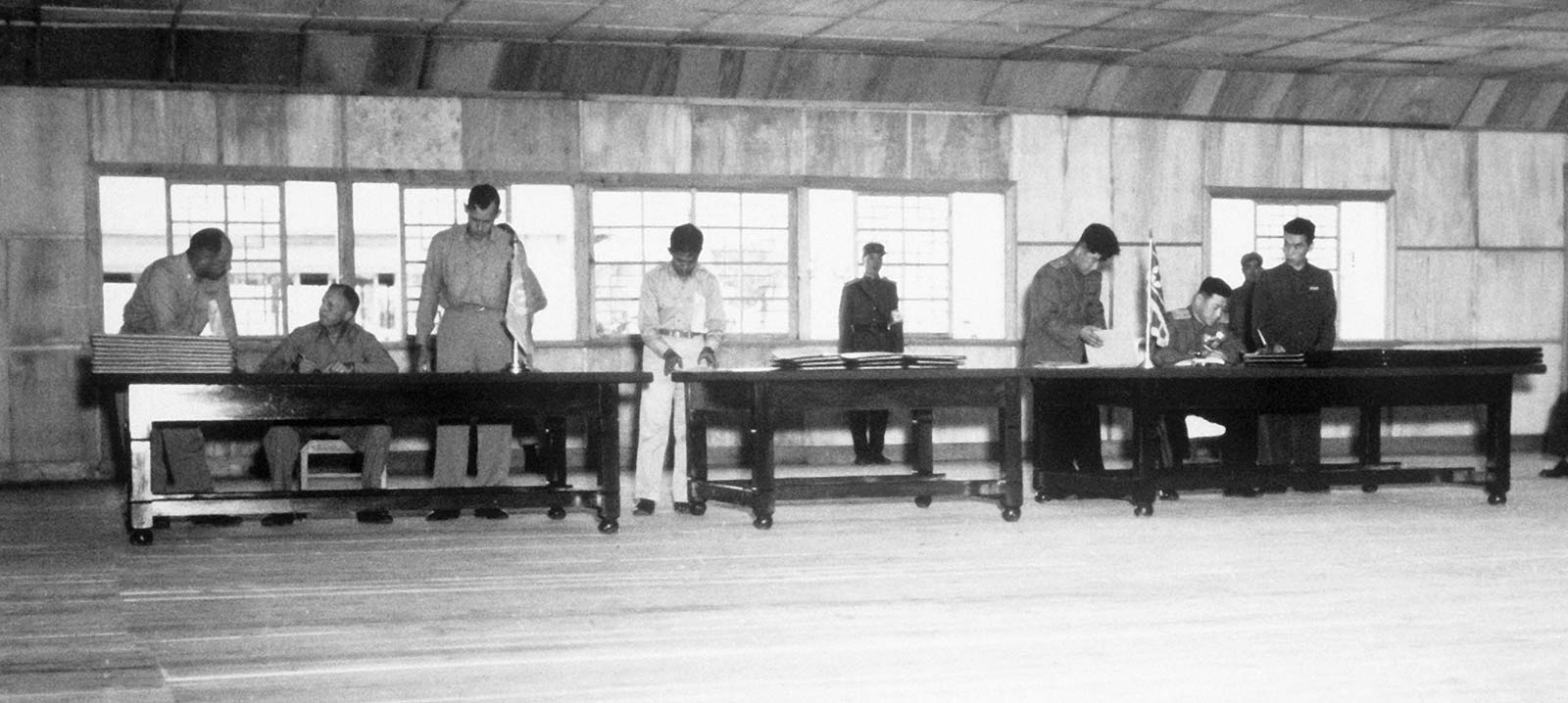
On July 27, 1953, the Korean War ended with a ceasefire agreement being signed by representatives for South Korea, North Korea, China, and United Nations. The agreement was signed with the stipulation that the two sides would continue to negotiate and agree to a final peace treaty. Today, 70 years later, that treaty still does not exist, and it is the terms of that ceasefire agreement that keeps the peace on Korean peninsula while keeping North Korea and South Korea divided. Tensions between the two countries continue to run high despite the “shooting war” ending 70 years ago last week. In this week’s post, I am going to provide a brief overview of the Korean War, the peace negotiations leading up to the armistice agreement, the agreement itself, and what South Korea and North Korea are like today.
The Korean War
Following the second world war, maps across the world were redrawn at negotiating tables. Japan had occupied the Korean peninsula since 1910, but they agreed to give it up following their surrender to the allies at the end of World War II in 1945. What would become the primary battle line of the Korean War was drawn in 1948 when the peninsula was divided at the 38th parallel with the Soviet Union (U.S.S.R.) controlling the northern portion and the United Sates (U.S.) controlling the southern portion. Tensions between the two Koreas began early, and as the Cold War got more frosty between the U.S. and U.S.S.R, Korea became the first proxy war of the Cold War when North Korea, backed by the U.S.S.R, invaded South Korea on June 25, 1950.
The Korean People’s Army (North Korea) quickly overpowered the South Korean Army and pushed south to Incheon. This meant that the Soviet backed North quickly controlled most of the Korean peninsula. However, in September 1950, the United Nations (U.N.) forces, led by the U.S., invaded at Incheon and pushed the Korean People’s Army north. The counter offensive was so successful, that the U.N. forces had pushed the Korean People’s Army back to the Yalu River and the border with China. The U.S.S.R.’s partnership with China prompted the People’s Volunteer Army (China) to join with the Korean People’s Army in October 1950. The massive influx of soldiers from China meant that the allied forces were pushed south, and the war would stall out at the 38th parallel by late December 1950. For the next two years, the war would be a virtual stalemate along the 38th parallel with the city of Seoul changing hands four times.
The war was brutal as each side gained a hill, then lost that hill, then regained it. The stalemate defined the policies for the U.S. and U.S.S.R. as the Cold War continued across the globe.The Korean War was the first war to use jet powered aircraft on a large-scale basis, and it was also the first time the U.S. Army used Mobile Army Surgical Hospital (MASH) units to treat the wounded close to the front lines. In total, over 4.5 million civilians and soldiers on both sides. Today, the Korean War is often called “The Forgotten War” because it didn’t require the mass mobilization of troops of World War II, and it was quickly overshadowed by the Vietnam War. There have been a few M*A*S*H related Korean War documentaries that I recommend. The first, Korean War: The Untold Story, tells the story of the war from the point of view of the men who fought it. Meanwhile, The Real MASH focuses on the men and women who served in MASH units during the war.
Korean Armistice Agreement
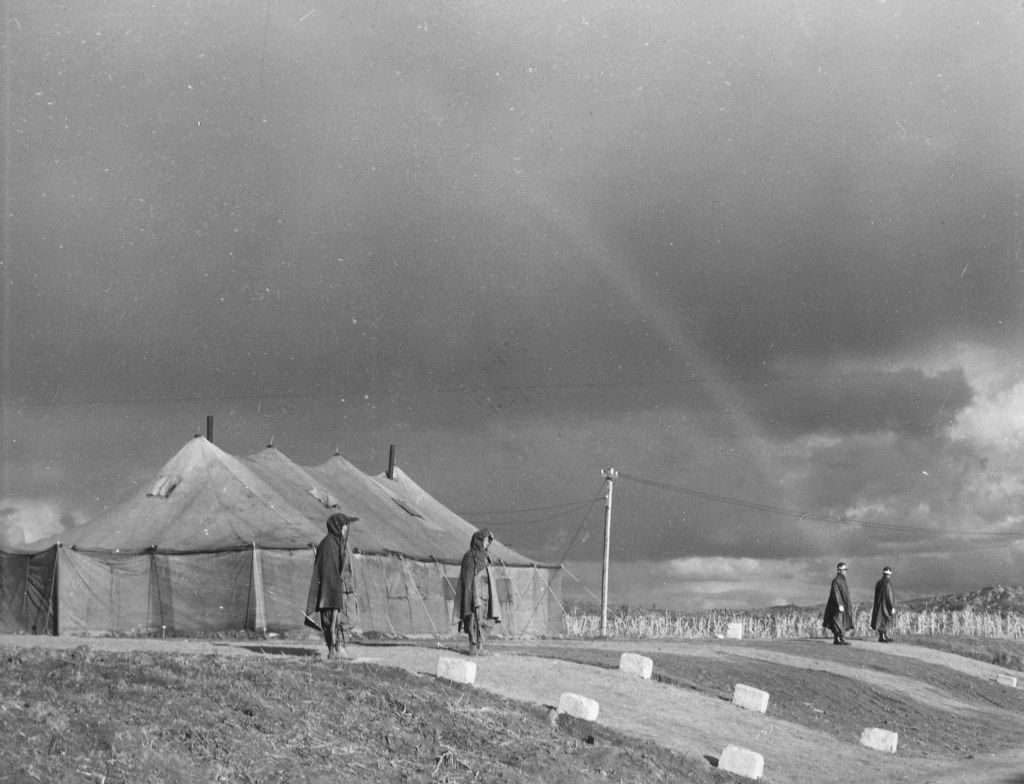
As the war raged on in 1951 and 1952, peace negotiations were off and on. These negotiations largely took place in Panmunjom, where a series of tents was constructed for all sides to meet and discuss terms of a potential agreement. Talks dragged on, and following his election as president in November 1952, then president-elect Dwight Eisenhower visited Korea to see what could be done to end the war. The U.S. was seeking an end to the war. On March 5, 1953, shortly after Eisenhower took office, U.S.S.R. leader Joseph Stalin died. The new Soviet leadership of the wasn’t committed to the war in Korea, and they called for an end to hostilities as well. Without the the backing of the U.S.S.R., China and North Korea could not continue fighting. The negotiations were left to the U.S. and China since they were the major powers backing South Korea and North Korea respectively.
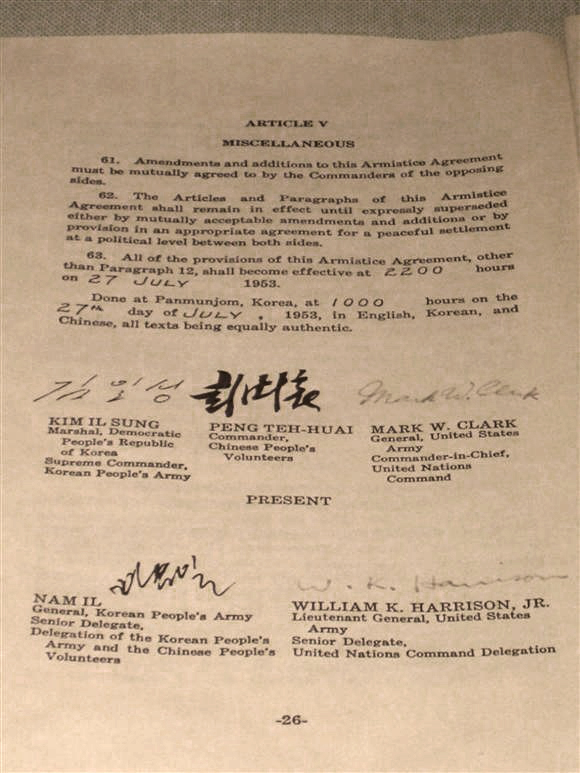
Negotiations were held for months with one of the many hang-ups being the repatriation of POWs. However, on July 27, 1953, an armistice agreement was signed by the South Korean Army, People’s Republic Army, and the United Nations command. Hostilities ended later that same day. Interestingly, neither leaders of South Korea or North Korea signed. Syngman Rhee, the leader of South Korea, refused to sign. Part of the agreement was for all parties to meet in Geneva, Switzerland to work out a final peace treaty. Meetings did take place in 1954, but no treaty was ever ratified. To this day, the July 27, 1953 armistice is all that keeps the peace between South Korea and North Korea.
Aftermath and the Koreas Today
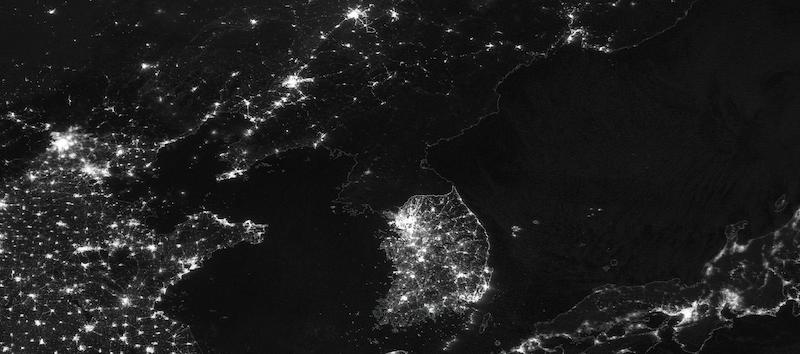
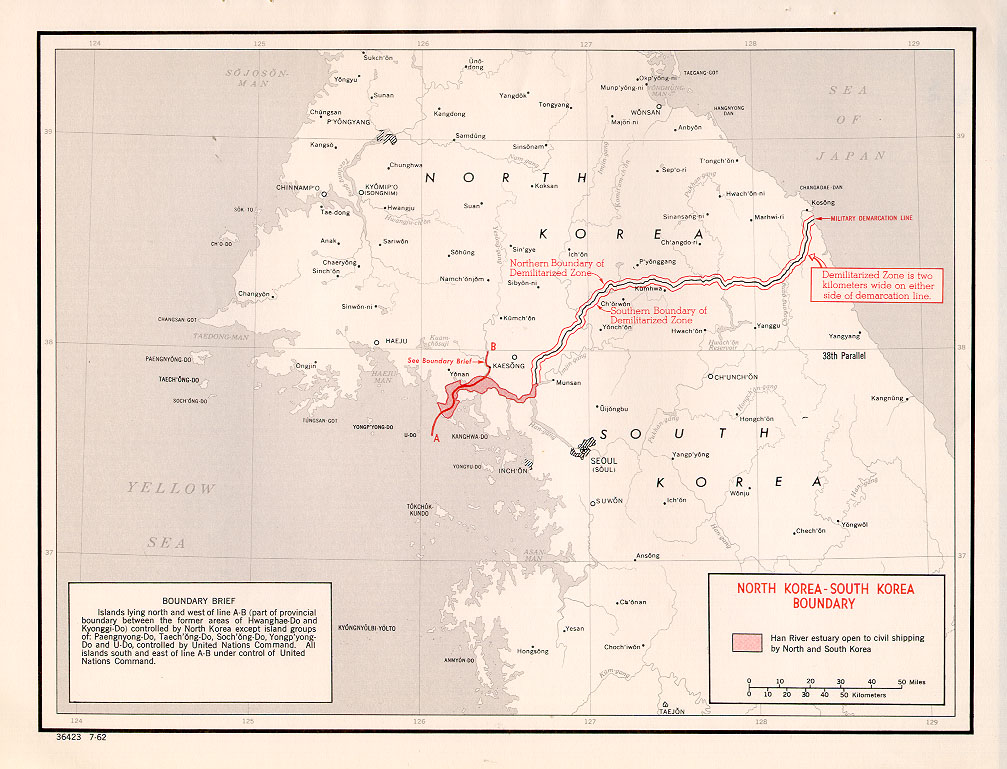
One of the key terms of the agreement was the continued division of the Korean peninsula. The line was drawn along the 38th parallel and created a Demilitarized Zone (DMZ) between the two countries. Seventy years later, that narrow strip of land running east to west is what divides the two countries. Since the war, the countries have remained hostile toward each other, but they have taken very different paths. South Korea being backed by the U.S. and its allies allowed the country to grow economically while North Korea stagnated. North Korea’s alliance with China and Russia continue to define it.
As I wrote earlier this year, South Korea was unstable following the conclusion of the war. The country had a series of elected dictators and several coups. One of its leaders was assassinated in a coup. Despite the political instability, the U.S. and its allies backed South Korea’s development, and the country quickly became a hub for modern technology. Since the late 1980s, the country stabilized politically and has a robust economy. Seoul is a bustling modern city, and the investment by the U.S. and its allies has paid off for both the western world and the South Korean people since South Korea is a strong trading partner on the global stage.
North Korea, meanwhile, is a mystery. It has remained isolated from the world aside from China and Russia. Politically, the country is a dictatorship and has been ruled by the same family since 1948. The country is not economically well developed, and North Korea captures headlines when it tests nuclear weapons, much to the disgust of South Korea, Japan, and the U.S. A look at a satellite image of the Korean peninsula at night shows the vast difference between the two countries. South Korea is bright with lights and activity; whereas, North Korea is dark. It’s ironic that South Korea banned the series M*A*S*H in the 1970s because its leaders felt the series didn’t portray the image of the modern South Korea. But the poverty and agrarian lifestyle of the Korean people portrayed in M*A*S*H matches modern North Korea.
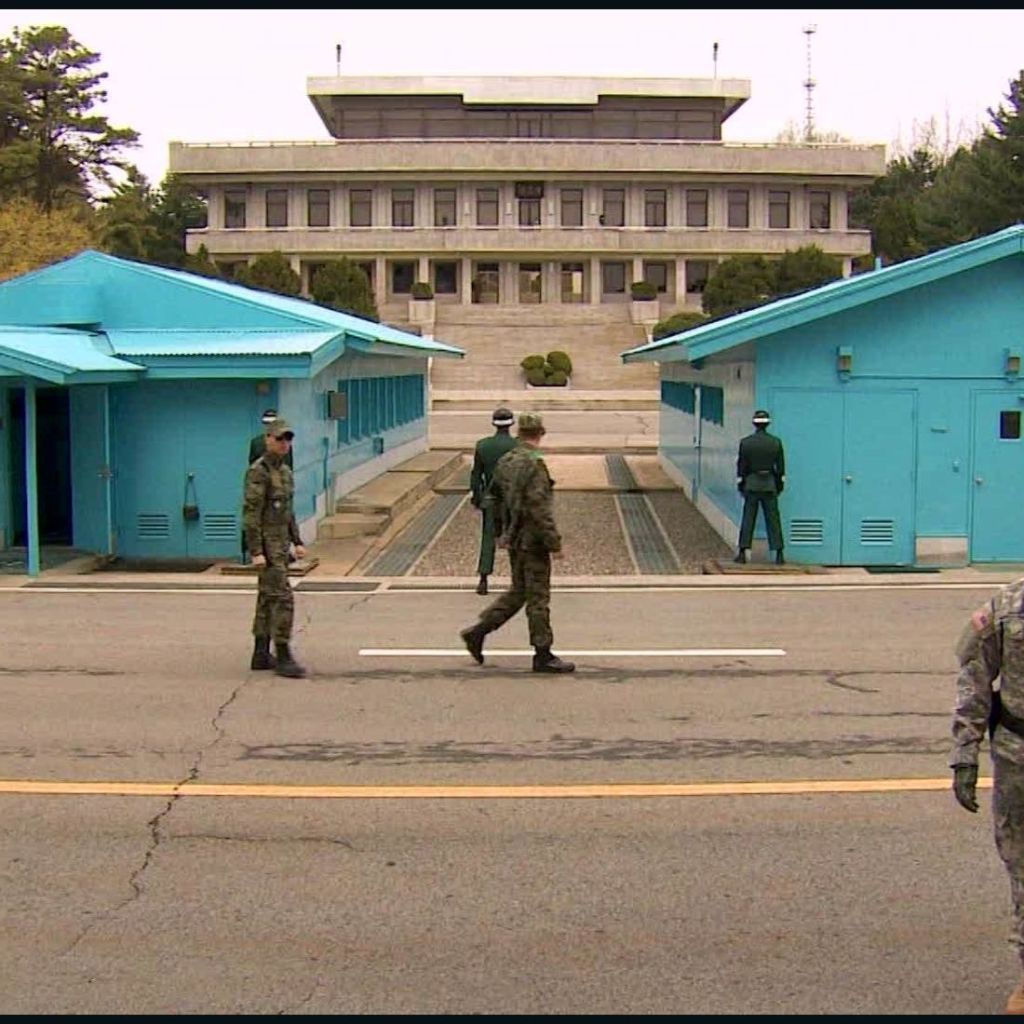
Despite there never being a formal treaty, the Korean Armistice Agreement has stood strong for 70 years, though it has been tested. Hostilities between the two countries and their allies continue to this day, but the “war” today is largely a war of words and a nuclear arms race. While this is not ideal, the fact that there has not been a follow-up war is a testament to the parties on both sides. To this day, the Korean War is referred to as “The Forgotten War,” and that is a shame because millions of people lost their lives on both sides. We can debate the merits of the war and the other proxy wars of the Cold War, but the three-year war in Korea was the first of its kind fought between the United States and the Soviet Union through their proxy states. As we pass the 70-year anniversary of the Korean Armistice Agreement, we pause to remember the men and women who died during the Korean War. While the events of war may be forgotten to history, the people who fought, were wounded, or lost their lives should not be.
Sources
Council on Foreign Relations. “North Korea’s Power Structure.” 2020
Seth, Michael J. A Concise History of Modern Korea: From the Late Nineteenth Century to the Present, Volume 2, Third Edition. Lanham, MD: Roman & Littlefield, 2020.
Seth, Michael J. Korea at War: Conflicts that Shaped the World. Rutland, VT: Tuttle Publishing, 2023.
United States Institute of Peace. “The Current Situation in North Korea.” 2022.
 The M*A*S*H Historian
2 thoughts on “M*A*S*H-ish 7: 70th Anniversary of the End of the Korean War”