What is it?
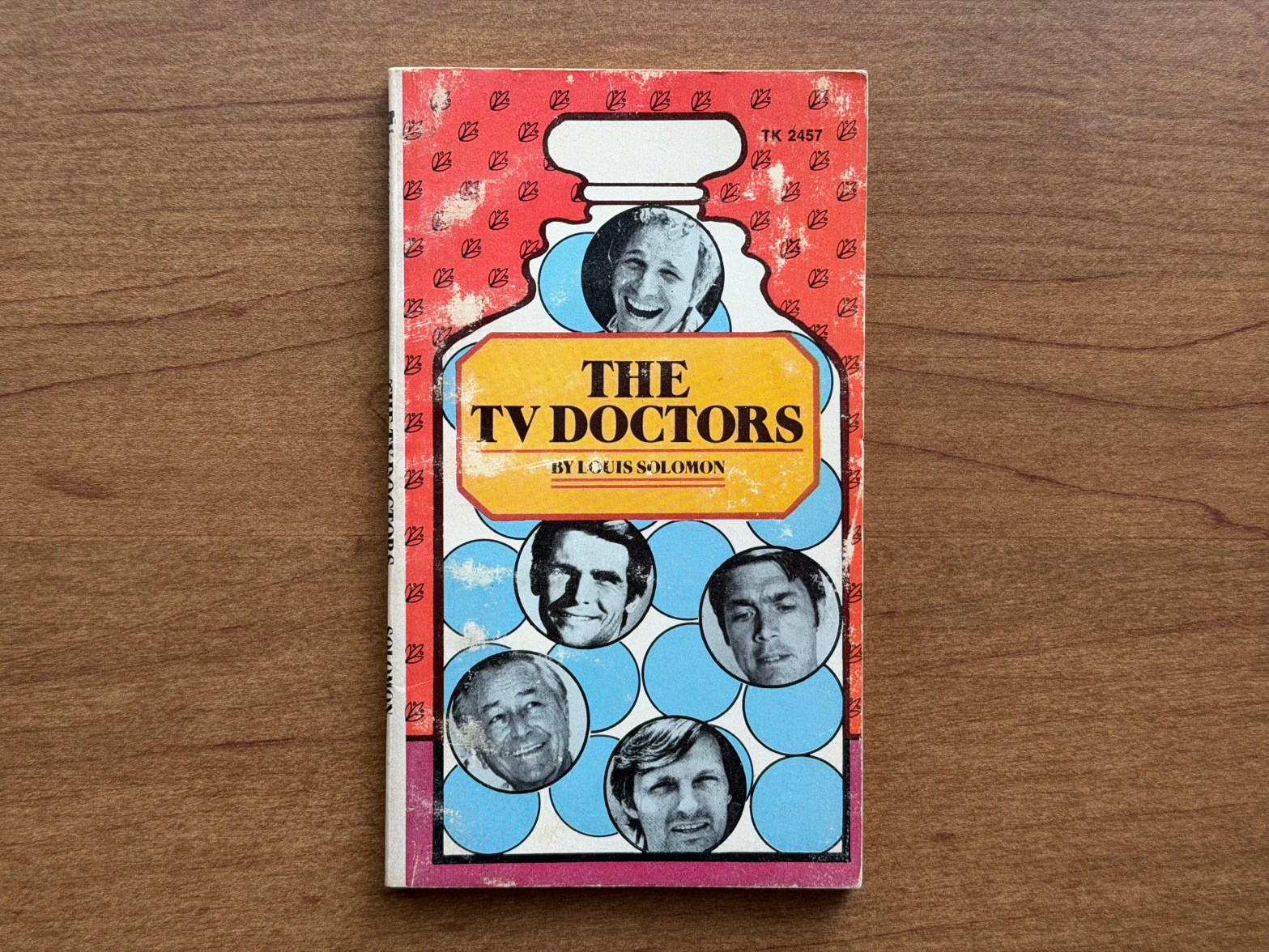
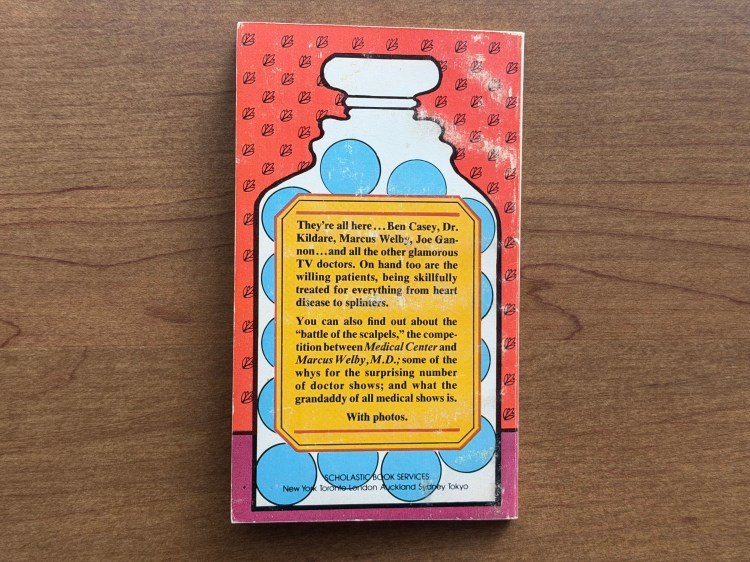
Solomon, Louis. The TV Doctors. New York: Scholastic Book Services, 1974.
Why should M*A*S*H fans care?
M*A*S*H was developed at a time when the concepts of the “medical comedy” and “medical drama” were in their infancy. Author Louis Solomon explores the history of medical shows on television up to 1974, and reviews the medical shows at the time, including M*A*S*H.
As a M*A*S*H fan, what part(s) should I read?
While written fro the children’s market, this book is not like the others I featured where M*A*S*H, or its actors, gets its own chapter. The series is weaved throughout the book, so I recommend reading it all since it is a fairly quick read!
TL;DR Review
Scholastic’s books about television often focused on the actors who played popular characters. Instead of following in this mold, Louis Solomon reviewed the genre of medical shows on television up to the early 1970s. M*A*S*H played a major role since it was about a medical unit in a war zone, and it was a comedy. As Solomon explores, the early medical shows on television fell largely into two camps: comedy or drama. It was at this time that shows began to blend the two, and we can see the roots of shows from today such as Scrubs and The Pitt.
Full Review
When I found this Scholastic book about The TV Doctors, I expected it to be similar to the books written by Peggy Herz. She was a journalist who wrote about the entertainment industry, so the books focused on the lives of the actors who brought popular characters to life. Instead, Louis Solomon took a different approach in exploring television’s doctors in 1974. He explored the genre of medical shows on television and how they were divided into two categories: the medical comedy and the medical drama. M*A*S*H became a major part of the history of the medical show because it often bridged the gap between both comedy and drama.
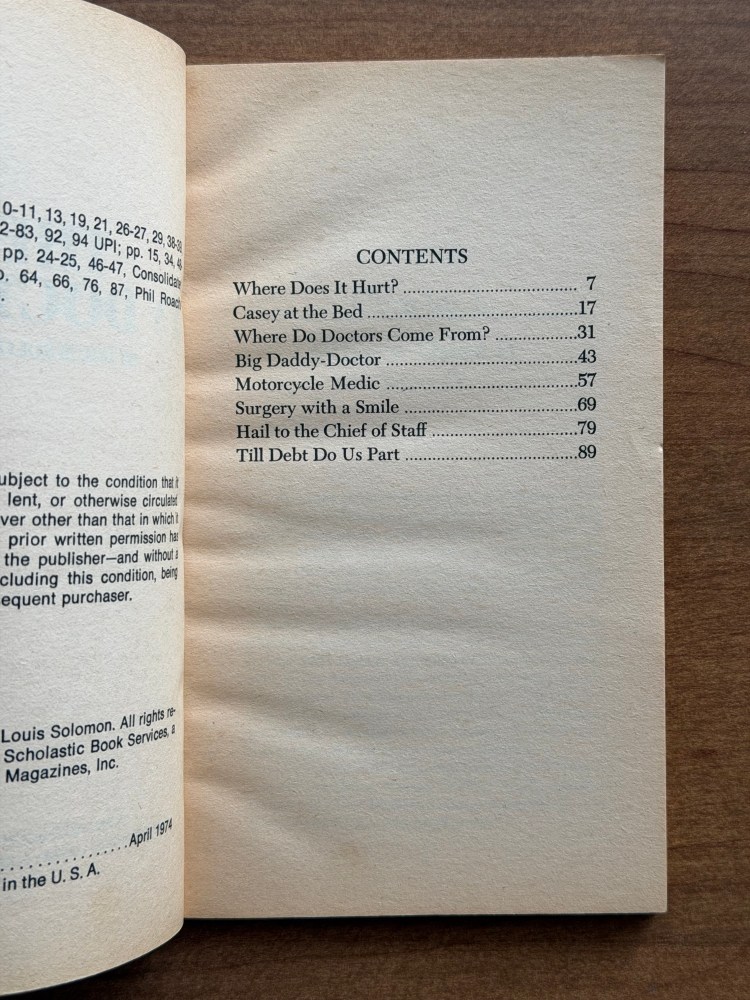
Solomon begins the book by exploring the history of doctors on television. He explores how talking about certain, common medical conditions (such as pregnancy and venereal diseases) was taboo on television in the 1950s and into the 1960s. That changed in the early 1970s, and by the time Solomon published this book in 1974, M*A*S*H and other shows talked about medical conditions fairly openly. After giving a brief overview of the history of medical shows and the portrayal of doctors on television, he explores a collection of shows from the 1973-74 season including the medical dramas Marcus Welby, M.D., Medical Center, and Emergency! Then, he features three medical comedies including New Temperatures Rising, the Brian Keith Show (later called The Little People and co-starred Shelley Fabares), and M*A*S*H. Each of the shows focused on medical professionals in a hospital setting, but they each took a very different approach. Solomon explores the themes of medical shows on television and how each of the shows fits into the genre.
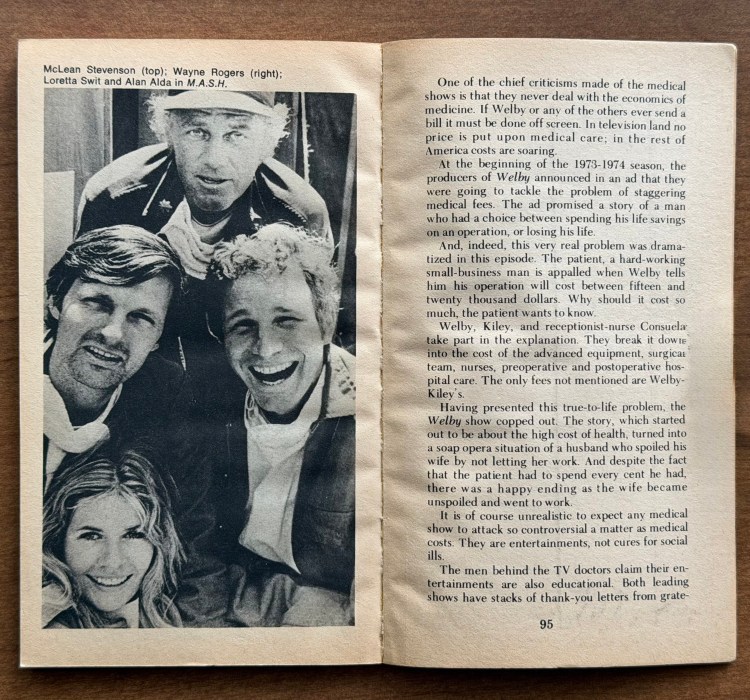
M*A*S*H fans might be a little disappointed with this book because it doesn’t feature as prominently as one might hope. This book was written in 1974, so M*A*S*H was still very new. The show changed over the years, and it would have been interesting to see how his analysis of M*A*S*H would have been different had this book been written after the death of Lt. Col. Henry Blake. Solomon does credit M*A*S*H for finding a balance between comedy and the serious nature of the tasks at hand for the 4077th surgeons. He discusses how M*A*S*H was able to have a series of glib jokes about Hawkeye and Trapper’s seeming lack of professionalism, but once they are called into action, that all goes out the window. The surgeons of M*A*S*H were shown as human. Not superhuman. But merely humans who were asked to perform in the worst possible circumstances.
Solomon’s book offers a compelling, early history of medical shows on television. He draws an interesting concluding point when he says, “The medical shows must be given credit for breaking many of the taboos about the human body. They’ve helped make the anatomical differences between male and female facts of television life. And there are no longer any unmentionable illnesses.” I find this to be fascinating since M*A*S*H continued to break barriers by showing more blood on television, killing off a main character, and exploring the horrible effects war can have on the human body and mind. Reading this book in 2026, I enjoy connecting the dots from 1970 to the shows that came after M*A*S*H and this selection of medical dramas and comedies. In the 1980s, shows such as Trapper John, M.D. and St. Elsewhere pushed the medical dramas further. As did ER in the 1990s. Today, there is no shortage of medical shows with Grey’s Anatomy, Scrubs, and The Pitt that are still blending the drama, comedy, and action and representing the medical profession in the same vein as M*A*S*H.
Meet Peggy Herz

This is the final post in the series of children’s books published by Scholastic and Weekly Reader. Had I planned better, I would have made sure the final book was by Peggy Herz, since most of the books I have reviewed were by her! But I wanted to wrap up this series by including a photo and some information about Herz. There isn’t much information available about her, but I did find some information (and this photo) from, of all places, the Phoenix Zoo. Her and her husband are long time supporters of the zoo, and they did have a page on their site dedicated to them that has since been taken down.
Herz wrote dozens of books for Scholastic in the 1970s, and she also wrote classroom magazine articles. I have tried to find a full bibliography of her works, but I haven’t found one. When you search for her name on Amazon, eBay, or Goodreads, there is no shortage of books by Herz, and they are all entertainment themed. As I have mentioned before, I have great respect for children’s books authors because it is hard to write in a way that is attention grabbing, informative, and age appropriate. Her books accomplish all of that while appealing to middle schoolers, and I am sure, many of their parents as well. So while Peggy Herz may not be the household name of other children’s book authors, judging by the number of copies of her books that are readily available on the second hand market, she was successful in writing books that fans of television wanted to read. Getting children to read can be a challenge, and meeting them where their interests are is a great way to encourage reading. Herz’s books appealed to readers of all ages, and she did so by providing information about the shows and actors that were popular at the time. As I wrap up this series, I am reminded of why M*A*S*H, television, and popular culture as a whole are important in society.
M*A*S*H Children’s Books
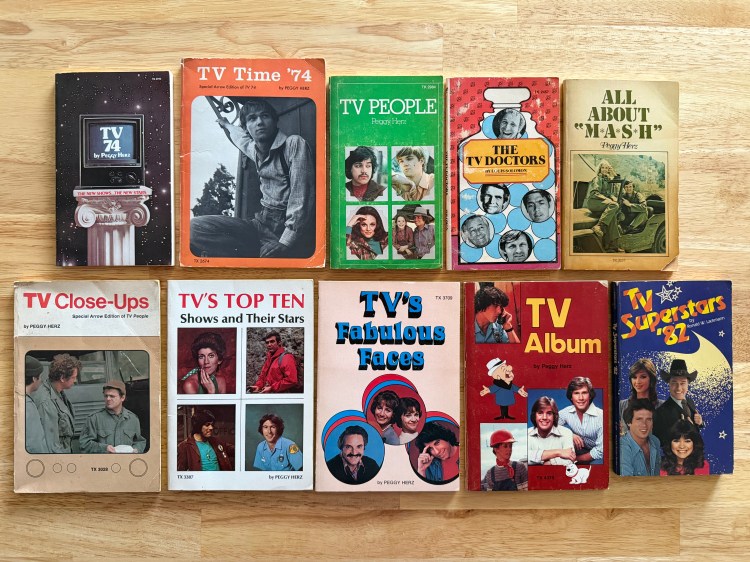
All the Scholastic/children’s books are pictured above, and a list with links to each of the reviews is below:
- TV ’74 (1973)
- The TV Doctors (1974)
- TV People (1974)
- TV Time ’74 (1974)
- All About M*A*S*H (1975)
- TV Close-Ups (1975)
- TV’s Top Ten: Shows and their Stars (1976)
- TV’s Fabulous Faces (1977)
- TV Album (1978)
- TV Superstars ’82 (1982)

