

Last month, I reviewed a Licensed Product Kit that was sent to retailers by 20th Century Fox Television highlighting the M*A*S*H licensed products that they could carry in store. This week, we look at the other side of the licensed products strategy by reviewing a packet from a M*A*S*H licensing conference held in 1981. This folder includes information about the conference itself, a list of current licensees, M*A*S*H demographic data, packets about the show’s 10th season, and a few cast photos. This conference would have likely gathered current licensees and potential licensees as Twentieth Century-Fox Licensing Corporation worked to capitalize on the success of the series and its characters. Let’s review each set of documents included in this M*A*S*H licensee kit!
Licensee Conference Information
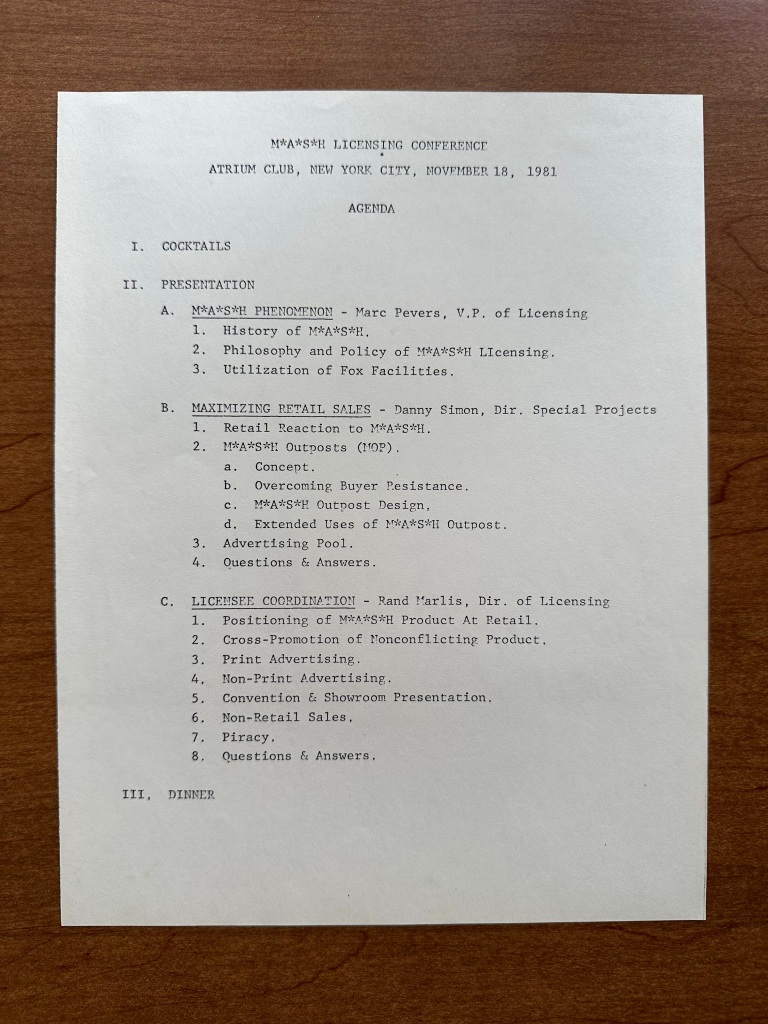
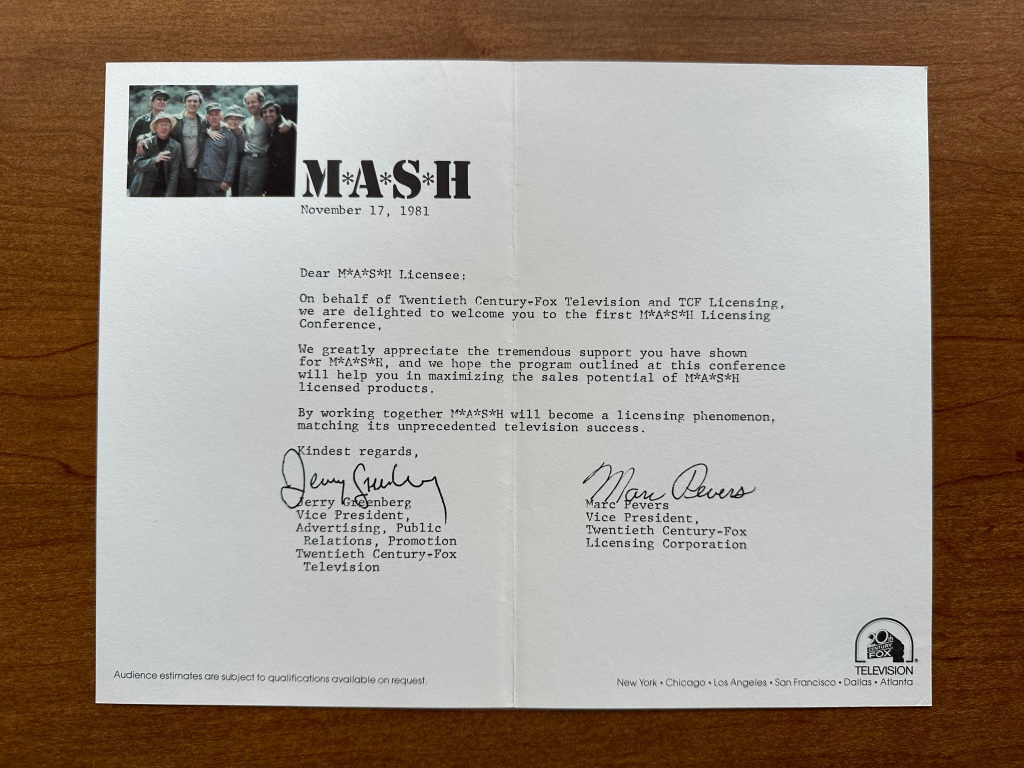
The M*A*S*H Licensing Conference was held on November 18, 1981 at the Atrium Club in New York City. The packet includes a letter from Jerry Greenberg (VP of advertising, PR, and promotion for 20th Century Fox Television) and Marc Pevers (VP of Twentieth Century-Fox Licensing Corporation). The letter thanked the licensees for contributing to the success of the series, and congratulated them on their successes. Perhaps the most important information to those attending the conference was the agenda for the day. The first presentation by Pevers provided a history of M*A*S*H, an overview of licensing, and the use of Fox facilities. The next presentation, by Danny Simon, reviewed the retail reaction to M*A*S*H and discussed the “M*A*S*H Outpost” (see some photos of the Outpost concept in last month’s Licensed Product Kit post). It would have been interesting to include some sales or revenue figures in the packet, but these were likely presented at the conference and not shared outside of the conference since many companies would consider this privileged information. The final presentation was licensee coordination, and this is interesting to me. Fox had a keen interest in every item sold since they profited from it, but they also didn’t want the market to be oversaturated. So by working with licensees to coordinate product strategy, they helped themselves and helped the licensees by not allowing multiple companies to make the same merchandise.
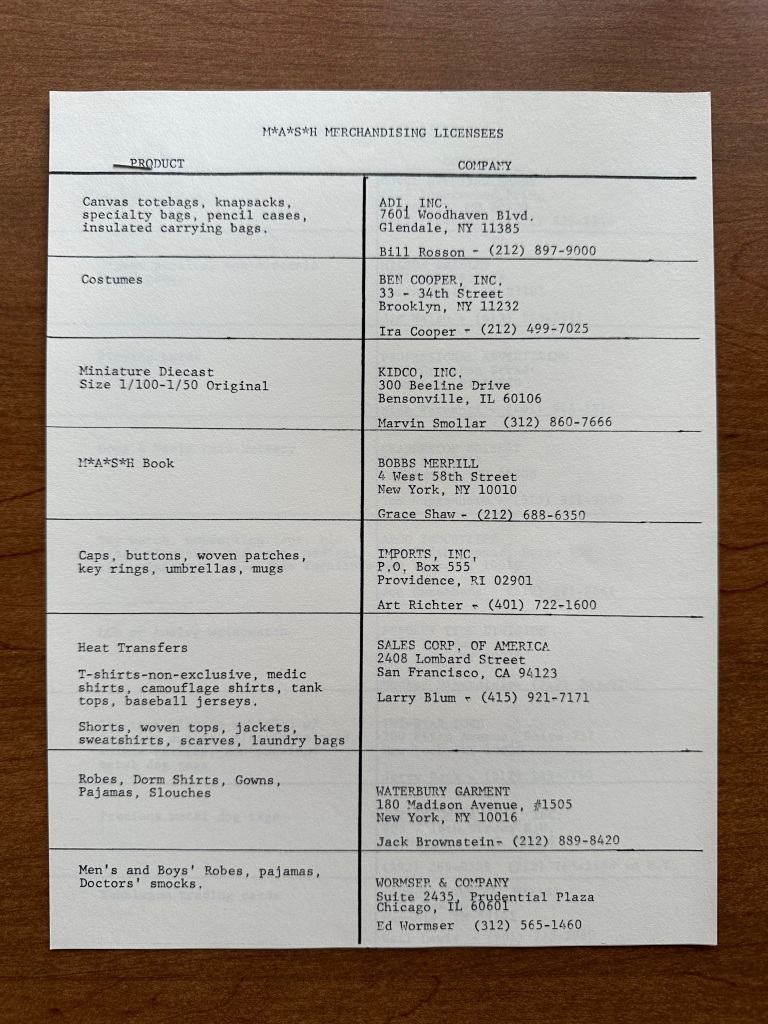
The most interesting document in this packet, however, is M*A*S*H Merchandising Licensees. In three pages, we get a full list of the current licensees, their contact information, and the product(s) they produced. We see a wide variety of products from 23 companies. Licensed products available included tote bags, costumes, books, decanters, caps, shirts, pajamas, greeting cards, puzzles, board games, watches, dog tags, bubblegum cards, bedding, posters, towels, and much more! There was something for everyone, and these three pages demonstrate the wide variety of M*A*S*H merchandise available in the early 1980s. There are products and companies not on this list that would be available closer to the series finale in 1983. Twentieth Century-Fox Licensing Corporation built partnerships and promoted the series late in its run. I have not collected many of the licensed products, but this list is great for collectors to know what types of M*A*S*H products were available at the time.
M*A*S*H Market Information
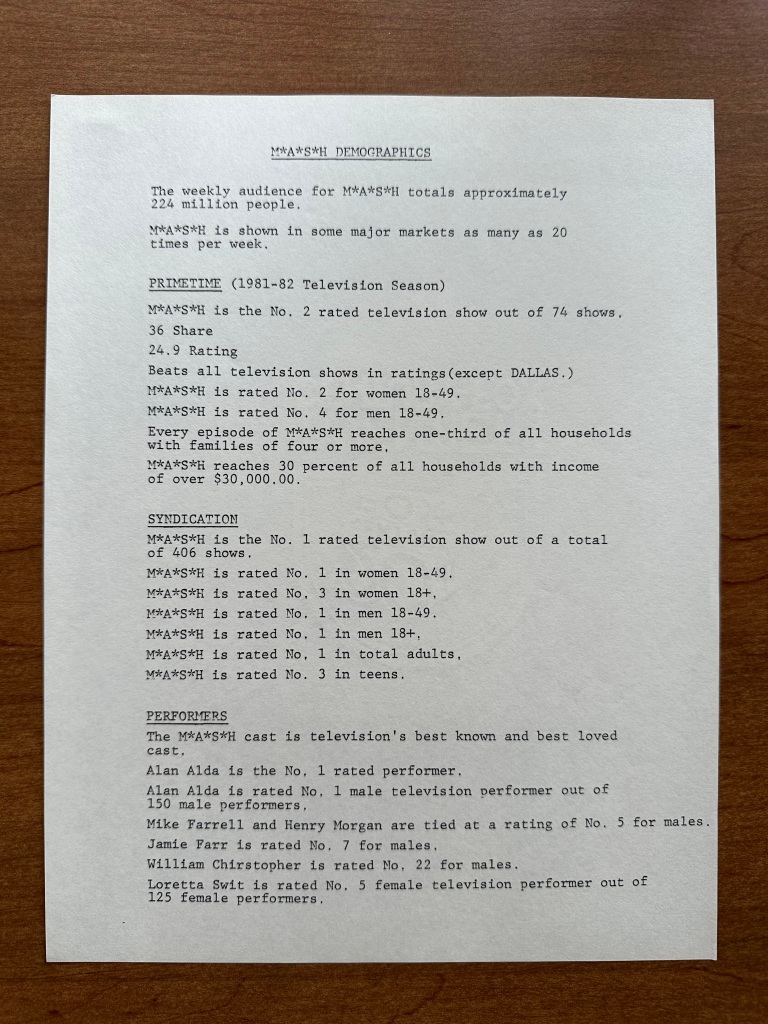
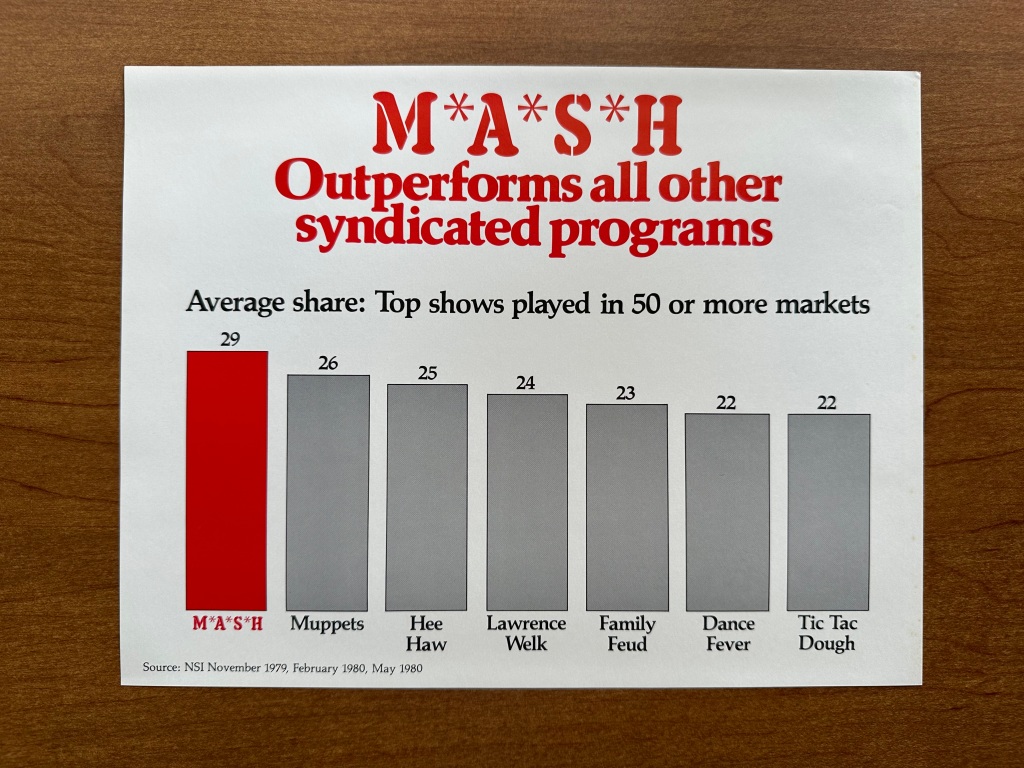
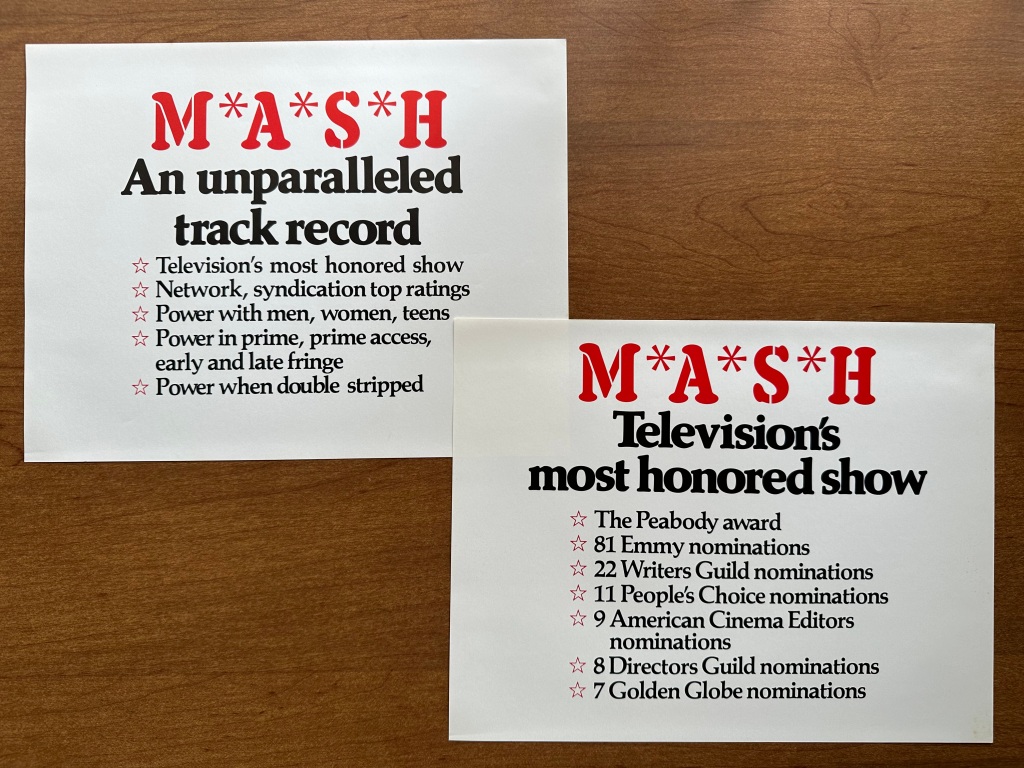
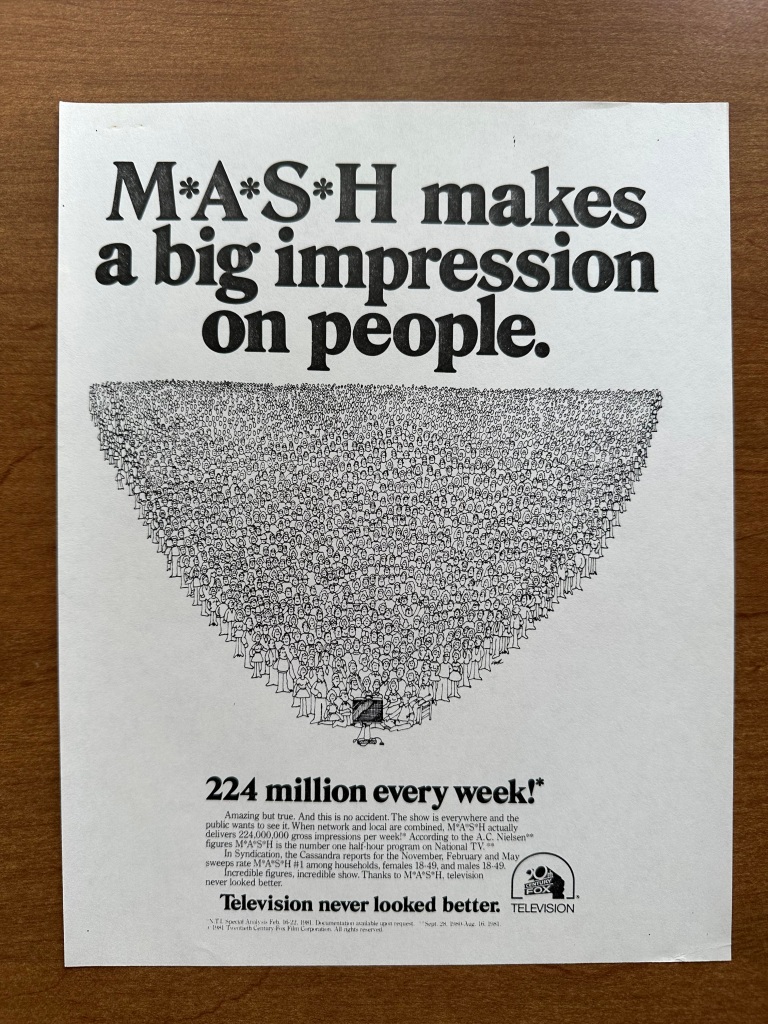

The next set of documents is about the M*A*S*H audience. Some of this information was included in the Licensed Product Kit, but a few of the pages are new. The M*A*S*H Demographics sheet presents a lot of information about the domestic audience for both primetime and syndication. This was important information to companies as they had to assess the potential profit/risk of creating M*A*S*H products. Seeing the popularity of the series among men and women and among certain income groups would make companies feel comfortable investing in M*A*S*H products. As one of document points out, M*A*S*H was viewed 224 million times every week (this includes both primetime views and syndication views). Three other data sheets tout the series’ awards and honors, the reach the show had, and its success in syndication.
There was one sheet in this packet, however, that answered a question that I’ve had for years. How many countries did M*A*S*H in while it was still in primetime? One of the documents lists all of the countries, and it is impressive the number of languages the the series would have been either subtitled or dubbed for. The list as of 1981 included:
- Canada
- United Kingdom
- Ireland
- Australia
- New Zealand
- Denmark
- Germany
- Holland
- Italy
- Norway
- Sweden
- Switzerland
- Japan
- Thailand
- Phillippines
- Malaysia
- Hong Kong
- Bangladesh
- Costa Rica
- Ecuador
- Guatemala
- Panama
- Paraguay
- Puerto Rico
- Mexico
I am sure the list today would be much longer since the series is still in syndication and available on streaming platforms such as Hulu and Disney+. However, in 1981, this was an impressive reach for an American television series. (Note that South Korea is not included on this list. Find out more in my post about M*A*S*H being banned there.)
M*A*S*H Series Information
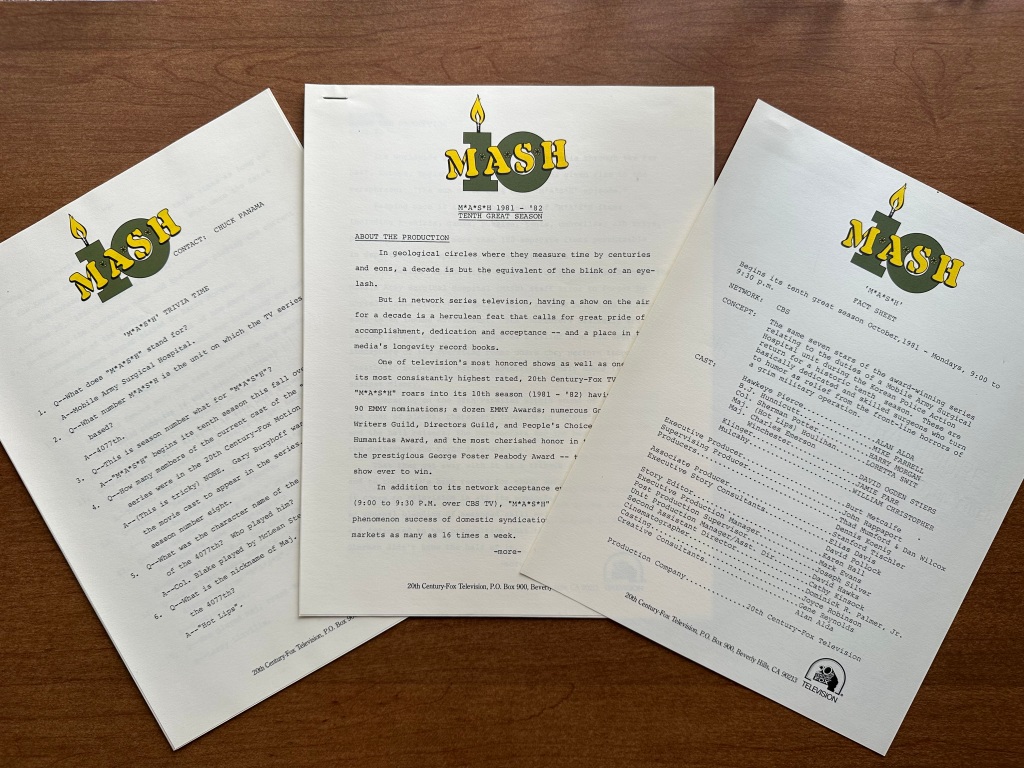
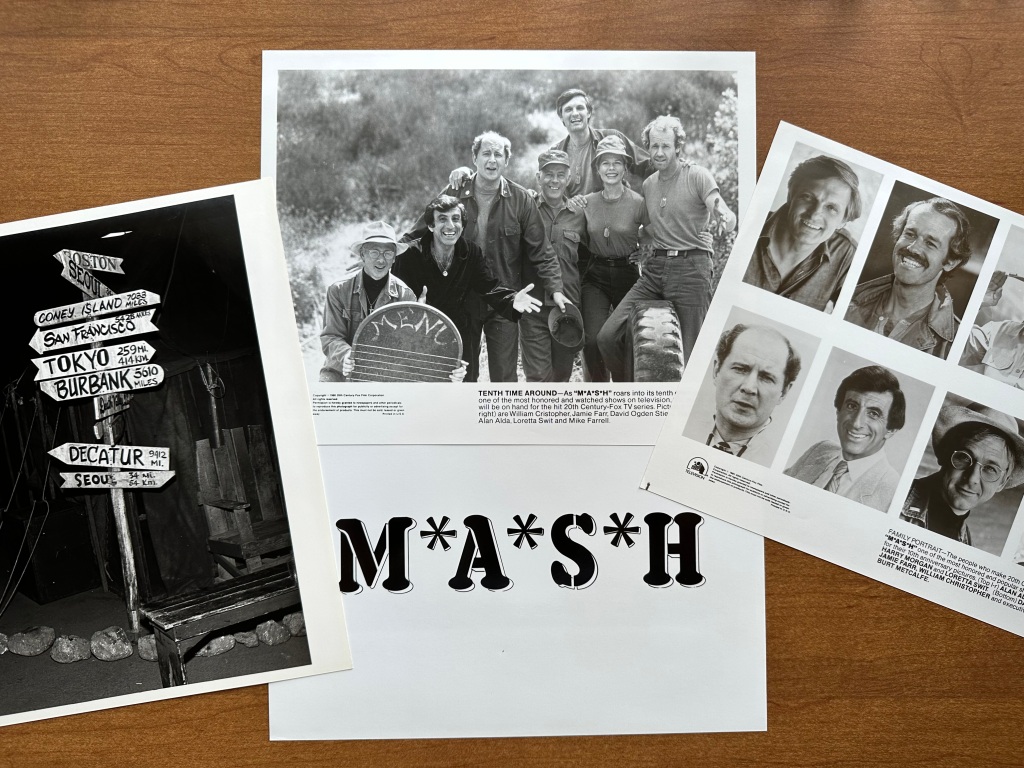
Information about the 10th season of M*A*S*H was included in the packet as well. The season 10 fact sheet lists a description of the series, the cast, and many members of the crew. A four-page “About the Production” document covers more detailed information about the series, its history and awards, and the actors and the characters they portrayed. Then, there’s a six-page “M*A*S*H Trivia Time” document with 58 trivia questions and answers about the series. (This information is the same that was included in the Season 10 Press Kit that I wrote about in 2021.) Finally, a set of four photos were included. One is the M*A*S*H logo and two are photos of the (season 10) cast. The fourth photo though is one I have never seen before. It is of the signpost. Most photos of the signpost are with the cast, but seeing a photo of the signpost on the set at Stage 9 is really cool!
There is no doubt that M*A*S*H was a successful television series, but it was also a successful licensed property. In the early 1980s, there were likely hundreds of available licensed products available. This is a credit to the people at the Twentieth Century-Fox Licensing Corporation as they worked with companies to produce merchandise fans wanted. This cool, M*A*S*H folder contained more information than I expected. From this one packet, we got a glimpse inside the licensed product process, got a list of M*A*S*H licensees, learned about the success of the series across many demographic groups, and saw that M*A*S*H was airing in 26 countries in 1981. I enjoy materials like this because it is likely that the majority of these packets were thrown away by the attendees decades ago, but through it we get a snapshot of what it was like to be a M*A*S*H licensee at the height of the series’ popularity.
 The M*A*S*H Historian
It’s not Holland but the Netherlands, the subs would be in Dutch.
LikeLike