
Last month, I kicked off the 50th anniversary of M*A*S*H season five by spotlighting the script for “Lt. Radar O’Reilly” (05×04) and a press release outlining the cast and crew members for season five. The fifth season of M*A*S*H was important for several reasons. It was the first season of the show to be produced without the show’s creator, Larry Gelbart. Gene Reynolds still maintained the role of executive producer, but the loss of Gelbart was a major shift. Season five was also the second season to feature the new characters of B.J. Hunnicutt and Col. Sherman Potter. Throughout the fourth season, the two new characters were introduced, and they built relationships with the existing personnel of the 4077th. Season five also saw the addition of William Christopher as a series regular as Father Mulcahy. But season five turned out to be a major turning point for one M*A*S*H character that had been in the show since the pilot episode. Major Margaret Houlihan began to morph in season four, and with the excellent acting talent of Loretta Swit, the writers began to push Margaret’s character forward. Season five saw her biggest development with her engagement and eventual marriage. But in one of my favorite Margaret centric episodes, we see a more vulnerable side of the character. This month, let’s take a deep dive into the episode “The Nurses” (05×05).
The Script
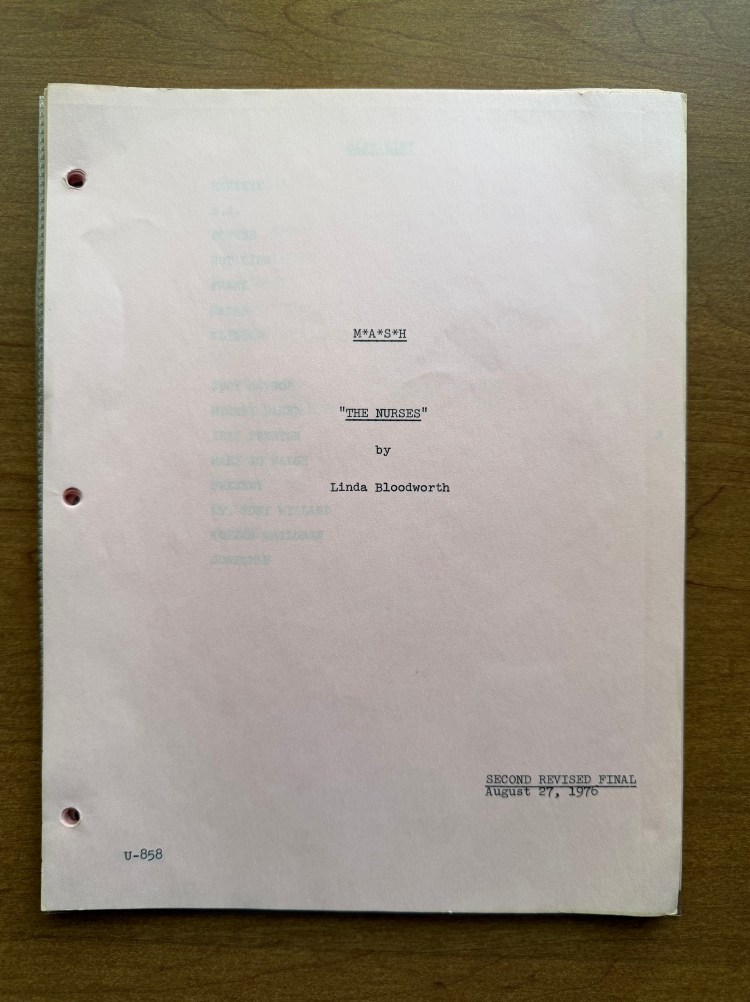
This copy of the script is a Second Revised Final draft dated August 27, 1976. The episode was written by Linda Bloodworth, who is credited with writing five M*A*S*H episodes. This was her last. “The Nurses” was directed by Joan Darling. This is her only episode of M*A*S*H, but she has worked as a writer, director, and actor since the 1960s. Her previous credits include shows such as The Dick Van Dyke Show, The Mary Tyler Moore Show, Taxi, and Doogie Howser, M.D. “The Nurses” originally aired on CBS on October 19, 1976.
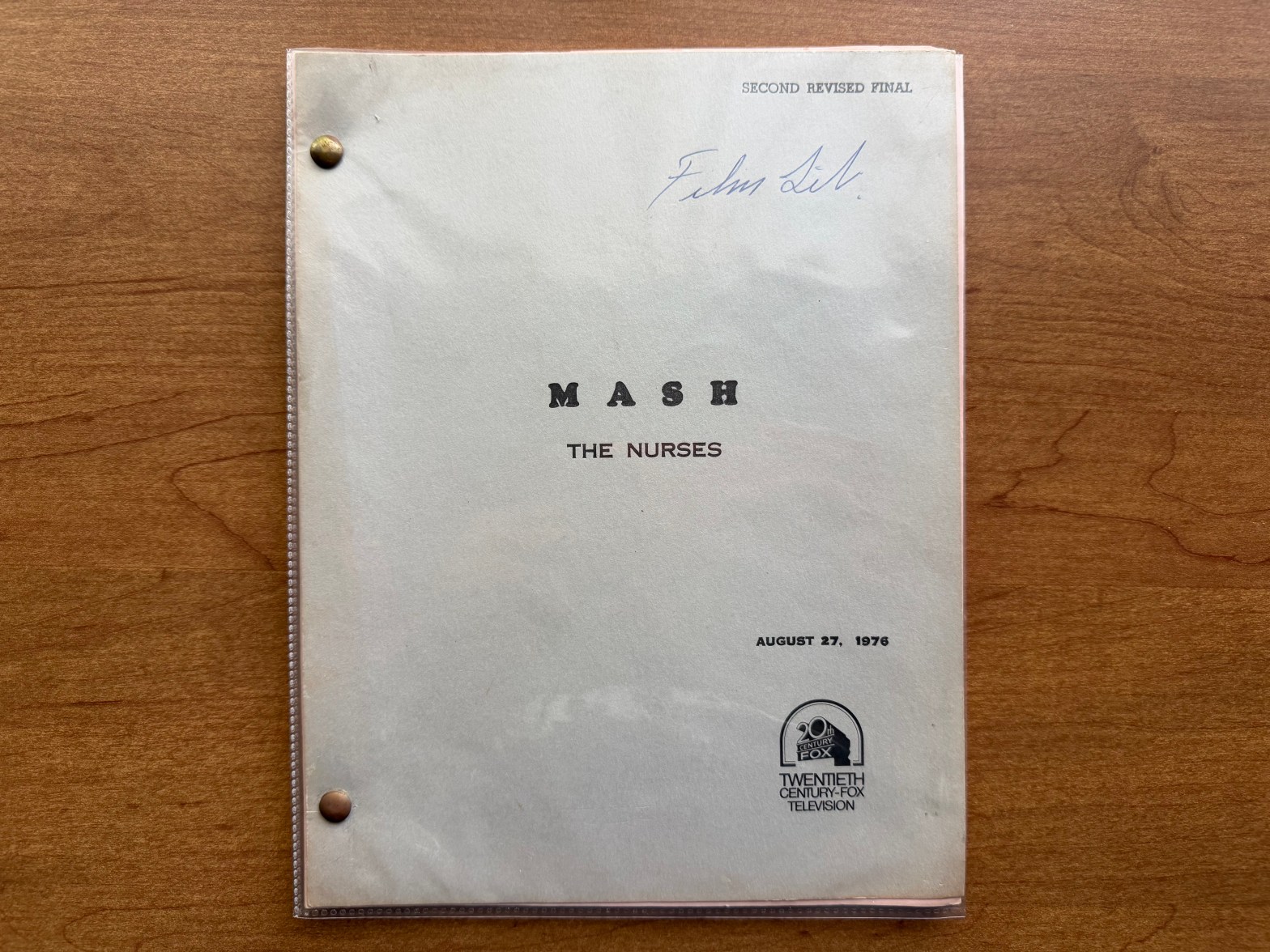
Since this script is a Second Revised Final draft, I didn’t expect there to be too many differences between it and the final episode, but there are a few that I’ll discuss later. On the cover of the script, there is a notation for “Film Lib.” which I assume is short for “Film Library.” I am not sure who that would have been used by, but I have previously written about a corrected version of a script that was used to create the closed captioning. This script could have been used by another department at Fox for a similar purpose since the wording in it is very close to the final version that aired on television. There are no revised pages in this script, but all of the pages are pink. I have noticed that Revised and Second Revised drafts of the scripts often have colorful pages. The cast and crew were given Final draft copies, and their revised pages were colorized by revision dates. It seems that the drafts created following those rounds of revisions were printed on colored pages to help differentiate them. However, this is a great reading copy of the script, and it really helps illustrate how great the acting was on M*A*S*H since the words on the page were brought to life by the actor.
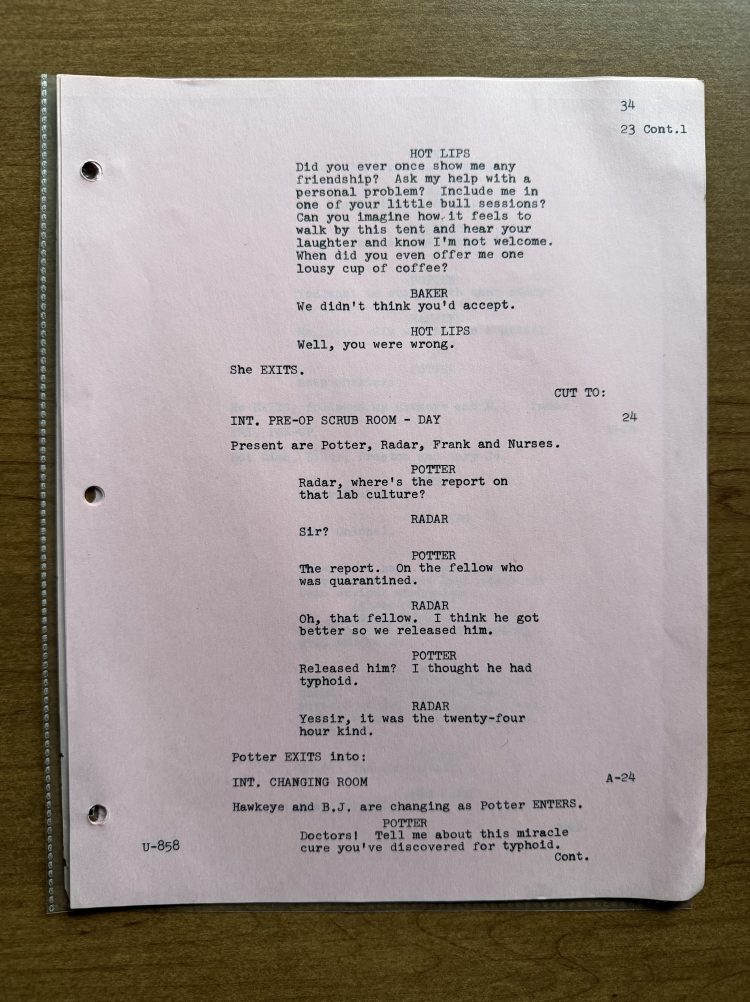
It would be easy to be disappointed that this script doesn’t have any production documents such as the Call Sheets, Shooting Schedule, or revised pages. But this script is still important since it illustrates the magic of bringing the “words on a page” to life on the screen. In the image above, I have captured the impassioned speech that Margaret gave in the nurses’ tent. There are no instructions to Loretta Swit on this page to cry or for her voice to break with any of the lines. The most heartbreaking part of that scene is her deep inhale as she says, “Can you imagine how it feels to walk by this tent and hear your laughter and know that I’m not welcome.” That was all credit to Swit and her acting ability. She knew Margaret, and she has said that she knew how Margaret felt in that moment, so she channeled it. It is the highlight of the episode, and it is also one of the highlights for Margaret’s character.
Final Episode
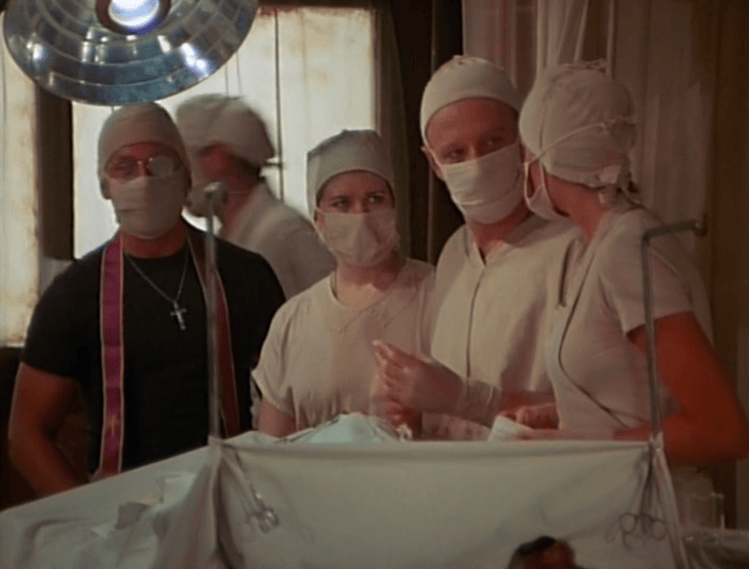
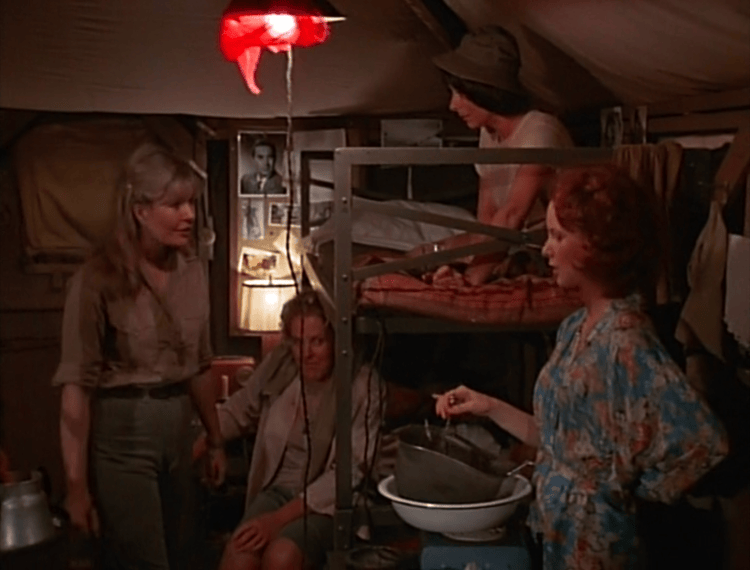
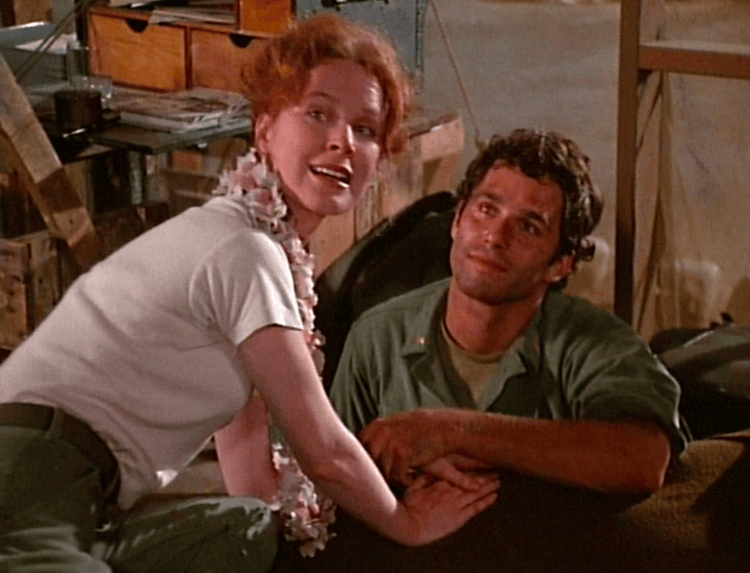
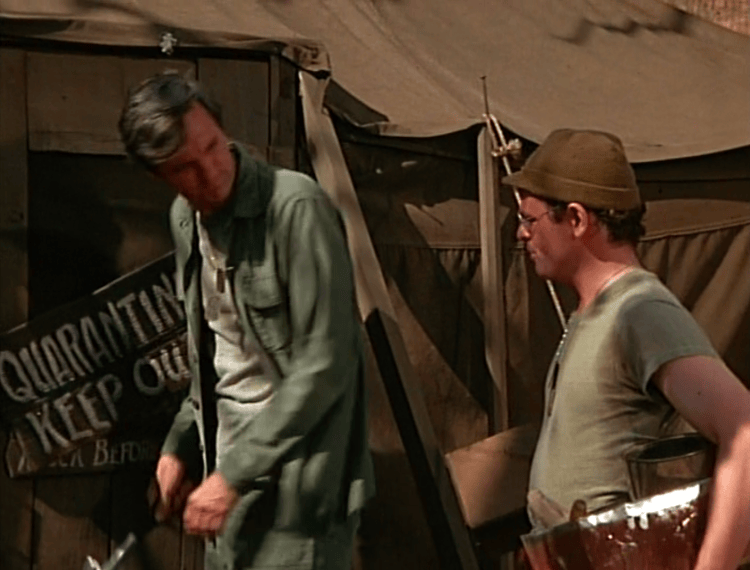
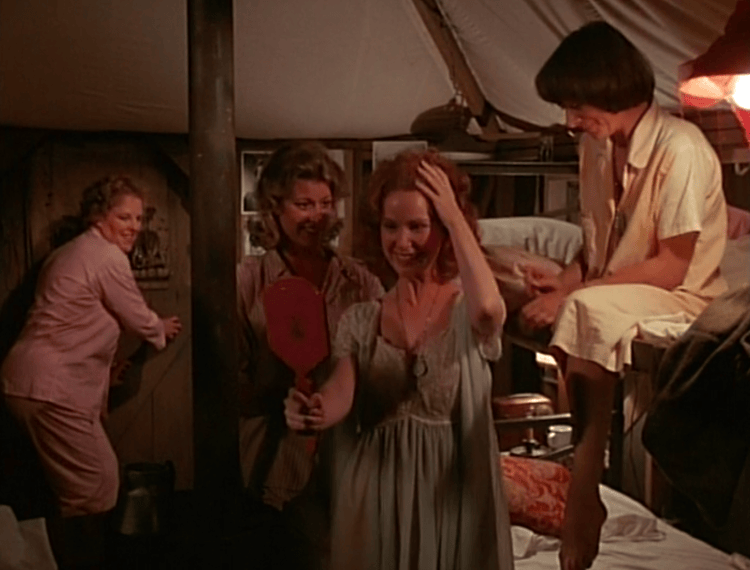
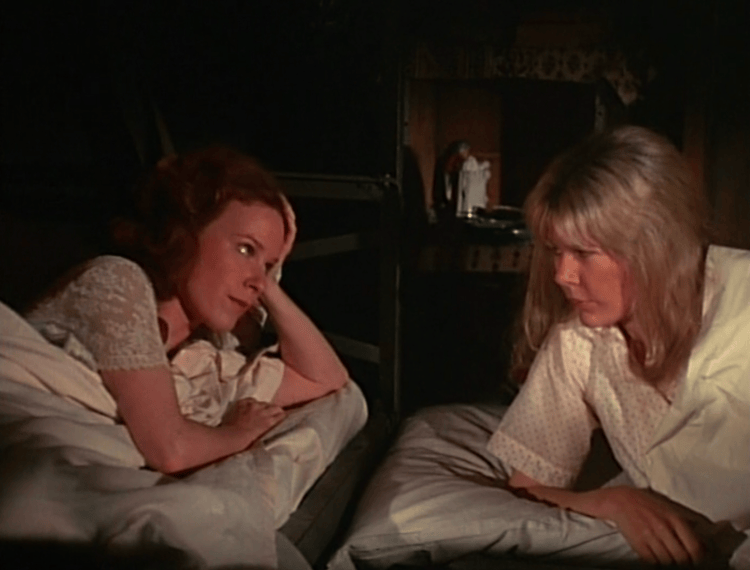
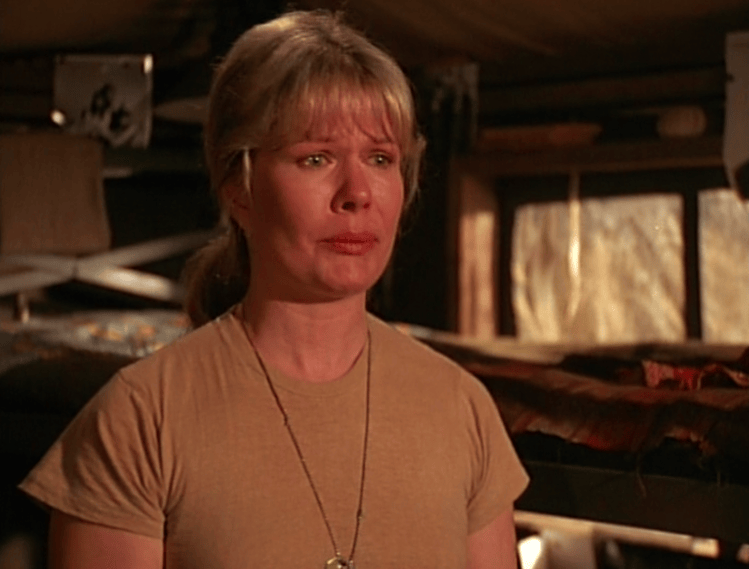
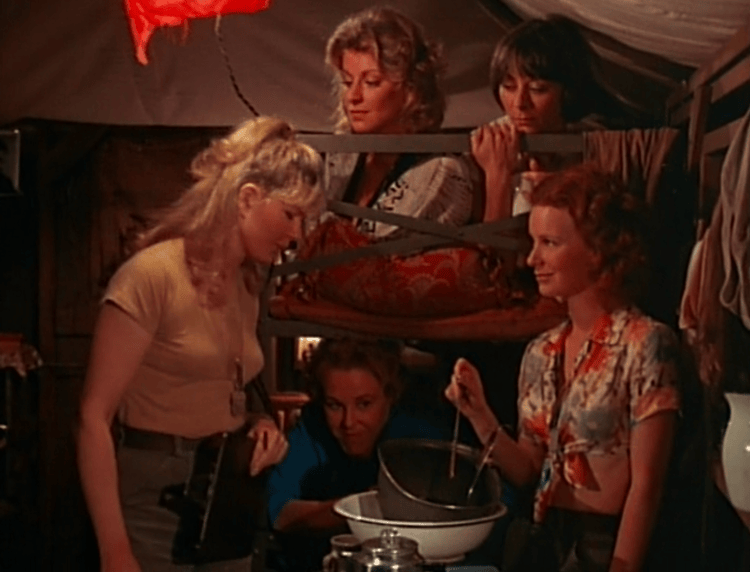
The heat is getting to everyone at the 4077th, and especially after a long session in the O.R. But the tension is especially high between Margaret and the nurses. When Margaret goes to the nurses’ tent to give them their duty roster, they are making fudge, something they know they aren’t supposed to do in their tent. Margaret and the nurses argue, but the nurses stick together. As a result, Margaret puts Lt. Baker on report and confines her to her quarters for her behavior. Baker’s husband visits the camp, so Hawkeye and B.J. try to find a way for them to have a night alone together. They “quarantine” him in Margaret’s tent claiming he is a sick soldier, so Margaret has to bunk with the nurses. That makes it hard for Lt. Baker to sneak out to see her husband. She is able to get away, but she gets caught when she returns. Margaret vows to “throw the book at her.” The nurses confront Margaret and Baker admits the quarantined soldier was her husband. Margaret tells them that she feels unwelcome and like they treat her poorly. When Col. Potter finds out that Margaret’s tent was used for seedy activities, he assumes that she will want to press charges against Hawkeye and B.J. However, she covers for the nurses and lets it go. When Margaret returns to the nurses’ tent, they are making fudge…again. They offer some to Margaret, and she accepts.
There are so many reasons to love this episode! One is that the doctors, war, or wounded are not the center of attention. Instead, we see the effects the war has on the interpersonal relationships that have formed between the nurses at the 4077th. The episode highlights the talents of the supporting cast by showing the close-knit relationship the nurses have, and their defense of one another. I am left wanting more episodes from the point of view of the nurses! But the highlight of “The Nurses” is the amazing acting talent of Loretta Swit. For over four years, she had played the hard-charging Margaret Houlihan, and showing the depth of the character that develops in season five is great! Margaret wasn’t “Hot Lips” anymore, even though this episode has a rare mention of her referred to as Hot Lips in this episode. Swit fought to flesh out the character of Margaret, and season five is when the character took on a life of her own. Margaret’s speech to the nurses about feeling unwelcome is one of the most heartfelt speeches she gave. It’s the most vulnerable we had seen Margaret up to this point, and it greatly added to her character.
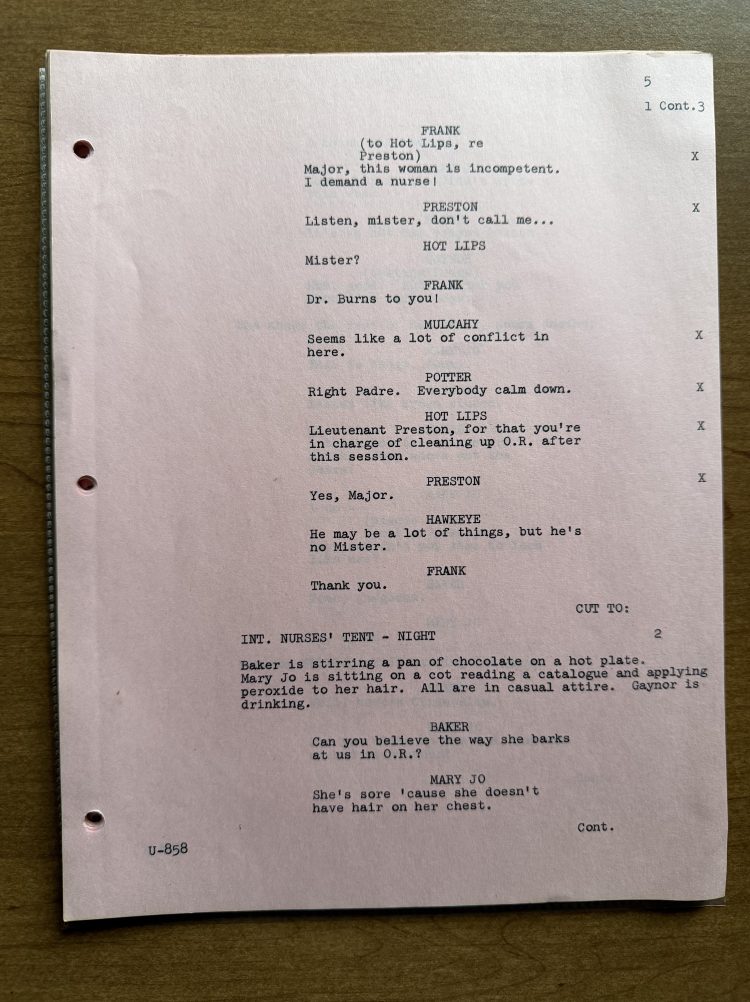
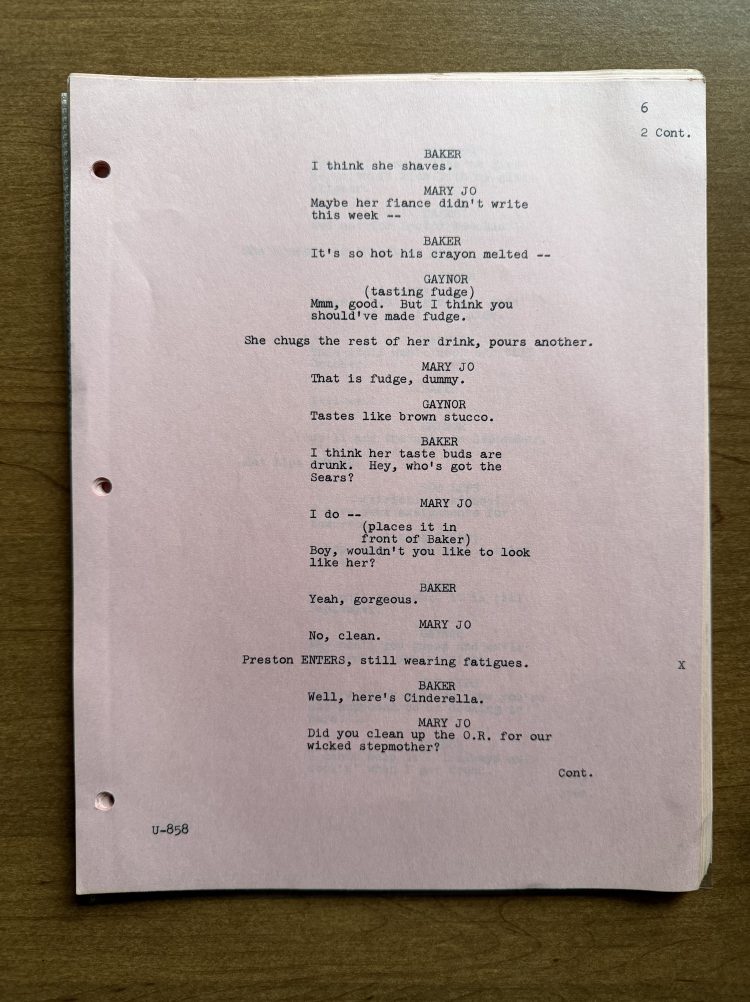
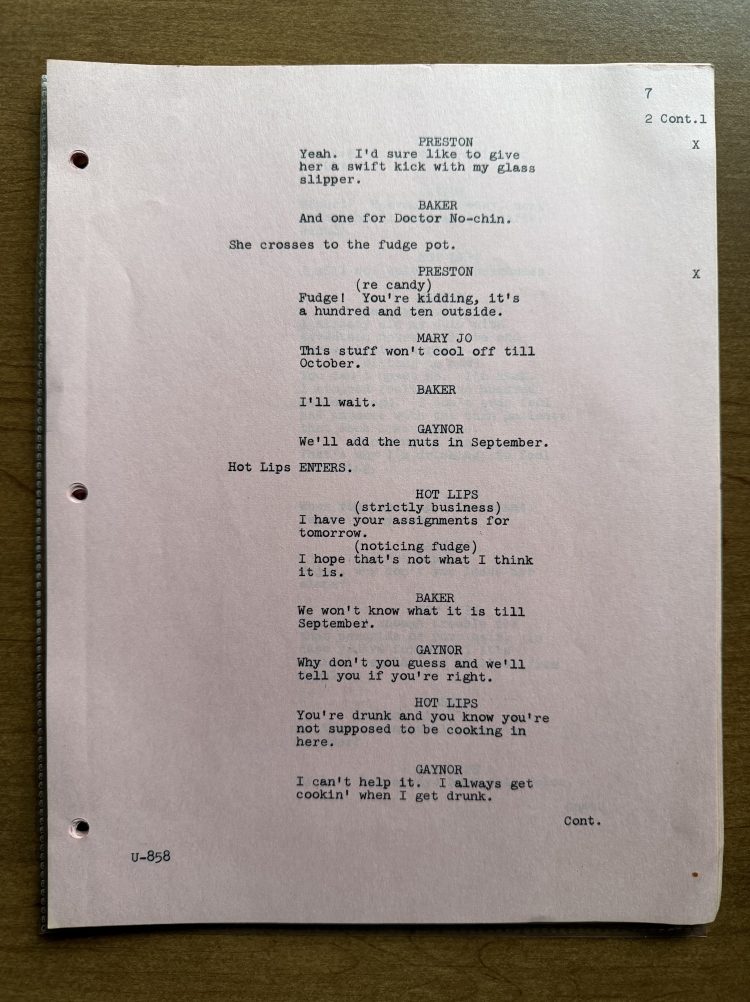
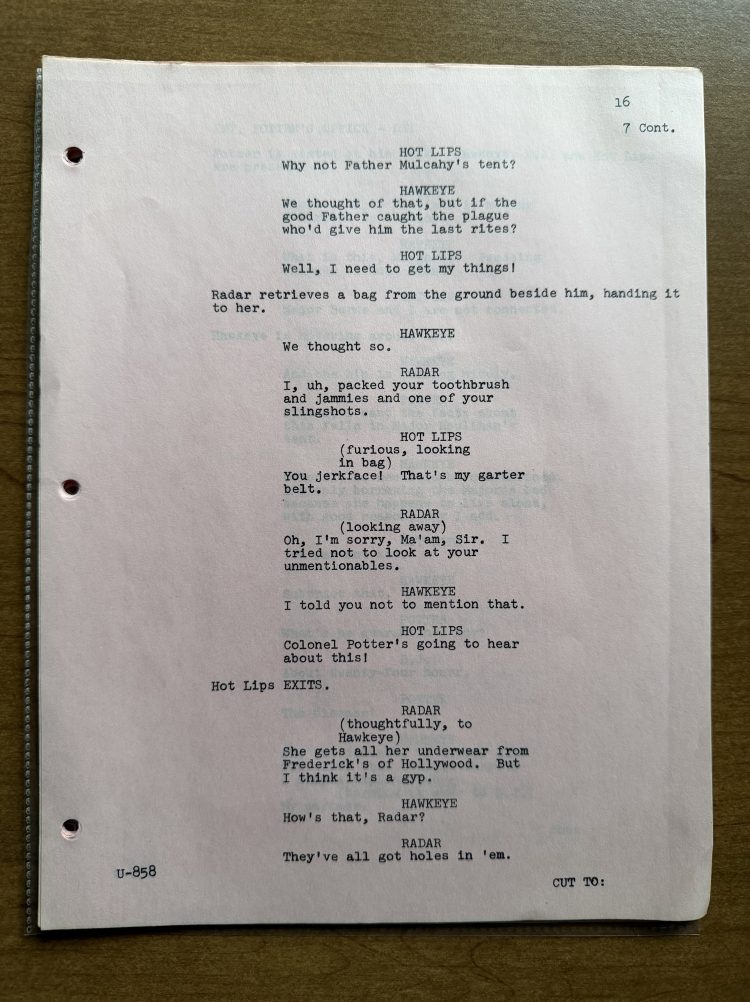
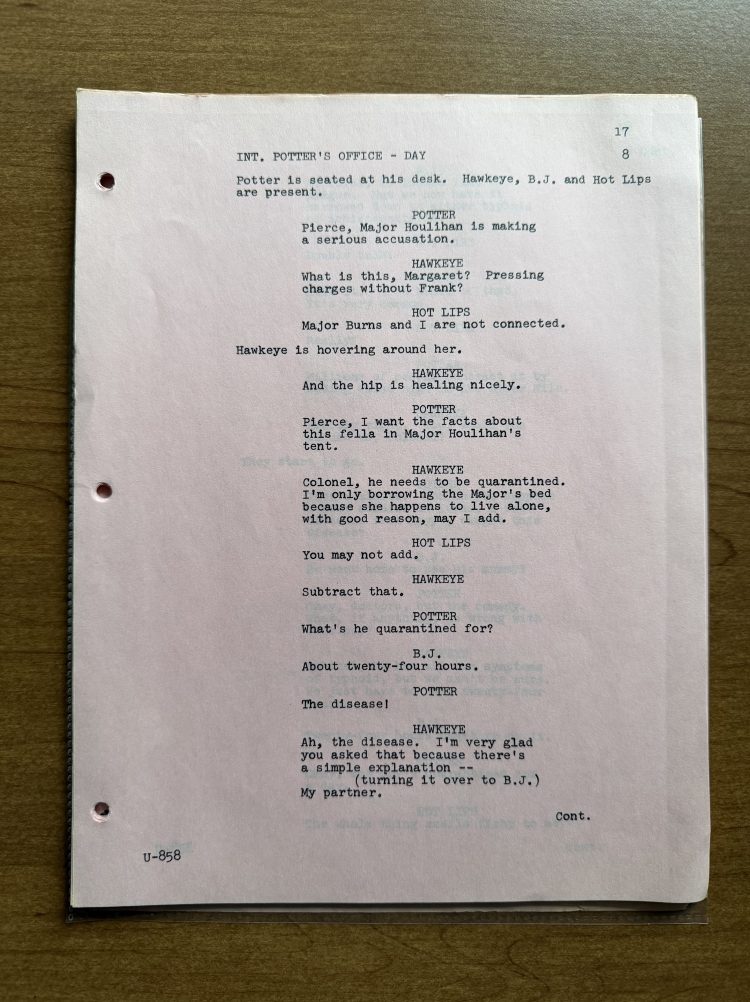
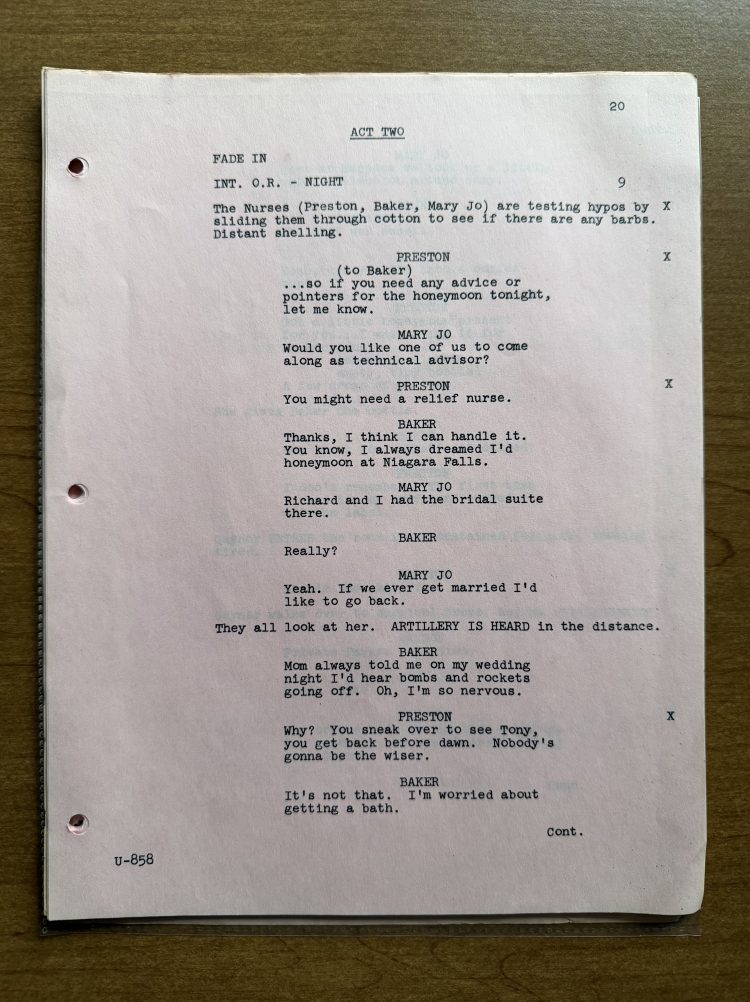
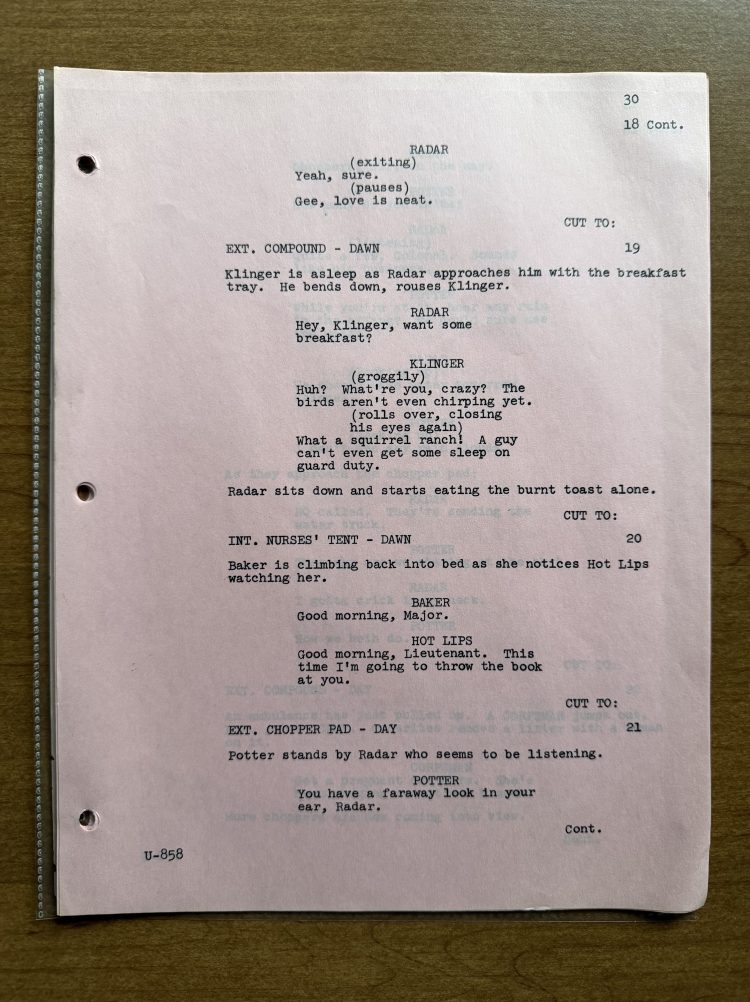
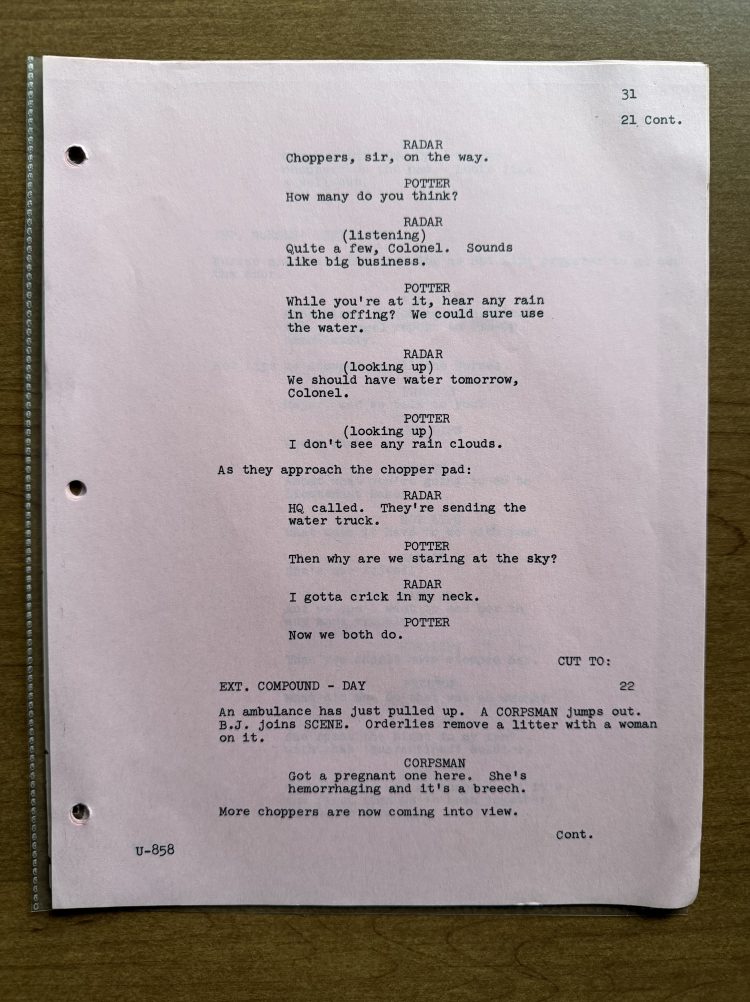
Every episode of M*A*S*H has one or two things that can be nitpicked, and there is one big plot hole in this episode that has always bothered me. I mentioned it in my season five rewatch post last year. Why did Hawkeye and B.J. put Lt. Baker’s husband in Margaret’s tent when it had been well established that the 4077th had the VIP Tent? I understand the argument that for the story, they needed Margaret to be in the nurses’ tent, but did they? There are plenty of ways that Lt. Baker could have still gotten caught without Margaret literally sleeping inches from Baker’s head. Aside from that, and the fact that Lt. Baker is a name that is used by several actresses, neither take away from the episode! As for changes between the script and the final episode, there were a few. The first scene in the nurses tent was written longer (pages 5 – 7), there was a longer scene between Radar and Hawkeye (pages 16 – 17), the scene with the nurses in the O.R. was written to be longer (page 20), and there was a cut scene between Col. Potter and Radar before the wounded arrived (pages 30 – 31).
As I mentioned in the introduction, season five was when Margaret’s character truly began to develop beyond the hard-charging punchline of jokes. Swit had more of a say in how Margaret was written and portrayed on screen, and there were women in the writers’ room. In fact, I believe this is the only episode of M*A*S*H to be written AND directed by women. It works wonderfully because we see the 4077th from a point of view that had been overlooked. The nurses were featured before, but this is the first time we saw the nature of the relationship between the women of the 4077th, and it required a writer like Linda Bloodworth to bring it to life. There are M*A*S*H fans who do not like the later season of M*A*S*H because it changed, but I would argue that it largely changed for the better because the characters had more depth. Yes, M*A*S*H was not the joke-a-minute sit-com of the first few seasons. It became something else. It wasn’t a sitcom. It wasn’t a drama. It was M*A*S*H. And a lot of shows today blend drama and comedy in a similar way because M*A*S*H gave shows the blueprint for how it could be done.


I personally have a love/hate complex with this episode.
I love it, because this was really a major (pun intended) turning point in Margaret’s character development (which Gene Reynolds made a key element during his only season as the sole showrunner). I remember seeing this episode for the first time when I was younger, and being floored when I watched Margaret’s “lousy cup of coffee” speech, and while this wasn’t the first or only time we saw Margaret have such an emotional breakdown, this was the first time I can recall where it was actually treated seriously, and not played for laughs as a joke (i.e. her begging Frank to take her home with him in “Ceasefire” or when she gets drunk over her lack of respect and how her life seems to waste away in “Hot Lips and Empty Arms”). I can actually remember my initial reaction to such: “Wow! Margaret has feelings!?” It was an unbelievable thing to witness at that point in the series, since up until then, as the nurses point out, she was always so rigid when it came to rules and regulations, so it was also a satisfying thing to witness as well.
But, I also hate it, because after a number of revisits to this episode, I’ve come to realize how, in spite of Margaret’s moment of glory, it’s an overall weak episode that suffers from the same problem as ‘Edwina”: it feels less like an episode of M*A*S*H, and more like an episode of an anthology series. We have a group of secondary characters we’ve never seen before (unless Mary Jo Catlett as a nurse counts), and never see again, and yet they are the main focus of the plot, and are given their own plot threads that we’re supposed to invest in (Baker and her husband, Gaynor’s numbness), but again, that’s kind of difficult when these are just incidental, one-shot characters who have otherwise contributed nothing to the show to warrant such investment (much like Edwina). Meanwhile, all of the main characters (save for Margaret) are reduced to supporting parts to further help drive the plot of these one-shot characters. Again, watching it on its own, it feels just like that: it’s own thing, like something out of an anthology that just happens to take place in the M*A*S*H universe.
Those are just my thoughts anyway.
LikeLiked by 1 person
I don’t disagree with the weaknesses of the episode. Including Kellye Nakahara in the nurses’ tent scenes would have gone a long way! Plus, we had never really seen Margaret’s relationship with the nurses before this point. I think the goal of the episode, in addition to character growth, was to show that Margaret was isolated and alone. Things had changed with Frank and her impending marriage, so Margaret was changing too. Overall, it’s still a good turning point for Margaret in a season filled with change for her character.
LikeLike